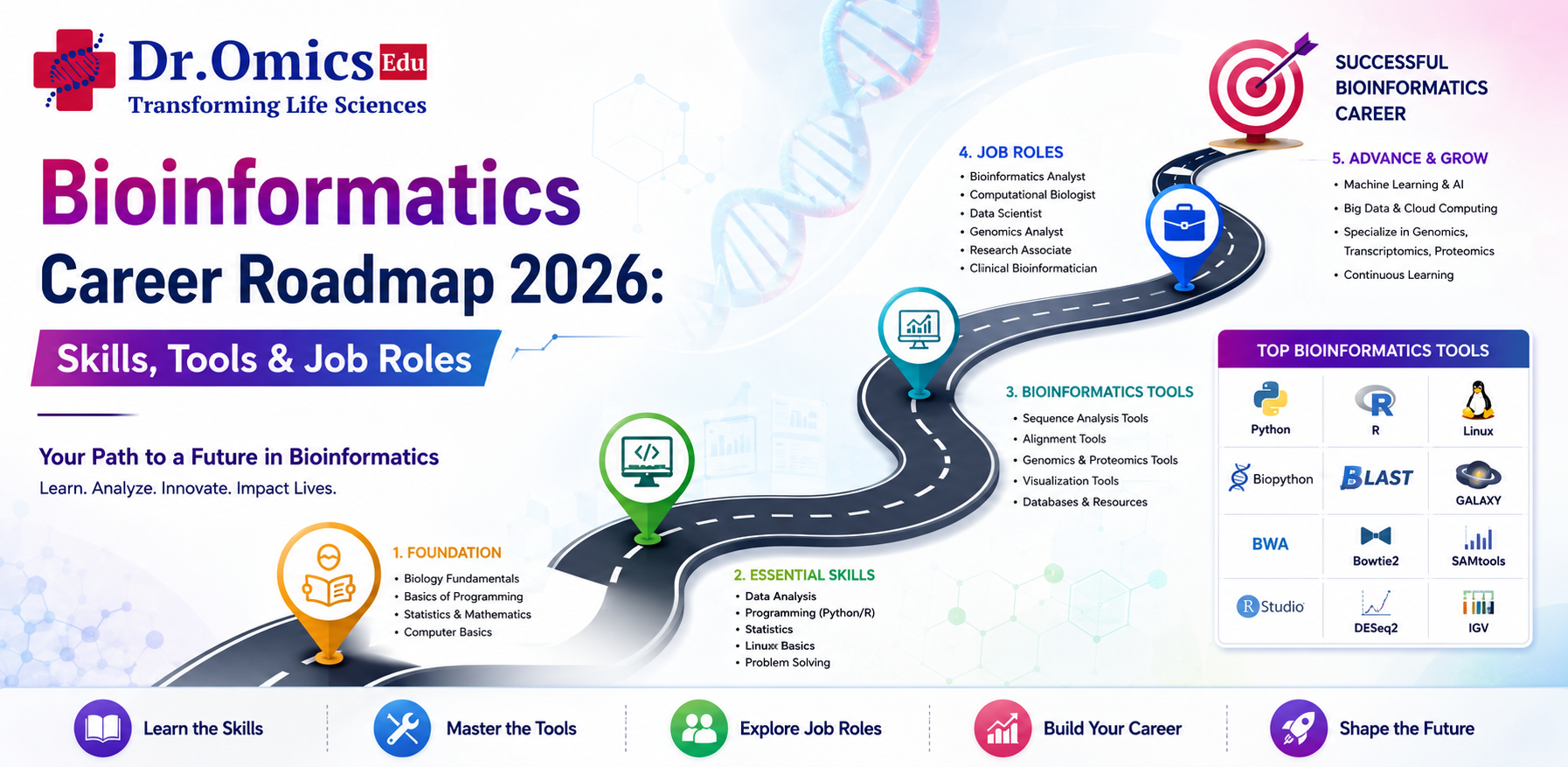
Bioinformatics Career Roadmap 2026: Skills, Tools & Job Roles
Dr. Omics Edu Team ·
The demand for bioinformatics professionals is growing rapidly as genomics, artificial intelligence (AI), precision medicine, and big data continue to transform life sciences. Whether you're a biology student, biotechnology graduate, or an IT professional looking to enter the field, understanding the right bioinformatics career roadmap can help you build a successful and future-proof career.
In this guide, we'll explore the bioinformatics skills required, the essential bioinformatics tools list, popular bioinformatics job roles, and the ideal career path in bioinformatics for 2026.
Why Choose a Career in Bioinformatics?
Bioinformatics combines biology, computer science, statistics, and data analysis to solve complex biological problems. It plays a crucial role in genomics, drug discovery, cancer research, agriculture, and personalized medicine.
With industries investing heavily in AI-driven healthcare and genomic research, skilled bioinformaticians are in demand across pharmaceutical companies, research institutes, hospitals, biotech startups, and healthcare organizations.
Step 1: Build a Strong Foundation
A successful career path in bioinformatics starts with understanding the basics.
Focus on learning:
- Molecular Biology
- Genetics and Genomics
- Cell Biology
- Biochemistry
- Basic Statistics
- Computer Fundamentals
A strong biological foundation makes it easier to understand sequencing data and biological workflows.
Step 2: Learn Programming and Data Analysis
Programming is one of the most important bioinformatics skills required today.
Start with:
- Python
- R Programming
- Linux Command Line
- SQL Basics
- Data Visualization
These skills help automate workflows, analyze biological datasets, and build reproducible research pipelines.
Step 3: Master Essential Bioinformatics Tools
No bioinformatics career roadmap is complete without hands-on experience with industry-standard tools.
Some of the most widely used tools include:
Sequence Analysis
- BLAST
- FASTQC
- MultiQC
Read Alignment
- BWA
- HISAT2
- STAR
RNA-Seq Analysis
- featureCounts
- DESeq2
- edgeR
Variant Analysis
- GATK
- SAMtools
- BCFtools
Genome Visualization
- IGV
- UCSC Genome Browser
Learning this bioinformatics tools list will prepare you for both academic research and industry projects.
Step 4: Work on Real Projects
Theory alone isn't enough. Employers value practical experience.
Build projects such as:
- RNA-Seq Data Analysis
- Variant Calling Pipeline
- Genome Assembly
- Differential Gene Expression Analysis
- Cancer Genomics Analysis
- Metagenomics Analysis
Create a GitHub portfolio to showcase your work and demonstrate your analytical skills.
Step 5: Explore Bioinformatics Job Roles
The field offers diverse career opportunities based on your interests and expertise.
Popular bioinformatics job roles include:
- Bioinformatics Analyst
- Computational Biologist
- Genomics Data Analyst
- Clinical Bioinformatician
- Research Associate
- Data Scientist (Life Sciences)
- NGS Data Analyst
- Bioinformatics Software Developer
As your experience grows, you can specialize in areas such as cancer genomics, multi-omics, drug discovery, AI in healthcare, or precision medicine.
Career Tips for 2026
To stay competitive in the evolving bioinformatics industry:
- Stay updated with the latest sequencing technologies.
- Learn cloud platforms like AWS or Google Cloud.
- Explore AI and machine learning applications in biology.
- Participate in bioinformatics competitions and workshops.
- Build a strong LinkedIn and GitHub profile.
- Keep learning through research papers and online courses.
Continuous learning is one of the biggest advantages for long-term career growth.
Final Thoughts
The future of bioinformatics is brighter than ever. As genomics, AI, and precision medicine continue to expand, organizations are actively seeking professionals with the right combination of biological knowledge, computational skills, and practical experience.
By following this bioinformatics career roadmap, mastering the bioinformatics skills required, gaining expertise with the latest bioinformatics tools list, and exploring diverse bioinformatics job roles, you'll be well-prepared to build a rewarding career path in bioinformatics in 2026 and beyond.
Start learning today, build real-world projects, and invest in continuous skill development—the future of life sciences belongs to data-driven innovators.
