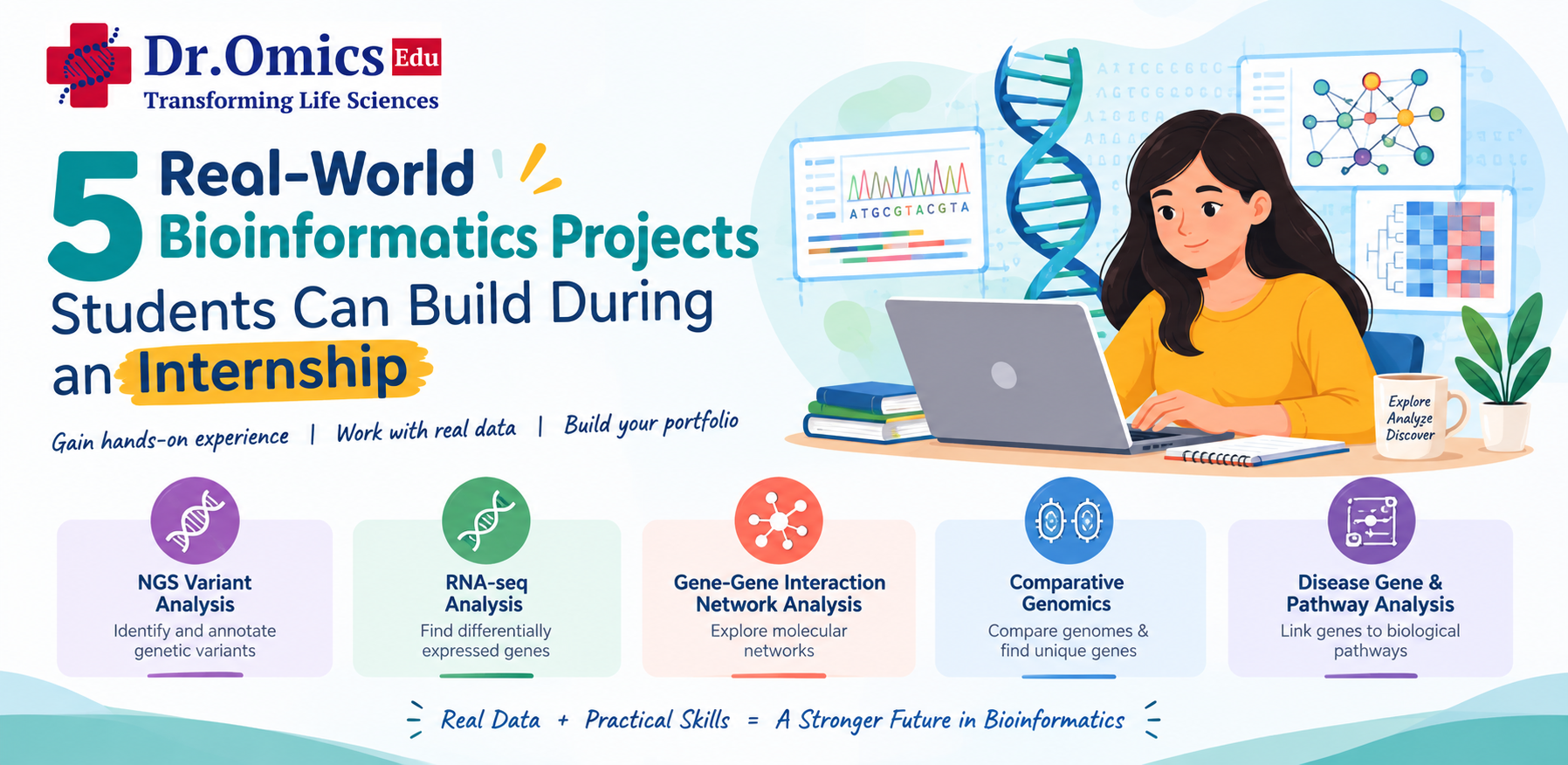
5 Real-World Bioinformatics Projects Students Can Build During an Internship
Dr. Omics Edu Team ·
Bioinformatics is best learned by working with real biological data. During an internship, students can move beyond theoretical concepts and gain practical experience by working on projects involving genomics, NGS, RNA-seq, databases, and biological networks.
If you're searching for bioinformatics project ideas or internship project ideas in genomics, here are five practical projects that can help build valuable research and technical skills.
1. NGS Variant Analysis
Project: Identification and Annotation of Genetic Variants from NGS Data
NGS variant analysis is a great project for students interested in genomics and clinical bioinformatics.
Students can work with publicly available FASTQ data and perform a basic workflow:
FASTQ → Quality Control → Alignment → BAM Processing → Variant Calling → Variant Annotation
Tools may include FastQC, fastp, BWA, SAMtools, GATK, VEP, and IGV.
Students can investigate SNPs, indels, variant quality, genomic locations, and potential functional effects.
Skills gained: NGS analysis, genome alignment, variant calling, VCF interpretation, and annotation.
2. RNA-seq Differential Expression Analysis
Project: Identification of Differentially Expressed Genes Between Two Conditions
RNA-seq is one of the most popular areas for student projects. This makes it one of the most useful RNA-seq project ideas for students.
A typical workflow is:
RNA-seq Data → Quality Control → Read Processing → Quantification → Differential Expression → Visualization
Students can use tools such as FastQC, featureCounts, DESeq2, edgeR, R, Python, or Galaxy.
The project can answer questions such as:
- Which genes are upregulated?
- Which genes are downregulated?
- Which biological pathways are affected?
Students can generate volcano plots, heatmaps, DEG tables, and pathway enrichment results.
This project can also be developed into a bioinformatics capstone project.
3. Gene-Gene Interaction Network Analysis
Project: Exploring Molecular Networks Associated with a Disease
A list of significant genes becomes more informative when we understand how those genes interact.
Students can take differentially expressed genes and create an interaction network using STRING and Cytoscape.
The workflow can be:
Gene List → Protein Interactions → Network Visualization → Hub Genes → Functional Enrichment
Students can explore:
- Protein-protein interactions
- Hub genes
- Functional clusters
- Biological pathways
- Gene Ontology enrichment
This is a good choice for students interested in systems biology and network analysis.
4. Comparative Genomics
Project: Comparison of Two Genomes to Identify Conserved and Unique Genes
Comparative genomics allows students to investigate how genomes differ between organisms or strains.
Students can compare:
- Genome size
- GC content
- Conserved genes
- Unique genes
- Protein sequences
- Functional annotations
Tools and databases can include NCBI, BLAST, Clustal Omega, MEGA, UniProt, and InterPro.
For example, a student could compare two bacterial strains and identify genes that are conserved in both or specific to one strain.
This project provides useful exposure to sequence analysis, evolutionary biology, and genome annotation.
5. Disease Gene and Pathway Analysis
Project: From Disease-Associated Genes to Biological Pathways
Students can also create meaningful projects without starting from raw sequencing data.
For example, they can select a disease, collect associated genes, and investigate their functions and biological pathways.
A simple workflow is:
Disease → Gene Collection → Functional Annotation → Pathway Analysis → Network → Interpretation
Resources such as NCBI, Ensembl, UniProt, PubMed, KEGG, Gene Ontology, and STRING can be used.
Students can finish the project with an annotated gene table, pathway visualization, interaction network, and literature-supported interpretation.
What Makes a Good Bioinformatics Internship Project?
A good project should not simply involve running different tools. Students should understand:
What is the biological question?
Why was this dataset selected?
Why is each tool being used?
What do the results mean?
The strongest student bioinformatics projects connect computational analysis with a clear biological question.
Turn Your Project Into a Portfolio
A completed internship project can become much more valuable when documented properly.
Students can include:
- Project objective
- Dataset information
- Workflow
- Tools used
- Results and visualizations
- Biological interpretation
- Limitations
- Final conclusion
This can be presented as a research report, GitHub project, presentation, or portfolio.
Start Learning Through Real Projects
The transition from classroom learning to research becomes easier when students work with real datasets.
Whether you choose an NGS project, RNA-seq analysis, comparative genomics, or network analysis, focus on one goal:
Don't just learn the tool. Learn how to use the tool to answer a biological question.
That is the foundation of practical bioinformatics learning, hands-on bioinformatics projects, and effective project-based learning in genomics.
