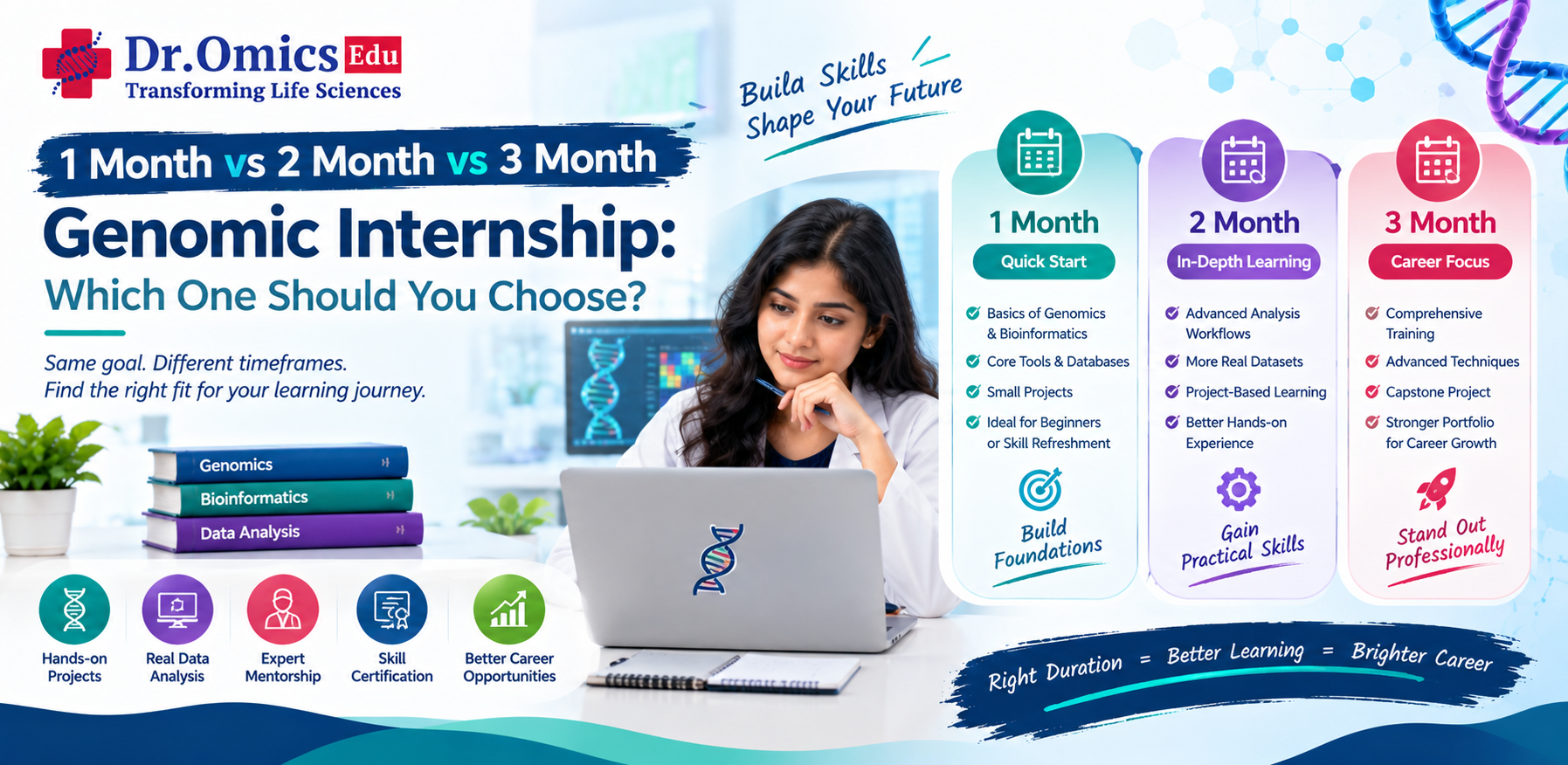
1 Month vs 2 Month vs 3 Month Genomic Internship: Which One Should You Choose?
Dr. Omics Edu Team ·
Choosing the right internship duration can significantly impact how much practical experience you gain in bioinformatics and genomics. With programs ranging from one-month introductory internships to three-month advanced projects, students often ask: What is the best bioinformatics internship duration?
The answer depends on your current skill level, career goals, and the depth of practical experience you want to gain.
1-Month Genomic Internship: Start with the Basics
A 1-month program is ideal for beginners who want to understand the fundamentals of computational biology and genomics.
Topics may include:
- Linux and command-line basics
- Biological databases
- BLAST and sequence analysis
- Introduction to NGS
- Basic genome analysis
- Data visualization
This short-term bioinformatics internship is useful for students exploring whether bioinformatics is the right career path.
Best for: Beginners and students seeking foundational exposure.
2-Month Genomic Internship: Learn + Apply
A 2-month internship provides more time to transition from theoretical learning to practical analysis.
Students may work through a structured workflow such as:
NGS Data → Quality Control → Preprocessing → Alignment → Variant Calling → Annotation → Interpretation
This format offers a balance between training and project work, allowing students to understand how multiple tools work together in a real bioinformatics workflow.
Best for: Students with basic knowledge who want hands-on project experience.
3-Month Genomic Internship: Go Deeper
A 3-month program provides greater opportunity for advanced, project-oriented learning. An advanced genomic internship may involve complete NGS workflows, scripting, troubleshooting, statistical analysis, and scientific reporting.
Potential areas include:
- Whole-genome sequencing
- Exome sequencing
- RNA-seq
- Variant analysis
- Genome annotation
- Comparative genomics
- Reproducible workflows
The additional time can help students develop greater confidence and a stronger project portfolio.
Best for: Students targeting research, higher studies, or bioinformatics careers.
1 vs 2 vs 3 Months: Quick Comparison
Duration | Focus | Best For |
| 1 Month | Fundamentals | Beginners |
| 2 Months | Training + Project | Intermediate learners |
| 3 Months | Advanced Project | Research & Career Preparation |
When doing an NGS internship comparison, don't focus only on duration. Consider the curriculum, hands-on datasets, tools, mentorship, project structure, troubleshooting opportunities, and final deliverables.
How to Choose a Bioinformatics Internship
Before you choose a bioinformatics internship, ask:
Will I work with real datasets?
Practical analysis is more valuable than demonstrations alone.
Will I complete a structured project?
A project gives you something meaningful to discuss during interviews or higher-study applications.
Will I learn industry-relevant tools?
Linux, Python/R, NGS analysis, alignment, variant calling, annotation, and workflow development can strengthen your skill set.
Will I receive mentorship?
Guidance during troubleshooting can make a major difference in practical learning.
Which Duration Should You Choose?
There is no single answer in this internship duration guide. Choose 1 month if you want to explore the field, 2 months if you want balanced training and project exposure, and 3 months if you want deeper project-based learning.
For students considering an NGS internship program in India, remember: the value of an internship is determined by what you learn, analyze, and build—not simply the duration printed on your certificate.
Ready to Start Your Genomics Journey?
Don't just collect an internship certificate—build skills you can demonstrate.
Enroll in a hands-on genomic internship today and gain practical experience with NGS workflows, bioinformatics tools, real-world datasets, and project-based analysis.
Choose your duration. Build your project. Strengthen your portfolio. Take the next step toward your bioinformatics career.
