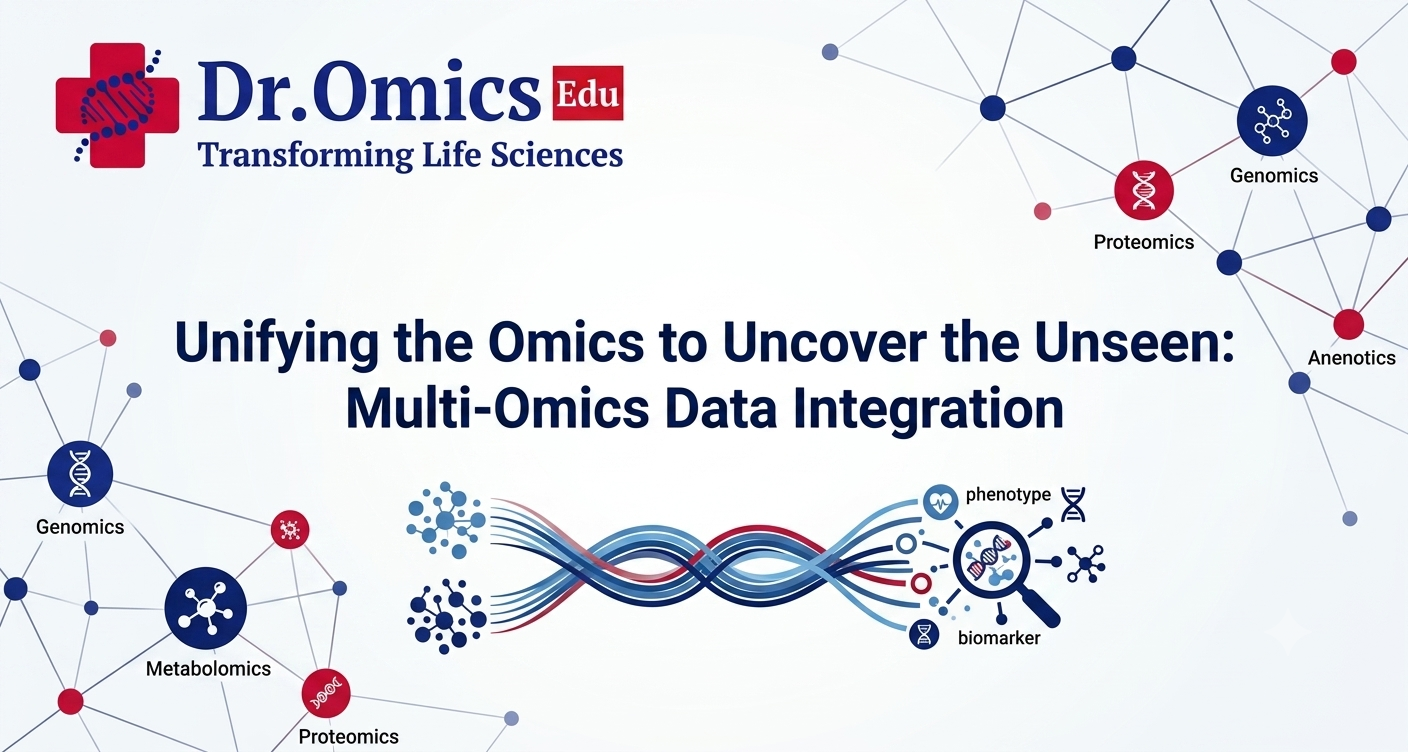
Unifying the Omics to Uncover the Unseen: Multi-Omics Data Integration
Master the integration of complex biological datasets using advanced machine learning, deep learning, and multi-omics algorithms. Bridge the gap between disparate bio-data streams to drive breakthrough discoveries in precision medicine and systems biology.
- 5.0/5
- English
- Updated Oct 2026
₹199
$5
Indian learners pay in INR; international learners are billed in USD.
Paying from outside India? Use this link to complete your payment.
About this course
This comprehensive course empowers life science professionals and researchers to master the complex landscape of multi-omics data integration. Modern biological research generates vast amounts of heterogeneous datasets across genomics, transcriptomics, proteomics, metabolomics, and epigenomics. However, extracting actionable biological insights requires moving beyond single-layer analysis. In this hands-on, AI-powered program, you will explore cutting-edge bioinformatics pipelines, machine learning models, and deep learning frameworks tailored for multi-layer bio-data synthesis. You will learn to clean, align, and fuse high-dimensional datasets to discover novel biomarkers, elucidate disease mechanisms, and accelerate target discovery. Guided by industry and research experts, you will gain practical experience using R, Python, and modern AI algorithms to solve real-world biological challenges. Transform raw data into predictive, actionable intelligence and position yourself at the forefront of computational biology and translational medicine.
What you will learn
Skills you will gain
Certification
Available
Issued by Dr. Omics EduCourse curriculum
1 moduleWhat you need to start
- Basic understanding of molecular biology concepts (DNA, RNA, proteins, and metabolic pathways).
- Foundational experience in programming using Python or R (data manipulation libraries like Pandas, NumPy, or Bioconductor). Familiarity with introductory statistics and linear algebra concepts.
Who this course is for
- Computational Biologists, Bioinformaticians, and Data Scientists expanding into multi-layer biological analysis.
- Life Science Researchers, Biotechnologists, and Geneticists seeking AI-driven methods for data integration.
- Pharmaceutical and Biotech R&D professionals working on drug discovery and biomarker identifier pipelines.
- Graduate students and postdoctoral scholars in Systems Biology, Precision Medicine, and Biomedical Engineering.
