Course Live Intermediate Dr. Omics

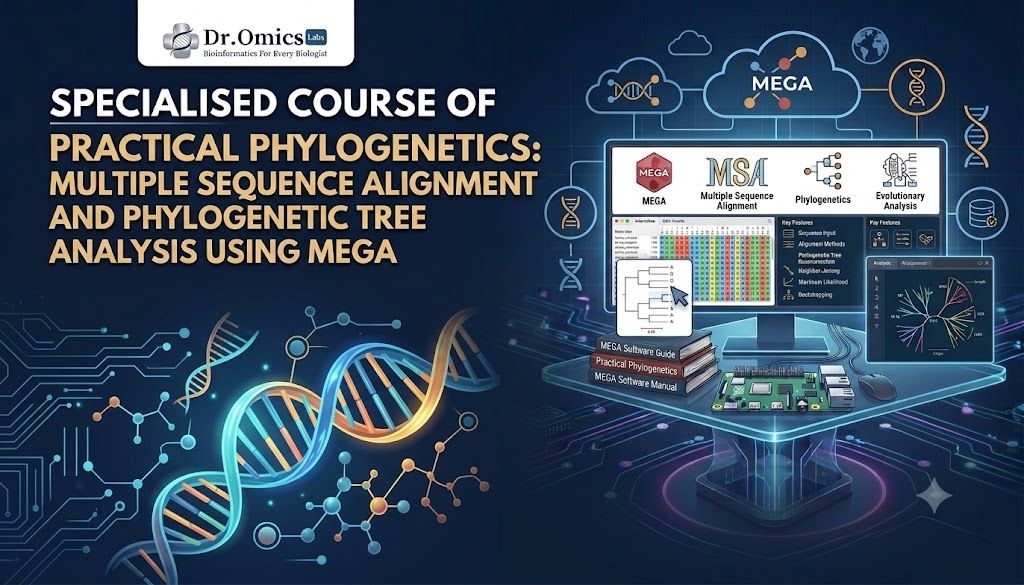
Specialised Course of Practical Phylogenetics: Multiple Sequence Alignment and Phylogenetic Tree Analysis Using MEGA

Master hands-on phylogenetic analysis using MEGA, from multiple sequence alignment and model selection to phylogenetic tree construction and interpretation.

  • 5.0/5
  • English
  • Updated Sep 2026
Specialised Course of Practical Phylogenetics: Multiple Sequence Alignment and Phylogenetic Tree Analysis Using MEGA

About this course

Develop practical skills in molecular phylogenetics through our specialised course on Multiple Sequence Alignment and Phylogenetic Tree Analysis Using MEGA. This hands-on course covers sequence preparation, multiple sequence alignment, alignment evaluation and editing, evolutionary distance calculation, substitution model selection, and phylogenetic tree construction using commonly applied methods in MEGA. Participants will learn how to visualize, analyze, and interpret phylogenetic trees to understand evolutionary relationships among genes, proteins, or organisms.

What you will learn

Understand the fundamental concepts of molecular evolution and phylogenetics.
Prepare and manage DNA or protein sequence datasets for phylogenetic analysis.
Perform multiple sequence alignment using MEGA.
Evaluate and refine sequence alignments.
Calculate evolutionary distances between sequences.
Select appropriate evolutionary models for analysis.
Construct phylogenetic trees using different methods.
Visualize, customize, and interpret phylogenetic trees.
Analyze evolutionary relationships from real biological sequence datasets.

Skills you will gain

MEGA software multiple sequence alignment DNA sequence analysis protein sequence analysis sequence editing alignment evaluation evolutionary distance analysis substitution model selection phylogenetic tree construction Neighbor-Joining Maximum Likelihood phylogenetic tree visualization tree interpretation molecular evolution evolutionary relationship analysis

Course curriculum

1 module

  • Introduction to Molecular Sequence Analysis and Multiple Sequence Alignment (MSA)
  • ClustalW – Principles, Parameters and Multiple Sequence Alignment
  • Introduction to Phylogenetics and Phylogenetic Trees
  • MEGA Software – Installation, Interface and Basic Features
  • Sequence Preparation and MSA Using ClustalW in MEGA
  • Phylogenetic Tree Construction Using MEGA
  • Distance-Based Methods – UPGMA and Neighbor-Joining (NJ)
  • Maximum Likelihood (ML) Method and Model Selection in MEGA
  • Bootstrap Analysis and Interpretation of Phylogenetic Trees
  • Result Interpretation, Tree Visualization and Hands-on Case Study

What you need to start

  • Basic understanding of molecular biology and genetics.
  • Familiarity with DNA and protein sequences.
  • Basic knowledge of bioinformatics is helpful but not mandatory.
  • No prior experience with MEGA is required.

Who this course is for

  • B.Sc./M.Sc. students in Bioinformatics, Biotechnology, Microbiology, Biochemistry, Genetics, and Life Sciences.
  • PhD scholars and research students working with sequence data.
  • Students interested in evolutionary biology and phylogenetics.
  • Researchers performing DNA or protein sequence analysis.
  • Bioinformatics beginners seeking practical experience in phylogenetic analysis.
INR

₹6000

₹8000 25% off
USD

$80

$100 20% off

Indian learners pay in INR; international learners are billed in USD.

Enroll for International Students

Paying from outside India? Use this link to complete your payment.
Active batch
Open for enrolment
Specialised Course of Practical Phylogenetics
  • Starts 16 Nov 2026
  • Ends 30 Nov 2026
  • Timing 7:00 PM – 8:00 PM
  • Days Mon, Tue, Wed, Thu, Fri
  • Platform MS Teams
This course includes
  • Format Live
  • Level Intermediate
  • Language English
  • Modules 1
  • Certificate On completion
  • Provider Dr. Omics
  • Hands-on training using MEGA software.
  • DNA and protein sequence preparation.
  • Multiple sequence alignment and alignment evaluation.
  • Evolutionary distance calculation.
  • Evolutionary model selection.
  • Phylogenetic tree construction using different methods.
  • Tree visualization and interpretation.
  • Practical exercises using biological sequence datasets.
  • Course materials and learning resources.
  • Certificate of completion.
WhatsApp
