Course Live Intermediate Dr. Omics

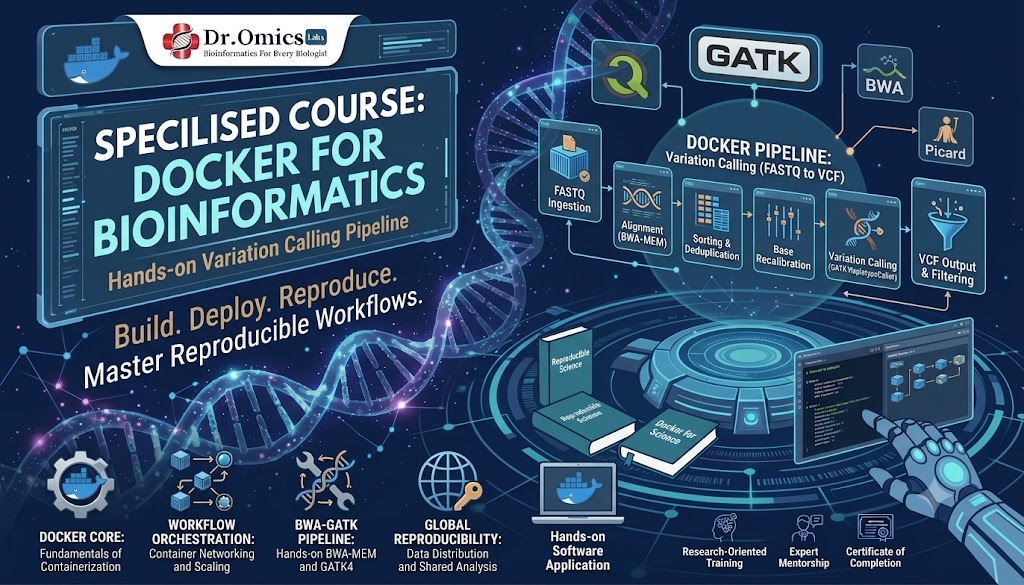
Specialised Course of Docker for Bioinformatics – Hands-on Variation calling pipeline

Master Nextflow to build scalable, portable, and reproducible DNA-Seq bioinformatics pipelines for efficient genomic data analysis.

  • 5.0/5
  • English
  • Updated Sep 2026
Specialised Course of Docker for Bioinformatics – Hands-on Variation calling pipeline

About this course

Learn to design and execute scalable and reproducible DNA-Seq analysis pipelines using Nextflow. This specialised course introduces Nextflow workflow concepts, process design, input/output handling, parameters, channels, pipeline execution, and workflow management. Through hands-on exercises, participants will build a complete DNA-Seq pipeline and learn how to integrate bioinformatics tools, manage computational resources, and create portable workflows that can be efficiently executed across different environments. The course provides a practical foundation for modern workflow-based genomic data analysis.

What you will learn

Understand the fundamentals of Nextflow and workflow-based bioinformatics.
Create and execute Nextflow processes and workflows.
Work with channels, inputs, outputs, and parameters.
Build a structured DNA-Seq analysis pipeline.
Integrate multiple bioinformatics tools into a single workflow.
Automate repetitive genomic data-processing tasks.
Develop scalable and reproducible analysis workflows.
Manage workflow execution, errors, and computational resources.
Understand how to make pipelines portable across computing environments.

Skills you will gain

Nextflow fundamentals workflow development Nextflow processes channels inputs and outputs parameters pipeline automation DNA-Seq analysis bioinformatics tool integration workflow execution error handling resource management scalable workflows reproducible analysis pipeline optimization workflow portability
Certification

Available

Issued by Dr. Omics

Course curriculum

1 module

  • Introduction to NGS and DNA Sequencing
  • NGS Terminologies and Understanding SRA Database
  • Docker Installation and Container Basics for Bioinformatics
  • Running NGS Tools and Managing Bioinformatics Containers Using Docker
  • Quality Control of NGS Reads Using FastQC and MultiQC in Docker
  • Read Trimming and Filtering Using fastp in Docker
  • Genome Indexing and Read Alignment Using BWA and StrobAlign in Docker
  • Variant Calling DeepVariant in Docker
  • Variant Annotation Using VEP
  • Complete DNA-seq Variant Calling Pipeline Using Docker and Result Interpretation

What you need to start

  • Basic understanding of bioinformatics and DNA sequencing.
  • Familiarity with NGS/DNA-Seq concepts.
  • Basic Linux and command-line knowledge is recommended.
  • Basic scripting knowledge is helpful but not mandatory.
  • No prior Nextflow experience required.

Who this course is for

  • B.Sc./M.Sc. students in Bioinformatics, Biotechnology, Genomics, Genetics, and Life Sciences.
  • PhD scholars and research students working with NGS data.
  • Bioinformatics professionals and computational biologists.
  • Researchers interested in workflow automation and reproducible analysis.
  • NGS analysts looking to improve pipeline development skills.
  • Beginners with basic Linux and bioinformatics knowledge who want to learn Nextflow.
INR

₹12000

₹15000 20% off
USD

$180

$200 10% off

Indian learners pay in INR; international learners are billed in USD.

Enroll for International Students

Paying from outside India? Use this link to complete your payment.
Active batch
Open for enrolment
Specialised Course of Docker for Bioinformatics – Hands-on Variation calling pipeline
  • Starts 12 Oct 2026
  • Ends 26 Oct 2026
  • Timing 7:00 PM – 8:00 PM
  • Days Mon, Tue, Wed, Thu, Fri
  • Platform MS Teams
This course includes
  • Format Live
  • Level Intermediate
  • Language English
  • Modules 1
  • Certificate Yes
  • Provider Dr. Omics
  • Hands-on introduction to Nextflow.
  • Nextflow process and workflow development.
  • Practical work with channels
  • parameters
  • inputs
  • and outputs.
  • Complete DNA-Seq pipeline development.
  • Integration of bioinformatics tools into workflows.
  • Pipeline automation and execution.
  • Reproducibility and scalability concepts.
  • Practical exercises using genomic datasets.
  • Workflow troubleshooting and optimization.
  • Course materials and learning resources.
  • Certificate of completion.
WhatsApp
