Course Live Intermediate Dr. Omics

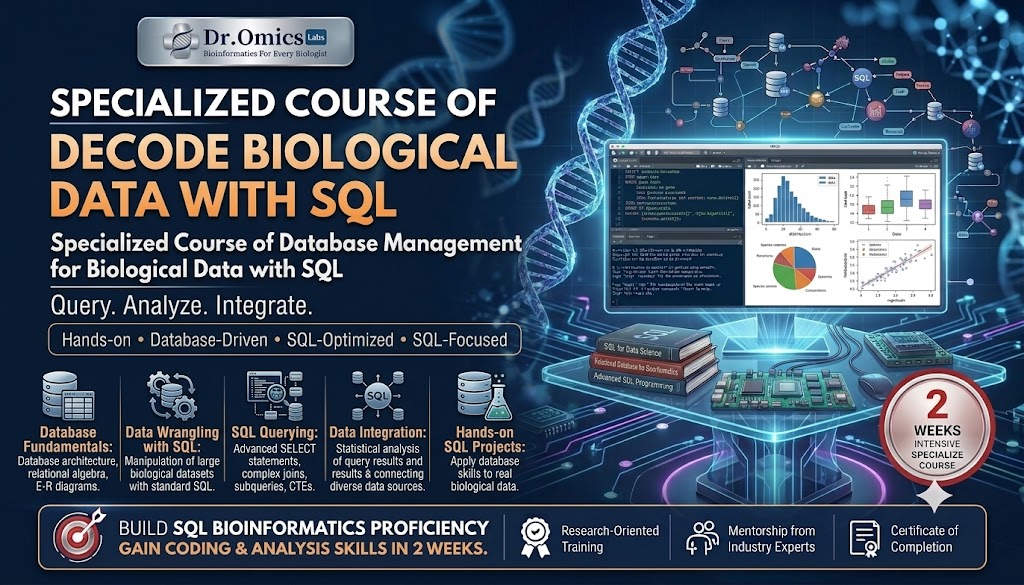
Specialised Course of Decode Biological Data with SQL

Learn SQL from the ground up to efficiently store, query, filter, and analyze biological and bioinformatics datasets.

  • 5.0/5
  • English
  • Updated Sep 2026
Specialised Course of Decode Biological Data with SQL

About this course

Build practical database skills with our Specialised Course of Decode Biological Data with SQL, designed to introduce SQL through real-world biological data applications. Participants will learn how databases are structured and how to write SQL queries to retrieve, filter, sort, join, and analyze biological information. The course covers essential SQL concepts including tables, keys, relationships, aggregate functions, subqueries, and data manipulation, with hands-on exercises focused on bioinformatics and life-science datasets. By the end of the course, learners will be able to efficiently query and extract meaningful information from biological databases.

What you will learn

Understand fundamental concepts of relational databases and SQL.
Create and execute SQL queries for biological datasets.
Retrieve, filter, sort, and organize database records.
Use SQL functions for data analysis and summarization.
Combine information from multiple tables using joins.
Apply subqueries and conditional logic to solve data-analysis tasks.
Insert, update, and manage database records.
Analyze and extract meaningful information from bioinformatics datasets.
Build a strong foundation for working with biological databases.

Skills you will gain

SQL fundamentals relational databases database tables primary and foreign keys data types SELECT queries filtering sorting grouping aggregate functions joins subqueries conditional queries data manipulation database management biological data querying bioinformatics database analysis

Course curriculum

1 module

  • Introduction to SQL: Commands, Syntax & Data Types
  • Understanding Databases, Tables & Biological Data
  • Creating Tables & Adding Biological Data |
  • Reading & Updating Data: SELECT, INSERT, UPDATE & DELETE
  • Working with SQL Workbench & Query Execution
  • Filtering & Sorting Data: WHERE, ORDER BY & LIMIT
  • Combining Tables Using JOINs
  • Analyzing Data Using COUNT, SUM, AVG & GROUP BY
  • Useful SQL Functions for Biological Data Analysis
  • Hands-on Bioinformatics SQL Project: Query & Analyze Biological Data

What you need to start

  • Basic computer knowledge.
  • Basic understanding of biological or scientific data is helpful.
  • No prior SQL or database experience is required.
  • Basic familiarity with bioinformatics concepts is an advantage but not mandatory.

Who this course is for

  • B.Sc./M.Sc. students in Bioinformatics, Biotechnology, Microbiology, Biochemistry, Genetics, and Life Sciences.
  • PhD scholars and research students.
  • Beginners interested in SQL and biological data analysis.
  • Bioinformatics students looking to strengthen database skills.
  • Researchers and professionals working with biological datasets.
  • Anyone interested in databases and computational biology.
INR

₹12000

₹15000 20% off
USD

$180

$200 10% off

Indian learners pay in INR; international learners are billed in USD.

Enroll for International Students

Paying from outside India? Use this link to complete your payment.
Active batch
Open for enrolment
Specialised Course of Decode Biological Data with SQL
  • Starts 12 Oct 2026
  • Ends 26 Oct 2026
  • Timing 7:00 PM – 8:00 PM
  • Days Mon, Tue, Wed, Thu, Fri
  • Platform MS Teams
This course includes
  • Format Live
  • Level Intermediate
  • Language English
  • Modules 1
  • Certificate On completion
  • Provider Dr. Omics
  • Hands-on SQL training from fundamentals to practical applications.
  • Database and relational database concepts.
  • Practical SQL query-writing exercises.
  • Data filtering
  • sorting
  • grouping
  • and aggregation.
  • Hands-on practice with joins and subqueries.
  • Biological and bioinformatics dataset examples.
  • Practical database analysis exercises.
  • Course materials and learning resources.
  • Certificate of completion.
WhatsApp
