Reserve free seat
Free live workshop · 1 September 2026 · All levels

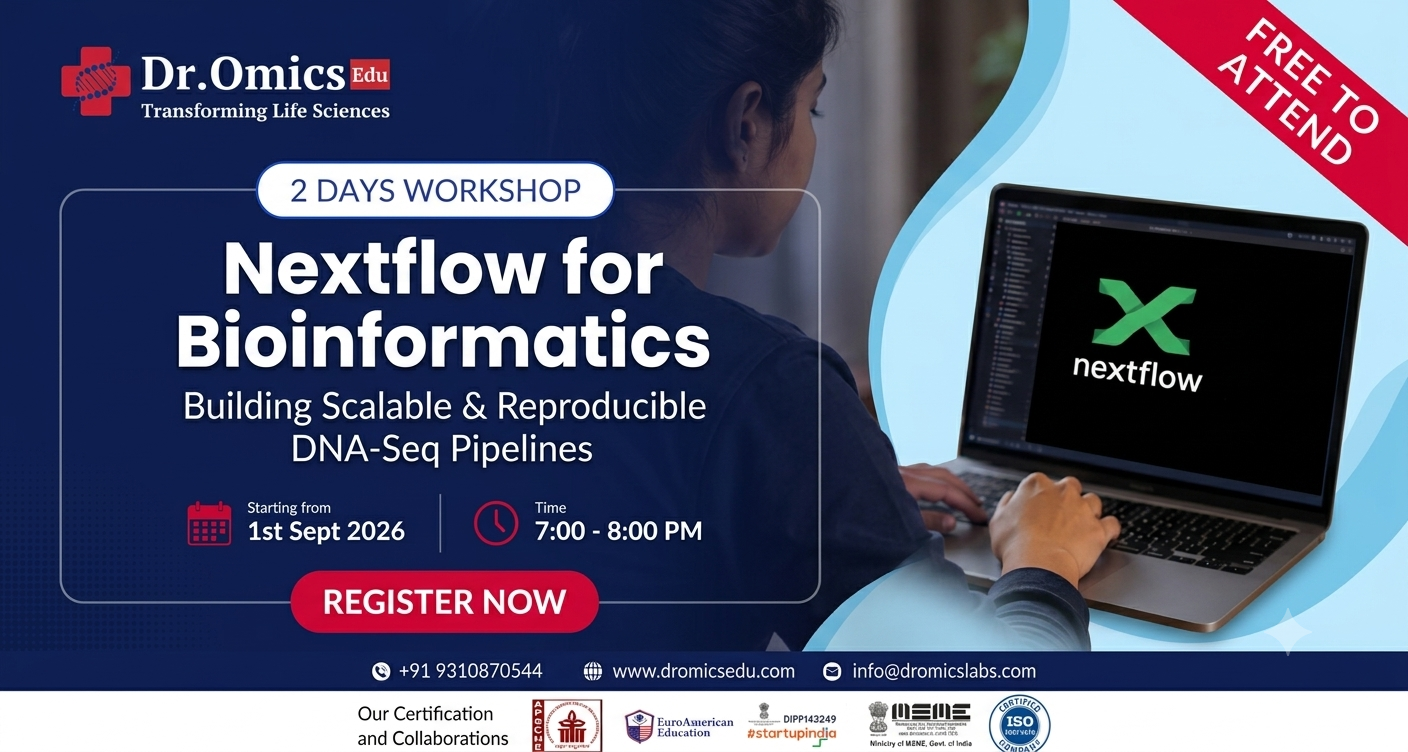
Nextflow for Bioinformatics: Building Scalable & Reproducible DNA-Seq Pipelines

Stop babysitting shell scripts. Build reproducible, containerised genomics pipelines that scale from a laptop to the cluster or cloud — and resume exactly where they stopped.

Free to attend · Limited live seats
1 September 2026 All levels · Hands-on labs Live on Zoom
50,000+ learners trained
★★★★★ 4.9/5
Backed by DST · Illumina · AWS
Your DNA-Seq pipeline · in Nextflow
ChannelsProcessesWork dir
Workshop starts in
days
hrs
min
sec
Grab a seat →
Attending is free

Free to join. Add what you need afterwards.

The live workshop costs nothing — the course fee is ₹0. The certificate and recording are an add-on from ₹599, and the tiers below build on each other if you want the pipeline code, the sample dataset, or a review of a workflow you are building yourself.

Attend live
Free

No charges to attend the workshop.

  • Live hands-on workshop
  • All four modules, with live pipeline labs
  • Live Q&A with the trainer
Reserve free seat
Get certificate + recording
₹599

Proof of completion, plus the full replay.

  • Everything in Free
  • Certificate of completion
  • Session recording
Certificate + Recording
Most picked + Study material & dataset
₹999

Everything you need to run the pipeline again on your own machine.

  • Everything in ₹599
  • Full study material
  • Reference Nextflow pipeline & sample dataset
Get the bundle
+ Project template & 1:1
₹1,699

For anyone building this into a real lab or team workflow.

  • Everything in ₹999
  • Project template
  • One 1:1 review of your own pipeline
Book with review

Each tier includes everything in the one before it. Add-ons are entirely optional — you can attend the full class without paying anything. See what we cover ↓

The curriculum

Four modules, from your first run to a working DNA-Seq pipeline

Built for life-science researchers whose analysis still lives in a folder of shell scripts — we start at what a workflow manager actually does and finish with an end-to-end variant-calling pipeline you can hand to someone else.

01

Introduction to Nextflow & Workflow Management

Why manual scripts break as datasets grow, what a workflow manager gives you in return, and getting Nextflow installed and running its first pipeline on your own machine.

Nextflow · Linux CLI
02

Nextflow Core Concepts (Processes, Channels & Workflows)

The three building blocks — processes that wrap your tools, channels that stream data between them, and the DSL2 workflow block that wires the whole thing together.

DSL2 · Processes · Channels
03

DNA-Seq Pipeline

Build a real variant-calling workflow end to end — quality control, trimming, alignment to a reference, duplicate marking and variant calls — from raw sequencing reads.

FastQC · BWA · Variant calling
04

Workflow Execution, Outputs & Best Practices

Config profiles and containers, publishDir for results, the work directory and -resume, execution reports — and the habits that keep a pipeline reproducible on someone else’s machine.

-resume · publishDir · Reports
Also covered through the labs
Containerisation with Docker & Singularity Running workflows on AWS & Google Cloud RNA-Seq differential expression AI, ML & LLMs for interpretation
Who it’s for

For anyone whose analysis has to run more than once

If your pipeline only works on your machine, or a re-run means starting again from the first FASTQ, this workshop is aimed at you. All levels welcome.

Bioinformaticians & computational biologists

You already run the tools — now you want them wired into one workflow that scales past a single sample without manual babysitting.

Life-science researchers & microbiologists

You generate the sequencing data and want to analyse it yourself, with a pipeline a collaborator or reviewer can actually reproduce.

Data scientists & software engineers

You know how to code but not the genomics conventions — this maps your skills onto NGS file formats, tools and reproducibility expectations.

Postgraduate & PhD students

You want workflow automation and containers on your CV — and a thesis analysis you can rerun in a single command a year from now.

What you’ll learn

Automate it, containerise it, reproduce it

  • Build reproducible pipelines — design scalable, fault-tolerant genomic workflows using Nextflow and Linux command-line tools.
  • Implement containerisation — package bioinformatics tools into Docker and Singularity containers for computational reproducibility.
  • Master NGS data processing — from DNA-Seq variant calling through to RNA-Seq differential expression.
  • Apply AI in life sciences — use AI tools, machine learning and LLMs for secondary and tertiary interpretation.
  • Execute cloud-based genomics — run the same workflow across cloud infrastructure on AWS and Google Cloud.

Certificate of Completion — Nextflow for Bioinformatics

Issued by DrOmics once you complete the workshop. Included from the ₹599 tier onwards — attending the live session itself stays free.

Who's behind this

Taught by a working genomics lab — not a content channel

DrOmics is a molecular diagnostics and bioinformatics lab first. The training exists because we kept meeting researchers stuck on data they couldn’t analyze — and pipelines nobody else could rerun.

Dr. Deepshikha Satish, PhD — Founder & CEO, DrOmics Labs
Founder

Dr. Deepshikha Satish, PhD

Founder & CEO · DrOmics Labs

DrOmics was founded by a translational bioinformatician who earned her PhD at the International Centre for Genetic Engineering and Biotechnology (ICGEB) and worked as a senior bioinformatics scientist before starting the lab. She built DrOmics around a gap she saw repeatedly: capable life-science researchers sitting on sequencing data with no practical way to analyze it.

That’s the gap this workshop is designed to close. The session itself is run by the DrOmics bioinformatics training team.

  • PhD, Translational Bioinformatics · ICGEB
  • 10+ international peer-reviewed publications
  • Woman Entrepreneur of the Year, 2024
  • CSIR-NET JRF qualified
Dr. Deepshikha on LinkedIn ↗
Research grants & funding from
DST AWS Illumina Pfizer–IIT Delhi
Skill-development collaborations
LSSSDC APSCHE
50,000+ students trained to date
What learners say

From “it works on my machine” to one command

★★★★★

“Our variant-calling steps were six bash scripts run by hand. Rewriting them as Nextflow processes took an afternoon, and now 40 samples run in one command.”

RN
Rohit N.Bioinformatician · Genomics core
★★★★★

“The container module fixed our reproducibility problem. A collaborator ran our pipeline and got identical output — first time that has ever happened.”

MJ
Meera J.Post-doc · Computational Biology
★★★★★

“I came for the syntax and left with the workflow habits. A failed run at step nine no longer means starting over — -resume picks it straight back up.”

AS
Arjun S.PhD scholar · Molecular Biology
Questions

Good things to know

Do I need programming experience?+

No. The workshop is pitched at all levels. Familiarity with a terminal helps, and beginner-level Python or R is useful — but every command is shown on screen and shared afterwards, so you can follow along from scratch.

What should I have installed?+

Nextflow (which needs Java 11 or newer) and Docker, on Linux, macOS, or Windows via WSL2. We send a short setup guide before the session so nothing eats into the live time.

Will we use containers?+

Yes. Packaging bioinformatics tools into Docker and Singularity containers is a core part of the workshop — it is what makes a pipeline reproduce identically on someone else’s machine.

Which pipeline do we build?+

An end-to-end DNA-Seq variant-calling workflow: quality control, trimming, alignment, duplicate marking and variant calls. RNA-Seq differential expression, cloud execution and AI-assisted interpretation are covered alongside it.

Can I run this on a cluster or in the cloud?+

That is the point of Nextflow — the same script runs locally, on an HPC scheduler such as SLURM, or on AWS and Google Cloud by switching an execution profile. We show how the config, not the code, changes.

Is it really free?+

Yes — the course fee is ₹0 and attending the live workshop costs nothing. The certificate and recording are ₹599, study material and dataset ₹999, and the project template with a 1:1 review ₹1,699. None are required to attend.

What certificate do I get?+

A Certificate of Completion in Nextflow for Bioinformatics, issued by DrOmics once you complete the workshop. It is included from the ₹599 tier onwards.

Free · Live · Hands-on labs

Build a pipeline you can run again

Join the free live workshop and leave with a working Nextflow DNA-Seq pipeline, containers that make it portable, and the workflow habits that save you the re-run. Certificate and materials are optional add-ons.

1 September 2026 · Free to attend · Limited seats