About this internship
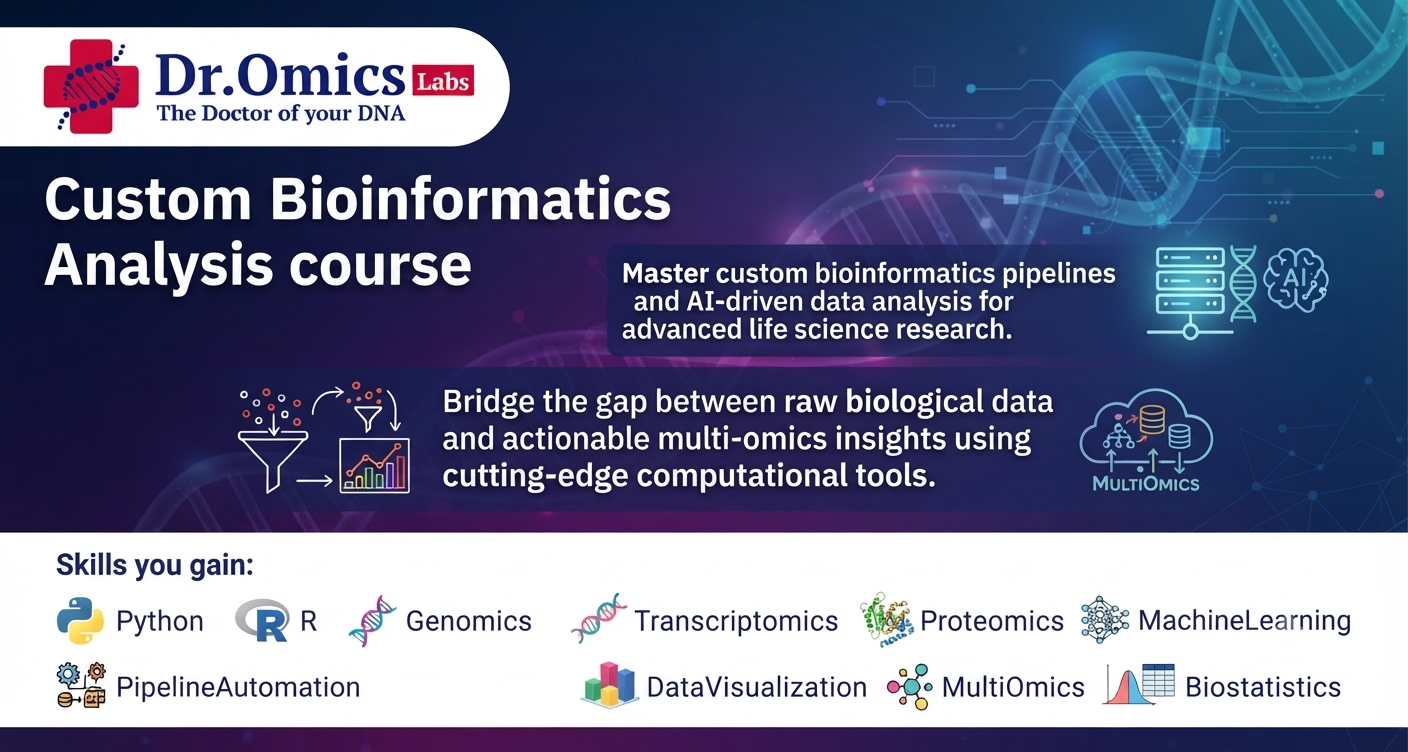
The Custom Bioinformatics Analysis course is a comprehensive, hands-on program designed for researchers, biologists, and data scientists looking to decode complex biological systems. Leveraging modern artificial intelligence and machine learning workflows, this course teaches you how to design, execute, and troubleshoot tailored computational pipelines. You will dive deep into multi-omics data integration, next-generation sequencing (NGS) analysis, and custom script development using Python and R. Learn how to handle large-scale genomic, transcriptomic, and proteomic datasets with precision and speed. Understand how to automate repetitive analytical tasks and build reproducible pipelines tailored to unique research questions. Whether you are aiming to accelerate drug discovery or publish high-impact genomic studies, this curriculum provides the exact technical edge required. Transform raw sequences into publication-ready visualizations and robust biological conclusions. Elevate your career by mastering the intersection of computational biology and cutting-edge AI technologies.
What you will achieve
Pipeline Customization: Design and deploy custom bioinformatics workflows tailored to non-standard research questions and specialized datasets.
AI & Machine Learning Integration: Apply advanced machine learning models for biomarker discovery, protein structure prediction, and genomic pattern recognition.
Next-Generation Sequencing (NGS): Process raw sequencing files through quality control, alignment, and variant calling protocols.
Multi-Omics Analysis: Integrate genomics, transcriptomics, and metabolomics data to generate holistic biological insights.
Advanced Visualization: Create publication-ready graphical representations of complex biological networks using Python and R libraries.
The project work
Hands-on implementation of everything covered in the sessions
Industry-standard tools and workflows
Project documentation and a final presentation
Code review and optimisation sessions with your mentor
Skills you will gain
Python
R
Genomics
Transcriptomics
Proteomics
MachineLearning
PipelineAutomation
DataVisualization
MultiOmics
Biostatistics
Certification
Available
Issued by Dr. Omics Edu
Internship curriculum
1 module
-
Bioinformatics Databases: An Introductory Guide
-
Introduction and overview of Bioinformatics & NCBI Gene Database Exploration
-
NCBI Gene Database Exploration
-
UCSC Genome Browser: Overview
-
Introduction to PubMed Database
-
KEGG db
-
Expasy server
-
Protein Databases (PDB)
-
ClinVar & OMIM database
-
GWAS catalog database
-
Introduction to Ensembl Database
-
Computational Tools in Bioinformatics: Applications and Uses
-
Introduction to Online BLAST with Practical Exercises
-
Setting Up Standalone BLAST and Hands-on Exercises
-
Advanced Standalone BLAST Applications and Exercises
-
Multiple Sequence Alignment Using MEGA
-
Linux for Beginners: A Practical Guide
-
Introduction to Linux: Overview and Installation
-
Importatant Linux Commands
-
Managing Packages in Linux (repositories, source code and conda enviroment)
-
Bash Scripting: Variables, Conditionals & Loops
-
AWK and SED practicals
-
Python Essentials for Bioinformatics
-
Installation and Environment Setup
-
Data Types in Bioinformatics Computing
-
String Handling for DNA and Protein Sequences
-
Efficient Data Structures for Biological Data
-
Control Structures for Genome Data Processing
-
Functions for Automating Bioinformatics Tasks
-
Importing, Exporting, and Handling Biological Files
-
Data Manipulation for Sequence and Expression Analysis
-
Visualization of Genomic and Proteomic Data
-
Biopython for Sequence and Structural Analysis
-
R Programming for Biological Data Analysis
-
Getting Started with R for Bioinformatics
-
Understanding Data Types , variables in R
-
Efficient Data Structures for Genomic Data
-
Importing, Exporting, and Handling Biological Data
-
Control Structures for Data Processing in R
-
Functions for Automating Bioinformatics Workflows
-
Managing and Utilizing R Packages for Analysis using Bioconducter
-
Data Manipulation for Genomic and Expression Data
-
Visualizing Biological Data with R-1 (Basic plots, PCA plot, Venn diagram)
-
Visualizing Biological Data with R-2(Heatmap, volcano plot, MA plot)
-
Variant Calling Pipeline: A DNA-Seq Approach
-
Introduction to NGS and DNAseq
-
Basic Terminologies in NGS
-
Understanding of SRA database
-
Installing Tools in Linux for Variant Calling
-
Quality Control of Reads using fastqc & multiQC
-
Trimming and Filtering Reads using fastp
-
Genome Indexing and Read Alignment using bwa and strobalign
-
Variation calling using GATK & Deepvariant
-
Predicting Variant Effects using VEP
-
Variation Visualization (IGV)
-
Docker installation
-
DNAseq pipeline in docker -1
-
DNAseq pipeline in docker -2
-
DNAseq pipeline in docker -3
-
DNAseq pipeline in docker -4
-
Reference-Guided RNA-Seq: A Complete Analysis Workflow
-
Introduction to RNA-seq and Key Terminologies
-
Setting Up Tools in Linux for Gene Expression Analysis
-
Quality Control using fastqc and multiqc
-
Read trimming using fastp
-
Genome Indexing and Read Alignment using Hisat2 & salmon
-
Data Normalization Using featurecounts
-
Merging Data and Identifying Differentially Expressed Genes using deseq2
-
Interpretation of DEG Results
-
Annotation of Differentially Expressed Genes using DAVID
-
Functional and Pathway Enrichment Analysis using shinyGO ,clusterProfiler & Enrichr
-
Network Analysis of gene interaction using stringDB
-
Network editing using cytoscape
-
Cloud computing for Genomics (AWS)
-
Introduction to AWS
-
Introduction to Compute Storage Databases
-
Introduction to AWS Services and free tier acount creation
-
creation s3 bucket, Ec2 instance and connection
-
Execution of pipeline through EC2 instance
-
Introduction to Machine Learning in Bioinformatics
-
Fundamentals of Machine Learning for Genomic Data
-
Linear Models and Nearest Neighbors for Pattern Recognition
-
Probabilistic Machine Learning Concepts and Applications
-
Support Vector Machines SVM Theory and Implementation
-
Naïve Bayes Classifier Fundamentals and Bioinformatics Use Cases
-
Decision Trees and Random Forest Interpretable ML Models
-
Logistic Regression for Predictive Analysis in Bioinformatics
-
Clustering Algorithms for Unsupervised Learning
-
Validation Techniques for Machine Learning Models
-
Machine Learning for Biomedical Image Analysis
-
Data Preparation and Statistical Analysis in Bioinformatics
-
Introduction to Statistical Methods for Bioinformatics
-
Descriptive Statistics and Data Structures
-
Correlation and Regression Analysis for Genomic Data
-
Probability and Bayes Theorem in Bioinformatics
-
Sampling Techniques and Distribution Theory
-
Hypothesis Testing for Data Analysis
-
Statistical Tools for Data Management, Analysis, and Visualization
-
Inferential Statistics for Biological Data Interpretation
-
Interpreting Statistical Outputs for Decision Making
-
Practical Applications of Statistical Methods in Bioinformatics
What you need to start
-
Basic foundational understanding of molecular biology, genetics, and the central dogma.
-
-
Familiarity with introductory programming concepts (any language; Python or R experience is a plus but not mandatory).
-
-
A computer with internet access and a strong enthusiasm for data-driven biological discovery.
Who this internship is for
-
Life science researchers, PhD students, and postdocs wanting to transition from manual tools to automated, custom computational pipelines.
-
-
Bioinformatics professionals seeking to upgrade their expertise with modern AI and machine learning techniques.
-
-
Data scientists and software engineers looking to break into the booming genomics and biotechnology sectors.