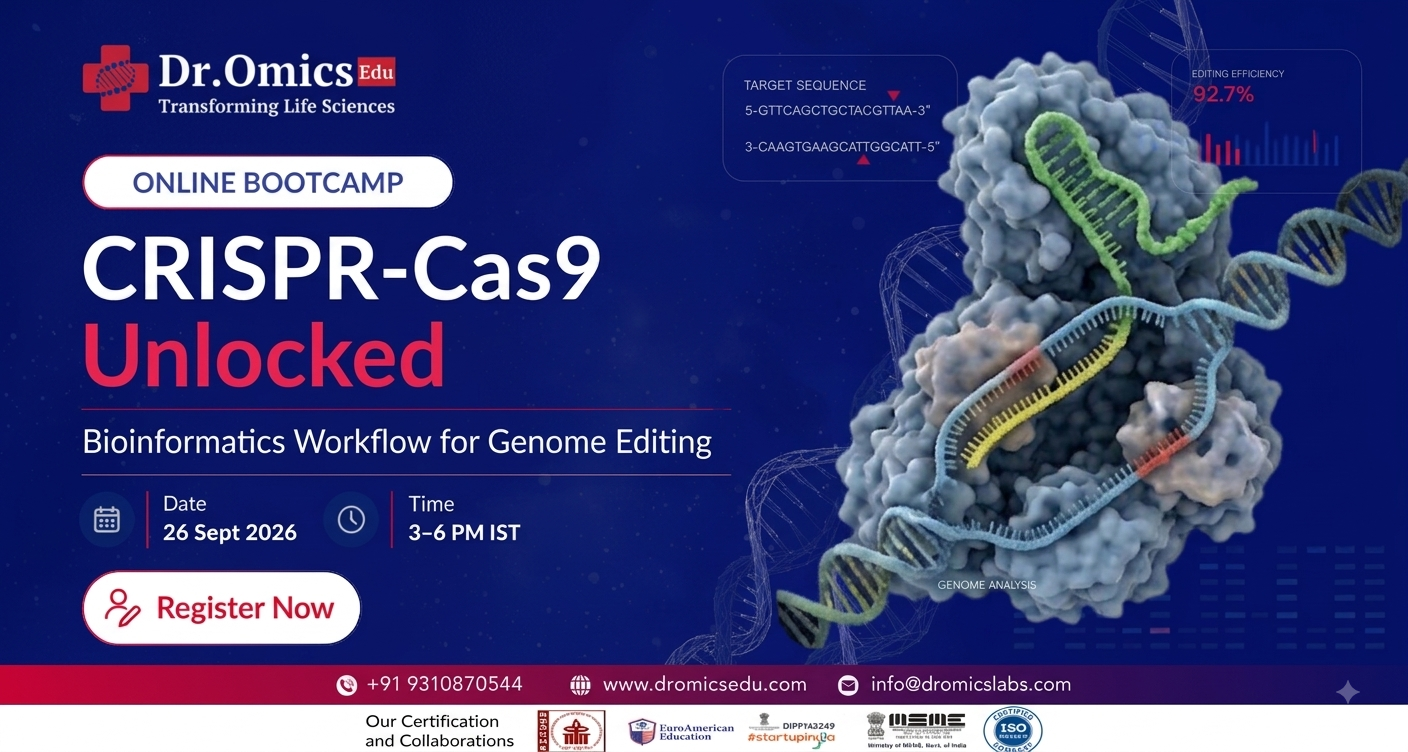
Explore how computational analysis supports CRISPR experiments — from understanding target regions to interpreting genome-editing outcomes. A practical introduction to using bioinformatics approaches in modern genome-editing research. No programming required.
The course fee is ₹0 — the live bootcamp costs nothing. The certificate carries a nominal fee, and the add-ons below are for anyone who wants the recording, materials, or a review of their own CRISPR analysis.
No charge to attend the live session.
Something to show for it on your CV.
Everything you need to redo it on your own data.
For anyone designing or troubleshooting work of their own.
Each tier includes everything in the one before it. Add-ons are entirely optional — you can attend the full class without paying anything. See what we cover ↓
Every step is walked through live on real CRISPR datasets — you follow the analysis alongside the instructor, not watch slides about it.
Learn how CRISPR-Cas9 uses a guide RNA to find a specific DNA sequence and Cas9 to cut it. Understand the basic role of PAM, target recognition, and how CRISPR-Cas9 enables gene editing.
Understand how CRISPR and NGS work together to edit and analyze DNA. Learn how NGS helps identify and verify CRISPR-induced genetic changes.
Learn how bioinformatics tools are used to analyze CRISPR sequencing data. Understand the basic workflow from raw sequencing reads to identifying genetic changes.
No prior bioinformatics or coding experience is needed — just molecular biology fundamentals, DNA structure and the central dogma, and a willingness to work through the exercises.
B.Sc., M.Sc. and Ph.D. students who want to learn CRISPR and bioinformatics for their studies, projects, or research.
Molecular biologists, geneticists and researchers who want to understand CRISPR data analysis and genome-editing results.
Anyone interested in learning how bioinformatics tools can be used to analyze CRISPR datasets.
Professionals in biotechnology, genomics, gene therapy or related fields who want to understand CRISPR analysis workflows.
Issued by DrOmics — add it to your CV, LinkedIn or lab profile.
DrOmics is a molecular diagnostics and bioinformatics lab first. The training exists because we kept meeting researchers stuck on data they couldn't analyze.
DrOmics was founded by a translational bioinformatician who earned her PhD at the International Centre for Genetic Engineering and Biotechnology (ICGEB) and worked as a senior bioinformatics scientist before starting the lab. She built DrOmics around a gap she saw repeatedly: capable life-science researchers sitting on sequencing data with no practical way to analyze it.
That's the gap this masterclass is designed to close. The session itself is run by the DrOmics bioinformatics training team.
"I had CRISPR sequencing data and no idea what to do with it. Now I can walk through the workflow myself and explain what the results actually show."
"The NGS session alone was worth it. I finally understand how sequencing confirms an edit, and what the numbers in the output are really telling me."
"No coding, real CRISPR datasets, and a finished figure by the end. I ran the same workflow on my own samples the following week."
None at all. Every tool we use is point-and-click or web-based, and no previous bioinformatics experience is required either — the bootcamp is built for beginners as well as experienced researchers. What you do need is a basic grounding in molecular biology, DNA structure and the central dogma.
A basic understanding of biology or life sciences, fundamental knowledge of DNA and proteins, basic computer skills, and a Windows or Mac computer with internet access. Familiarity with molecular biology concepts helps but isn't essential.
No. The bioinformatics tools we use run in the browser, so a laptop with a working internet connection is all you need. We walk through each one live, so you can follow along from scratch.
Yes. You'll work through real CRISPR sequencing data — following the workflow from raw reads to identifying genetic changes, and finishing with results you interpreted yourself.
Yes — the course fee is ₹0 and attending the live bootcamp costs nothing. The certificate carries a nominal fee, and the optional add-ons above (recording, materials, 1:1 review) are entirely up to you. None are required to attend.
Yes — a certificate of completion issued by DrOmics, available as an optional add-on. Attending the bootcamp itself stays free.
Join the free hands-on bootcamp and leave with a practical understanding of CRISPR data analysis — from raw sequencing reads through to editing results you can interpret, using a workflow you can run again on your own data. Certificate and materials are optional add-ons.