Bootcamp Live Beginner Dr. Omics Edu

BioDB Mining Lab: Query, Retrieve, Interpret in 3 Hours

A 3-hour hands-on bootcamp to mine NCBI GenBank, Ensembl, UniProt, and AlphaFold DB for genes, transcripts, proteins, and AI-predicted 3D structures using real research questions.

  • 5.0/5
  • English
  • Starts 26 Dec 2026
  • Updated Nov 2026
From

Free

4 options — see what each one includes.

Enroll for International Students

Paying from outside India? Use this link to complete your payment.
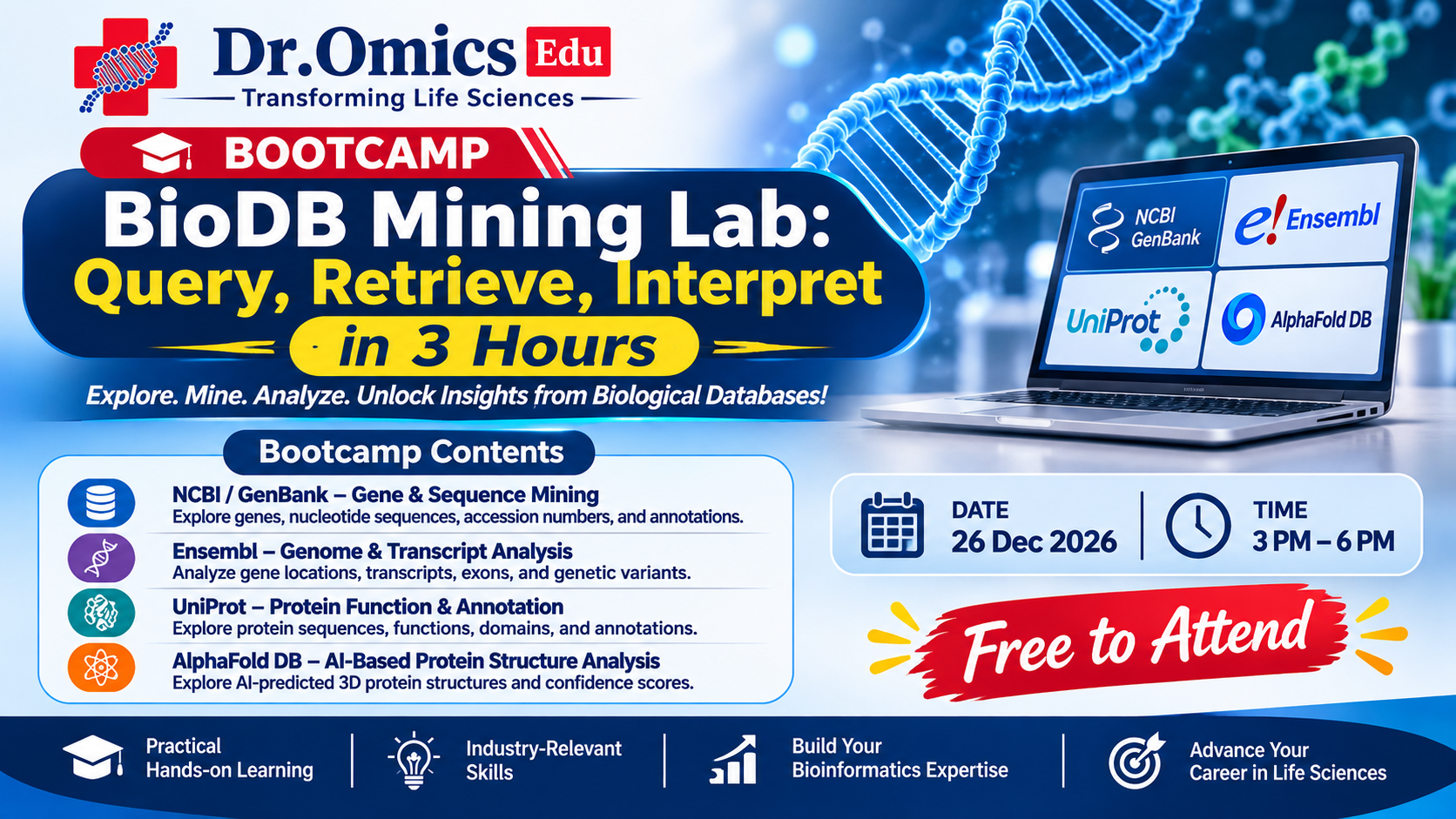
BioDB Mining Lab: Query, Retrieve, Interpret in 3 Hours

About this course

Biological databases hold the answers to countless research questions, but only if you know how to query them, retrieve the right data, and interpret it correctly. BioDB Mining Lab: Query, Retrieve, Interpret in 3 Hours is a practical, real-world bioinformatics database mining bootcamp that takes you from a gene name to a protein structure in a single guided session.

Using real research scenarios, you will work across four of the most widely used public resources in life sciences:

1. NCBI / GenBank: Gene and Sequence Mining
Explore genes, nucleotide sequences, accession numbers, and annotations. Learn to search the NCBI Gene and Nucleotide databases, read GenBank records, and download sequences in FASTA and GenBank formats.

2. Ensembl: Genome and Transcript Analysis
Analyze gene locations, transcripts, exons, and genetic variants. Learn to navigate the Ensembl genome browser, compare transcript isoforms, and understand variant annotations.

3. UniProt: Protein Function and Annotation
Explore protein sequences, functions, domains, and annotations. Learn to use UniProtKB, interpret Swiss-Prot reviewed entries, and connect proteins to their domains and biological roles.

4. AlphaFold DB: AI-Based Protein Structure Analysis
Explore AI-predicted 3D protein structures and confidence scores. Learn to interpret pLDDT scores and predicted aligned error (PAE) to judge how reliable a predicted structure is.

What you will learn

By the end of this bootcamp, participants will be able to:
Choose the right biological database (NCBI, Ensembl, UniProt, or AlphaFold DB) for a given research question
Search and retrieve gene and nucleotide records, accession numbers, and annotations from NCBI / GenBank
Locate genes on the genome and analyze transcripts, exons, and genetic variants in Ensembl
Explore protein sequences, functions, domains, and annotations in UniProt
Interpret AI-predicted 3D structures in AlphaFold DB using pLDDT and PAE confidence scores
Cross-link records across NCBI, Ensembl, UniProt, and AlphaFold DB to build a complete gene-to-protein-to-structure profile
Apply a repeatable database mining workflow to their own genes and proteins of interest

Skills you will gain

Advanced database searching and filtering reading GenBank records understanding accession numbers downloading data in FASTA and GenBank formats genome browser navigation transcript isoform comparison exon and gene structure analysis variant annotation interpretation protein domain analysis functional annotation analysis Swiss-Prot vs. TrEMBL entry evaluation AlphaFold structure interpretation pLDDT and PAE confidence score assessment cross-database ID mapping gene-to-protein-to-structure data integration documenting findings for research and reports

Course curriculum

1 module

  • 1. NCBI / GenBank: Gene and Sequence Mining
  • Explore genes, nucleotide sequences, accession numbers, and annotations.
  • 2. Ensembl: Genome and Transcript Analysis
  • Analyze gene locations, transcripts, exons, and genetic variants.
  • 3. UniProt: Protein Function and Annotation
  • Explore protein sequences, functions, domains, and annotations.
  • 4. AlphaFold DB: AI-Based Protein Structure Analysis
  • Explore AI-predicted 3D protein structures and confidence scores.

What you need to start

  • Basic knowledge of molecular biology (genes, transcripts, proteins, DNA/RNA)
  • Familiarity with using a web browser and the internet
  • No programming or coding experience required
  • A laptop or desktop with a stable internet connection
  • Optional: a gene or protein of interest to explore during the session

Who this course is for

  • Undergraduate and postgraduate students in Biotechnology, Bioinformatics, Life Sciences, and Pharmacy.
  • Researchers, PhD scholars, and faculty members integrating computational workflows into wet-lab projects.
  • Drug discovery enthusiasts and professionals looking to upskill in AI-assisted structural biology.

Choose what's included

Attending is priced on its own; recordings, notes and the certificate are what the higher options add. You can move up later and pay only the difference.

Attend live
Free

No charge to attend the live session.

Reserve free seat
+ Certificate & recording
₹199.00

Proof of participation, plus access to the session recording.

  • ✓ Everything in Attend live
Enroll
+ Study material & dataset
₹599.00

Everything you need to run the workflow at your own bench.

  • ✓ Everything in Attend live
Enroll
+ Project template & 1:1
₹1499.00

For anyone designing or troubleshooting work of their own.

  • ✓ Everything in + Study material & dataset
Enroll
From

Free

4 options — see what each one includes.

Enroll for International Students

Paying from outside India? Use this link to complete your payment.

Active batch
Open for enrolment
261226-BioDB Mining Lab: Query, Retrieve, Interpret in 3 Hours
  • Starts 26 Dec 2026
  • Ends 26 Dec 2026
  • Timing 3:00 PM – 6:00 PM
  • Days Sat
  • Platform MS Teams
This course includes
  • Format Live
  • Level Beginner
  • Language English
  • Modules 1
  • Access 6 months
  • Certificate On completion
  • Provider Dr. Omics Edu
  • 3 hours of live
  • hands-on guided training
  • Real-world case studies and practice exercises
  • Step-by-step workflow guide for gene-to-protein-to-structure mining
  • Cheat sheet of database search tips and file formats
  • Practice datasets and a list of example genes/accessions
  • Mini case study activity with instructor feedback
  • Q&A session with the instructor
  • Certificate of participation
  • Access to session materials and resources after the bootcamp (confirm whether you will provide a recording or slides)
WhatsApp