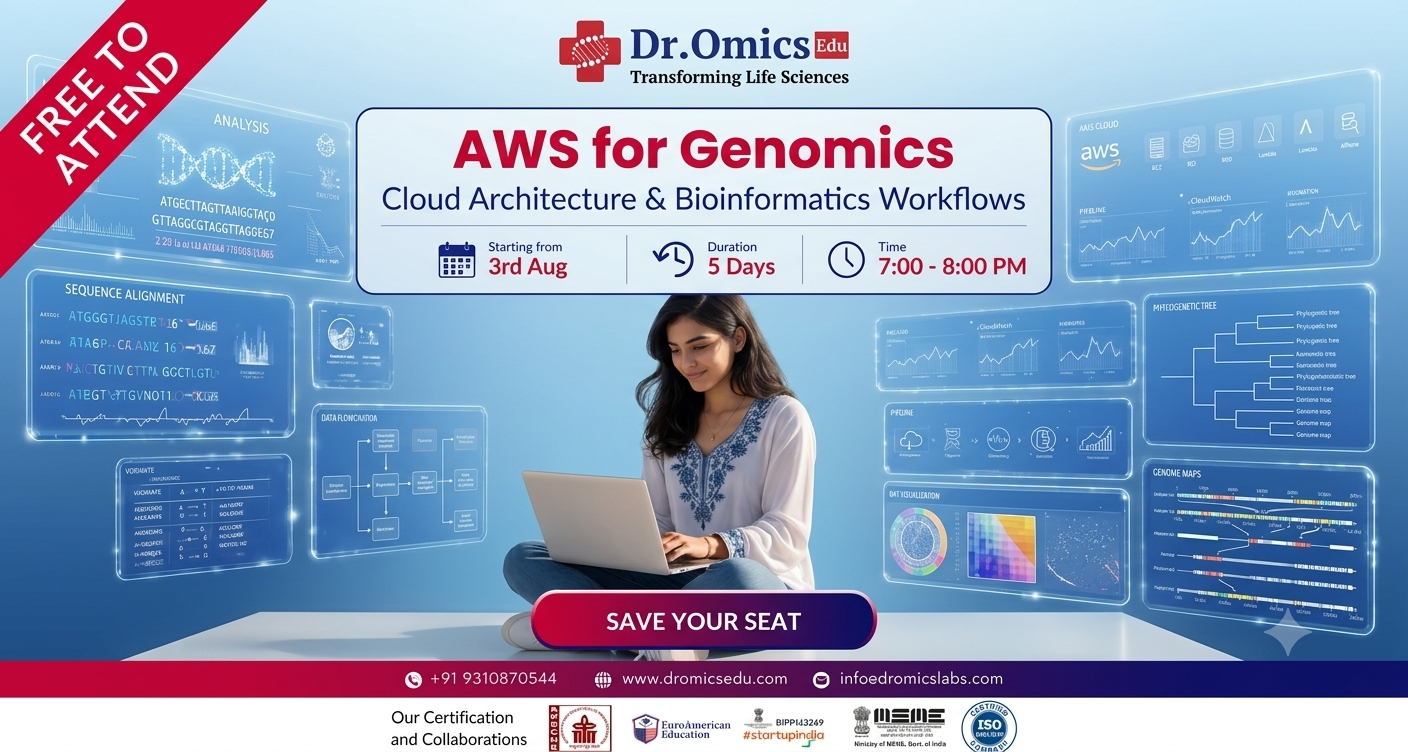
AWS for Genomics: Cloud Architecture & Bioinformatics Workflows
Master scalable cloud computing for high-throughput genomic data analysis. Accelerate your research by leveraging AWS infrastructure to build robust, AI-powered bioinformatics pipelines.
- 5.0/5
- English
- Starts 03 Aug 2026
- Updated Aug 2026
₹1299
$20
Indian learners pay in INR; international learners are billed in USD.
Paying from outside India? Use this link to complete your payment.
About this course
This comprehensive course empowers life science professionals to transition from local computing to cloud-native genomic analysis on Amazon Web Services (AWS). You will learn to design secure, scalable cloud architectures specifically optimized for high-throughput sequencing (HTS) and large-scale multi-omics datasets. The curriculum focuses on automating bioinformatics workflows using AWS Batch, S3 for data storage, and AWS Step Functions for orchestration. Beyond infrastructure, you will integrate artificial intelligence and machine learning services—such as Amazon SageMaker—to enhance variant calling, genomic data mining, and predictive modeling. Participants will gain practical experience in cost-optimization strategies, high-performance computing (HPC) configuration, and deploying containerized applications with Docker and Nextflow. By the end of this program, you will be equipped to architect resilient, reproducible, and automated cloud environments that drastically reduce the time from raw data to actionable biological discovery.
What you will learn
Skills you will gain
Certification
Participants who complete all modules and pass the final capstone project will earn the Professional Certification in AWS for Genomics & Bio-AI, an industry-recognized credential that validates your expertise in architecting high-performance, AI-integrate
Issued by Dr. Omics EduCourse curriculum
1 moduleWhat you need to start
- Foundational knowledge of NGS data types and common bioinformatics file formats (FASTQ, BAM, VCF).
- Basic experience with Linux/Unix command-line interfaces.
- Working knowledge of at least one scripting language (Python or R).
Who this course is for
- Bioinformaticians and research scientists seeking to scale their data analysis capabilities via the cloud.
- IT professionals in the biotechnology and pharmaceutical sectors managing genomics infrastructure.
- Computational biology students and post-docs aiming to master cloud-native bioinformatics.
- Data scientists and engineers looking to apply AI/ML tools to life science research datasets.
