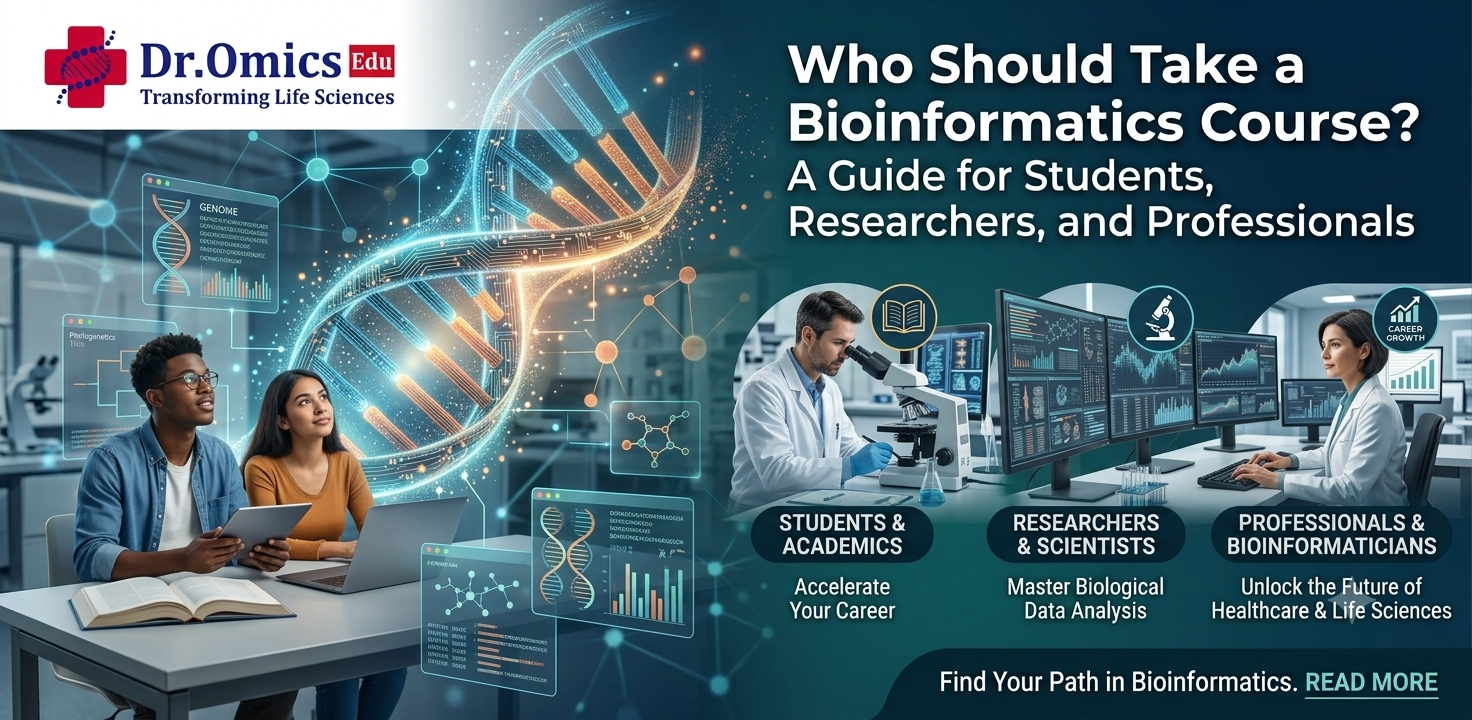
Who Should Take a Bioinformatics Course? A Guide for Students, Researchers, and Professionals
Dr. Omics Edu Team ·
Introduction
Modern biology is increasingly driven by data. From DNA sequencing and disease research to drug discovery and personalized medicine, scientists use computational tools to understand complex biological systems. This growing demand has made bioinformatics an exciting field for students, researchers, and working professionals interested in combining biology with technology.
But an important question remains: Who can learn bioinformatics, and is a programming background necessary to get started?
The good news is that learners from several academic and professional backgrounds can explore this field. Understanding the right learning pathway can help you decide whether a bioinformatics course aligns with your interests and career goals.
1. Bioinformatics for Beginners: Where Should You Start?
Bioinformatics for beginners introduces the computational methods used to collect, analyze, and interpret biological data. You do not necessarily need advanced coding skills before starting.
A beginner-friendly course typically covers molecular biology fundamentals, biological databases, DNA and protein sequence analysis, and introductory tools. Learners can gradually progress to Linux, Python or R, next-generation sequencing (NGS), and statistical analysis.
Students who enjoy problem-solving, scientific investigation, and working with data may find bioinformatics particularly interesting. A structured course can help them develop practical skills through guided exercises and real-world datasets.
2. Bioinformatics for Biology Students
Bioinformatics for biology students is especially relevant for learners pursuing biotechnology, microbiology, genetics, biochemistry, zoology, botany, and related life sciences degrees.
These students already have a foundation in biological concepts, making it easier to understand how computational analysis supports research.
Potential learning areas include:
- DNA and protein sequence analysis
- Gene expression and RNA-seq analysis
- Genome annotation and variant analysis
- Phylogenetics and evolutionary biology
- Biological databases and molecular visualization
For example, a biotechnology student could analyze publicly available gene-expression data to identify genes that behave differently between healthy and diseased samples.
These projects can strengthen research skills and help students prepare for higher studies, laboratory research, genomics, and biotechnology roles.
3. Bioinformatics for Pharmacy Students
Bioinformatics for pharmacy students offers a pathway into computational drug discovery, pharmacogenomics, and pharmaceutical research.
Pharmacy learners can apply their understanding of drugs, pharmacology, and disease mechanisms to investigate molecular targets and drug interactions.
Relevant topics include molecular docking, protein structure analysis, drug-target interactions, pharmacogenomics, and computer-aided drug design.
For instance, learners may explore how a potential drug molecule interacts with a target protein using molecular visualization and docking tools. Such exercises introduce computational approaches used in early-stage drug discovery, although computational predictions require further experimental validation.
This combination can be useful for students interested in pharmaceutical R&D, cheminformatics, biotechnology, and computational research.
4. Bioinformatics for MSc and PhD Scholars
Bioinformatics for MSc PhD learners is particularly valuable when research involves genomics, transcriptomics, proteomics, molecular biology, or disease mechanisms.
MSc students can use bioinformatics to develop research projects, interpret experimental results, and prepare for research-oriented careers. PhD scholars can apply more advanced methods to investigate biological questions using large-scale datasets.
Depending on their research objectives, learners may study NGS pipelines, RNA-seq, differential gene expression, variant calling, multi-omics integration, statistical modeling, or machine learning.
Practical training can also help researchers create reproducible workflows, document their analyses, and improve the computational component of publications and dissertations.
5. Working Professionals and Career Changers
Bioinformatics is not limited to students. Laboratory scientists, clinical research professionals, biotechnology employees, and data analysts may also benefit from learning computational biology.
For laboratory professionals, computational skills can expand opportunities in sequencing-data analysis and genomics research. For individuals with programming or data science experience, biological knowledge can provide an entry point into life sciences applications.
However, career transitions require more than course completion. Learners should build relevant projects, understand biological fundamentals, and develop skills aligned with their target roles.
6. Understanding Eligibility for a Bioinformatics Course
The eligibility for bioinformatics course enrollment varies by institution and course level.
Course level | Typical suitable background |
| Beginner | Students and learners interested in biology or data analysis |
| Foundation certificate | Life sciences, biotechnology, pharmacy, and related backgrounds |
| Advanced NGS training | Learners with basic molecular biology and genomics knowledge |
| Research-focused training | MSc, PhD scholars, research professionals, or learners with relevant foundations |
Some introductory programs accept learners from diverse academic backgrounds, while advanced programs may require prior knowledge of genetics, statistics, programming, or molecular biology. Always review the provider's specific admission requirements.
7. How to Choose the Right Bioinformatics Course
Before enrolling, consider your academic background, career goals, and available study time. Look for a course that includes practical exercises, commonly used tools, mentor support, and project-based learning.
Beginners should prioritize fundamentals before progressing to complex workflows. Learners interested in genomics may focus on NGS analysis, while pharmacy students may prefer computational drug discovery and pharmacogenomics.
A certificate can document your training, but demonstrable practical skills, well-documented projects, and the ability to explain your results are equally important.
Conclusion
Bioinformatics offers learning opportunities for biology students, pharmacy students, MSc and PhD scholars, researchers, and professionals seeking to expand their scientific or computational skills.
If you are wondering who can learn bioinformatics, the answer depends less on having a perfect starting skill set and more on choosing an appropriate learning pathway and practicing consistently.
Start with the fundamentals, select projects relevant to your interests, and gradually build your technical expertise. With the right training and practical experience, bioinformatics can become a valuable addition to your academic journey or professional development.
