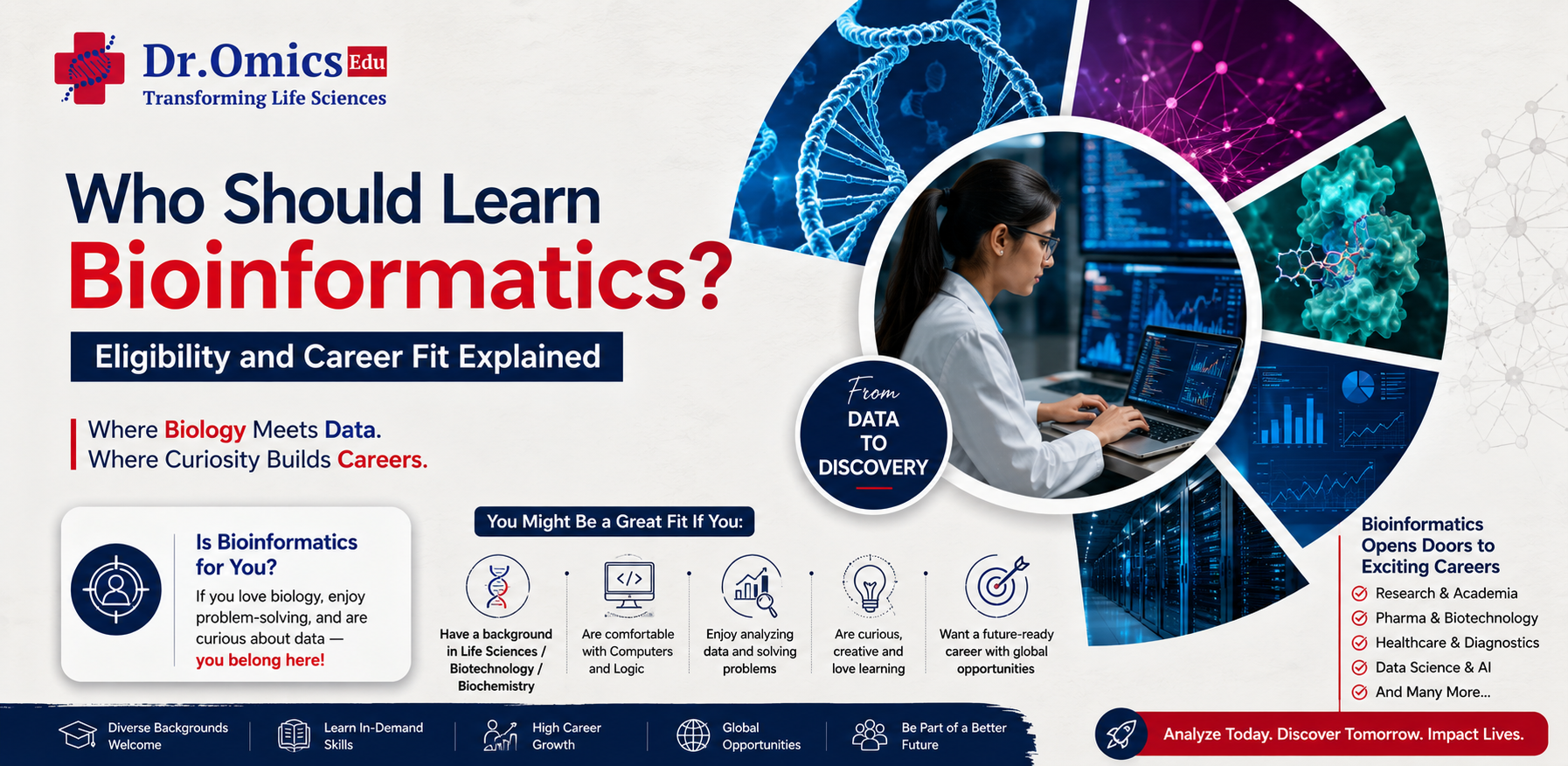
Who Should Learn Bioinformatics? Eligibility and Career Fit Explained
Dr. Omics Edu Team ·
Bioinformatics has emerged as one of the most important interdisciplinary fields in modern life sciences. The rapid growth of genomic, transcriptomic, proteomic, and clinical datasets has created a strong demand for professionals who can combine biological knowledge with computational and analytical skills. But who should learn bioinformatics, and what educational background is required to build a career in this field?
The good news is that bioinformatics is not limited to students with a specific degree. Learners from biology, biotechnology, life sciences, pharmacy, medicine, and even computer science can develop relevant skills and explore career opportunities in bioinformatics.
Who Should Learn Bioinformatics?
Students and professionals who are interested in biology, data analysis, research, and technology can consider learning bioinformatics. A basic understanding of biological concepts, combined with analytical thinking and willingness to learn computational tools, provides a strong foundation.
Bioinformatics for Biology Students
Bioinformatics for biology students is particularly valuable because it connects traditional biological knowledge with computational analysis. Students familiar with genetics, molecular biology, biochemistry, and cell biology can learn how biological sequences and datasets are analyzed using computational approaches.
Learning tools such as BLAST, biological databases, sequence alignment software, and genome browsers can help biology students understand how computational methods support modern research.
Bioinformatics for BSc Students
Bioinformatics for BSc students can be a valuable skill-building opportunity, particularly for students from Biotechnology, Microbiology, Biochemistry, Genetics, Zoology, Botany, and related disciplines.
At the undergraduate level, students can begin with fundamentals such as biological databases, sequence analysis, basic statistics, Linux, R or Python, and introductory genomics. Early exposure can help students prepare for postgraduate research, internships, projects, and entry-level opportunities.
Bioinformatics for MSc Life Sciences
Bioinformatics for MSc life sciences students can provide an important advantage when working on research projects involving large biological datasets. MSc students in Biotechnology, Microbiology, Biochemistry, Genetics, Molecular Biology, and related disciplines can apply bioinformatics to genomics, transcriptomics, structural biology, proteomics, and drug discovery.
For postgraduate students, practical experience with real datasets and commonly used analysis workflows can be especially valuable when preparing research projects or pursuing PhD opportunities.
What Is the Eligibility for a Bioinformatics Course?
The eligibility for bioinformatics course varies according to the institution and course level. Introductory and skill-based courses generally accept learners from life sciences, biotechnology, pharmacy, medicine, and related backgrounds. Advanced academic programs may have specific educational requirements.
Importantly, bioinformatics for beginners does not necessarily require previous programming experience. Beginners can first learn biological databases, sequence analysis, visualization, and workflow-based tools before progressing toward programming and command-line analysis.
Can Non-Programmers Learn Bioinformatics?
Yes. Bioinformatics for non-programmers is possible because programming is a skill that can be developed gradually. Beginners can start with user-friendly platforms and biological analysis tools before learning Linux, R, Python, or other computational approaches.
Bioinformatics is also relevant to interdisciplinary fields. Bioinformatics for pharmacy students can support knowledge of drug discovery, pharmacogenomics, molecular targets, protein–ligand interactions, and computational drug design.
Similarly, bioinformatics for medical students can introduce concepts such as genomics, disease-associated variants, biomarkers, personalized medicine, and clinical genomic analysis.
Is Bioinformatics Right for Me?
If you enjoy biology, problem-solving, data interpretation, research, and technology, bioinformatics may be a suitable career direction. It can open pathways in genomics, biotechnology, pharmaceutical research, clinical genomics, academic research, computational biology, and biological data analysis.
Ultimately, is bioinformatics right for me depends less on your degree and more on your interest in combining biology with computational thinking. You do not need to be an expert programmer or computer scientist from day one. With structured learning and consistent practice, students from diverse scientific backgrounds can build practical bioinformatics skills and develop a career in this rapidly evolving field.
