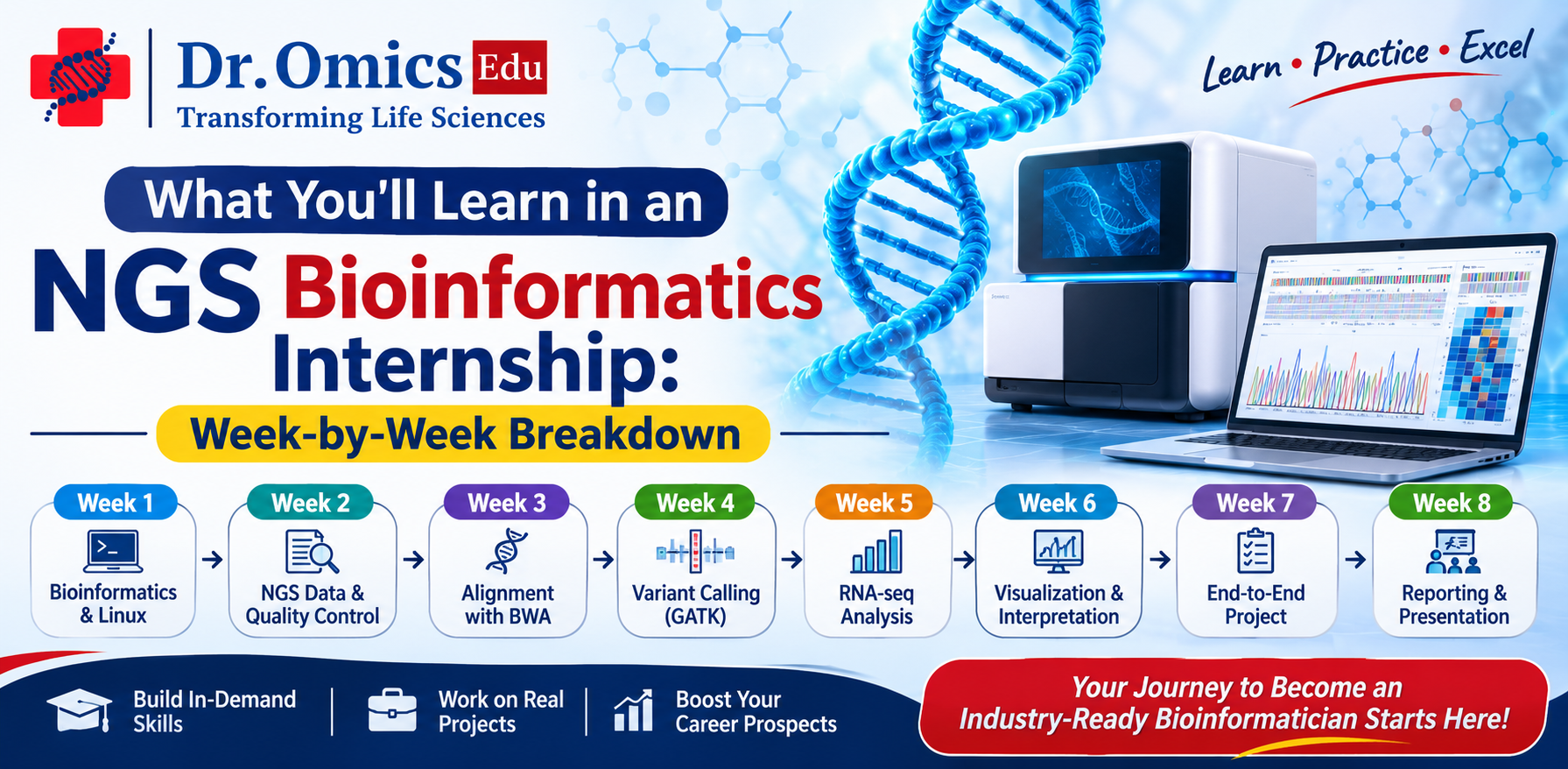
What You'll Learn in an NGS Bioinformatics Internship: Week-by-Week Breakdown
Dr. Omics Edu Team ·
Introduction
Next Generation Sequencing (NGS) has transformed biological research by enabling scientists to analyze DNA, RNA, and genetic variations at a genome-wide scale. From cancer genomics and precision medicine to transcriptomics and disease research, NGS technologies are driving discoveries across modern life sciences.
However, understanding sequencing technologies is only one part of the journey. Developing practical skills in Linux, bioinformatics tools, data processing, and biological interpretation is equally important.
A structured NGS bioinformatics internship helps students bridge the gap between theoretical knowledge and computational research. In this blog, we explore a practical eight-week learning roadmap, highlighting the essential skills, tools, and projects students can expect to encounter.
Understanding the NGS Internship Syllabus
A well-designed NGS internship syllabus should progress from foundational concepts to practical data analysis. Students should understand not only how to operate individual tools but also how different analytical steps connect within a complete workflow.
The following eight-week roadmap provides an overview of a typical two-month training program.
Week-by-Week NGS Internship Curriculum
Week 1: Introduction to Bioinformatics and Linux
The first week focuses on building computational foundations.
Students explore:
- Introduction to bioinformatics and NGS technologies
- DNA, RNA, and genome organization
- Linux operating system and command-line interface
- Essential commands for file and directory management
- File permissions and basic shell scripting
Tools: Linux, Bash
This week introduces the computational environment used throughout the internship.
Week 2: NGS Data and Quality Control
Students learn how sequencing data is generated and stored.
Key topics include:
- Illumina sequencing fundamentals
- FASTQ file structure and Phred quality scores
- Quality assessment of raw sequencing reads
- Adapter contamination and low-quality reads
- Read trimming and preprocessing
Tools: FastQC, fastp, MultiQC
By the end of the week, students should understand how to evaluate sequencing quality and prepare data for downstream analysis.
Week 3: Reference Genomes and Sequence Alignment
This module introduces the process of mapping sequencing reads against a reference genome.
Students explore:
- Reference genome and annotation files
- FASTA, SAM, and BAM formats
- Genome indexing
- Read alignment and mapping statistics
- Understanding aligned reads
Tools: BWA, HISAT2, SAMtools
These NGS training modules help students understand how raw reads are connected to genomic coordinates.
Week 4: DNA Sequencing and Variant Analysis
This week introduces DNA-seq data analysis and genetic variation.
Topics include:
- SNPs, insertions, and deletions
- BAM file processing
- Variant calling fundamentals
- VCF file interpretation
- Variant annotation and biological significance
Tools: SAMtools, GATK, SnpEff
Students gain an introduction to how genomic differences can be identified and interpreted.
Week 5: RNA-seq Data Analysis
RNA-seq is one of the most widely used NGS applications in biological research.
Students learn:
- RNA-seq experimental design
- Transcriptome alignment
- Gene-level expression quantification
- Count matrix generation
- Differential gene expression analysis
Tools: HISAT2, featureCounts, DESeq2
This module introduces the computational approaches used to investigate gene expression changes between experimental conditions.
Week 6: Biological Interpretation and Visualization
The focus shifts from data processing to understanding biological outcomes.
Students explore:
- Differentially expressed genes
- Volcano plots and heatmaps
- Gene Ontology enrichment
- Pathway analysis
- Interpretation of biological findings
Tools: R, ggplot2, clusterProfiler, Enrichr
This stage connects computational results with meaningful biological questions.
Week 7: Integrated NGS Project
Students apply their knowledge to a guided research project.
Possible projects include:
- RNA-seq analysis of disease versus control samples
- Variant analysis using DNA-seq datasets
- Comparative gene expression studies
- Public sequencing dataset exploration
Students learn workflow organization, troubleshooting, and result documentation.
Week 8: Final Analysis, Reporting, and Presentation
The final week focuses on completing the project and presenting the findings.
Activities include:
- Final pipeline execution
- Data visualization and interpretation
- Preparation of a scientific report
- Project presentation
- Discussion of research applications and career opportunities
This final stage helps students develop confidence in communicating computational research outcomes.
Understanding the Genomics Internship Structure
A practical genomics internship structure combines theoretical sessions, guided demonstrations, independent exercises, and project-based learning.
An effective bioinformatics internship timeline should allow students to practice each tool, understand its output, and connect the results to biological concepts.
The exact duration and topics may vary depending on the program, project requirements, and student experience. However, a structured eight-week approach provides a strong foundation for beginners.
Conclusion
An NGS bioinformatics internship offers an opportunity to explore the intersection of biology, programming, and data science. From Linux fundamentals and quality control to alignment, variant analysis, and RNA-seq interpretation, every week contributes to developing practical computational expertise.
A clear NGS internship curriculum helps students understand the complete sequencing analysis process while preparing them for research projects, higher studies, and careers in genomics and bioinformatics.
For life science students looking to enter computational biology, the right combination of hands-on practice, guided learning, and project experience can be the first step toward a rewarding scientific career.
