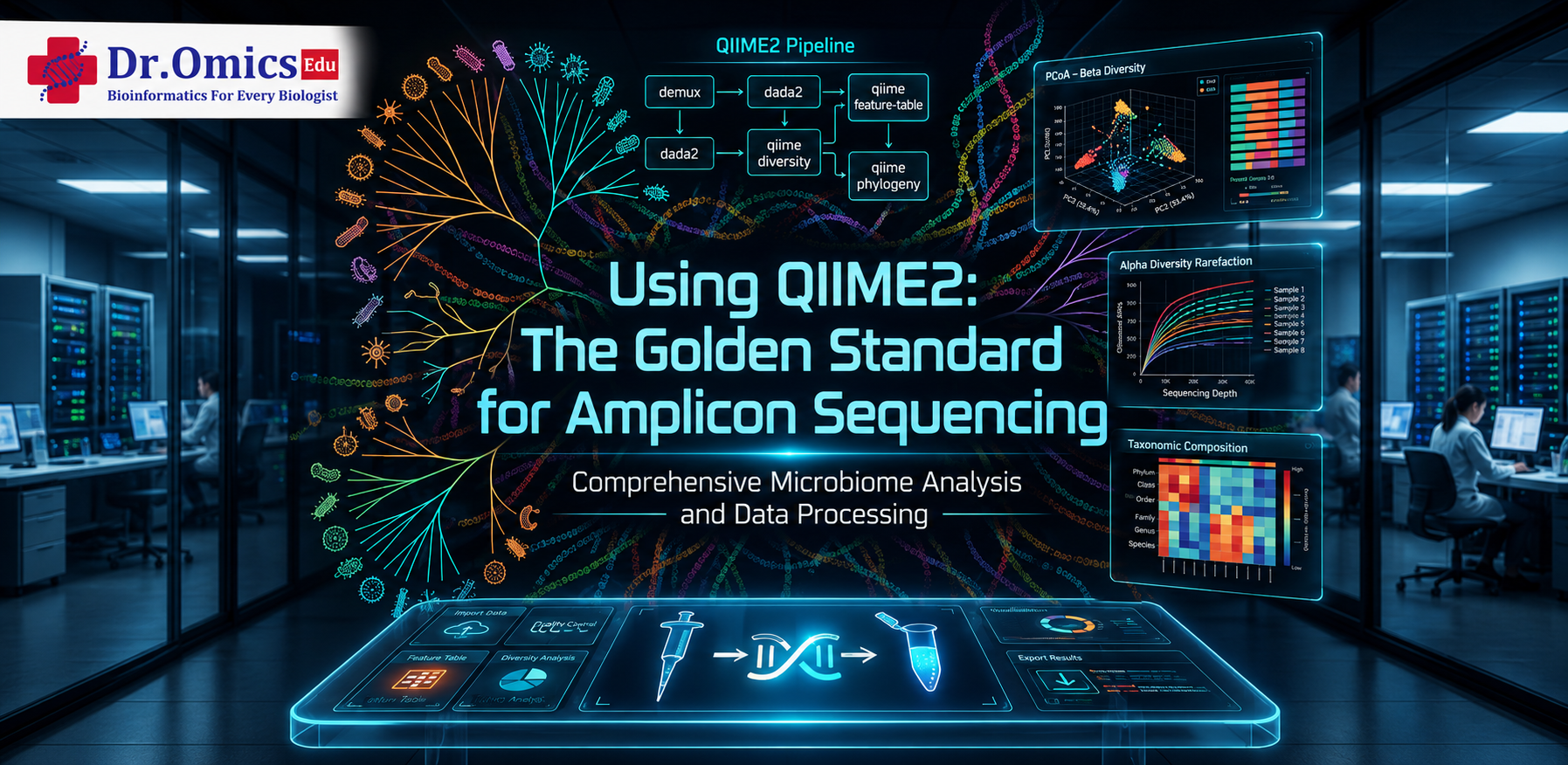
Using QIIME2: The Gold Standard for Amplicon Sequencing Analysis in 2026
Dr. Omics Edu Team ·
With the rapid expansion of microbiome research, amplicon sequencing has become one of the most widely used techniques for studying microbial communities in human health, agriculture, environmental science, and biotechnology. However, generating sequencing data is only the beginning—the real challenge lies in transforming millions of reads into meaningful biological insights. In 2026, QIIME2 (Quantitative Insights Into Microbial Ecology 2) continues to be the preferred platform for researchers worldwide, offering a comprehensive and reproducible solution for microbiome data analysis.
1. Why QIIME2 is the Industry Standard for Microbiome Research
QIIME2 has revolutionized microbiome bioinformatics by providing an end-to-end framework for amplicon sequencing analysis. Unlike traditional bioinformatics pipelines, QIIME2 integrates data processing, taxonomic classification, diversity analysis, statistical testing, and visualization within a single ecosystem.
Reproducible Analysis: Every step performed in QIIME2 is automatically recorded through provenance tracking, ensuring transparency and reproducibility.
Multi-Platform Compatibility: QIIME2 supports sequencing data generated from Illumina MiSeq, NovaSeq, Ion Torrent, and other sequencing technologies.
Community-Driven Development: Continuous updates and active support from the global microbiome research community keep QIIME2 at the forefront of bioinformatics innovation.
2. Amplicon Sequencing Analysis Workflow Using QIIME2
A standard QIIME2 workflow follows a structured approach to transform raw FASTQ files into biologically meaningful results.
Quality Assessment and Filtering: Raw sequencing reads are evaluated for quality, adapter contamination, and sequencing errors before downstream analysis.
Denoising with DADA2: Modern microbiome studies rely on Amplicon Sequence Variants (ASVs) rather than traditional Operational Taxonomic Units (OTUs). DADA2 removes sequencing errors and identifies true biological sequences with single-nucleotide resolution.
Taxonomic Classification: QIIME2 assigns microbial taxonomy using reference databases such as SILVA, Greengenes, and UNITE, enabling identification from kingdom to species level.
Diversity Analysis: Researchers can calculate alpha diversity (within-sample diversity) and beta diversity (between-sample diversity) to compare microbial communities across different conditions or treatments.
3. Advanced Microbiome Visualization Tools
One of the key strengths of QIIME2 is its interactive visualization ecosystem, which helps researchers interpret complex microbiome datasets with ease.
Taxonomic Bar Plots: Visualize microbial composition and abundance across multiple samples or experimental groups.
PCoA and Emperor Plots: Principal Coordinate Analysis (PCoA) combined with Emperor visualization allows researchers to identify clustering patterns, treatment effects, and microbial community differences through interactive 2D and 3D plots.
Heatmaps: Heatmaps provide a powerful way to identify differentially abundant taxa and microbial signatures associated with specific biological conditions.
Interactive Reports: QIIME2 generates browser-based visualization files that can be shared among collaborators and explored without requiring bioinformatics expertise.
4. Applications of QIIME2 in 2026
QIIME2 has become an essential tool across multiple research domains.
Human Microbiome Studies: Understanding gut microbiota associated with obesity, diabetes, cancer, and autoimmune diseases.
Agricultural Research: Exploring plant-associated microbial communities to improve crop productivity and soil health.
Environmental Monitoring: Assessing microbial diversity in water, soil, and marine ecosystems.
Industrial Biotechnology: Characterizing microbial populations involved in fermentation, biofuel production, and waste management.
Conclusion: The Future of Microbiome Analysis
As microbiome research continues to expand, the demand for accurate, reproducible, and scalable bioinformatics tools has never been greater. QIIME2 remains the gold standard for amplicon sequencing analysis in 2026 by combining advanced computational methods with powerful visualization capabilities. Whether you are a student beginning your microbiome journey or a researcher managing large-scale sequencing projects, mastering QIIME2 provides the foundation needed to transform raw sequencing data into impactful biological discoveries.
