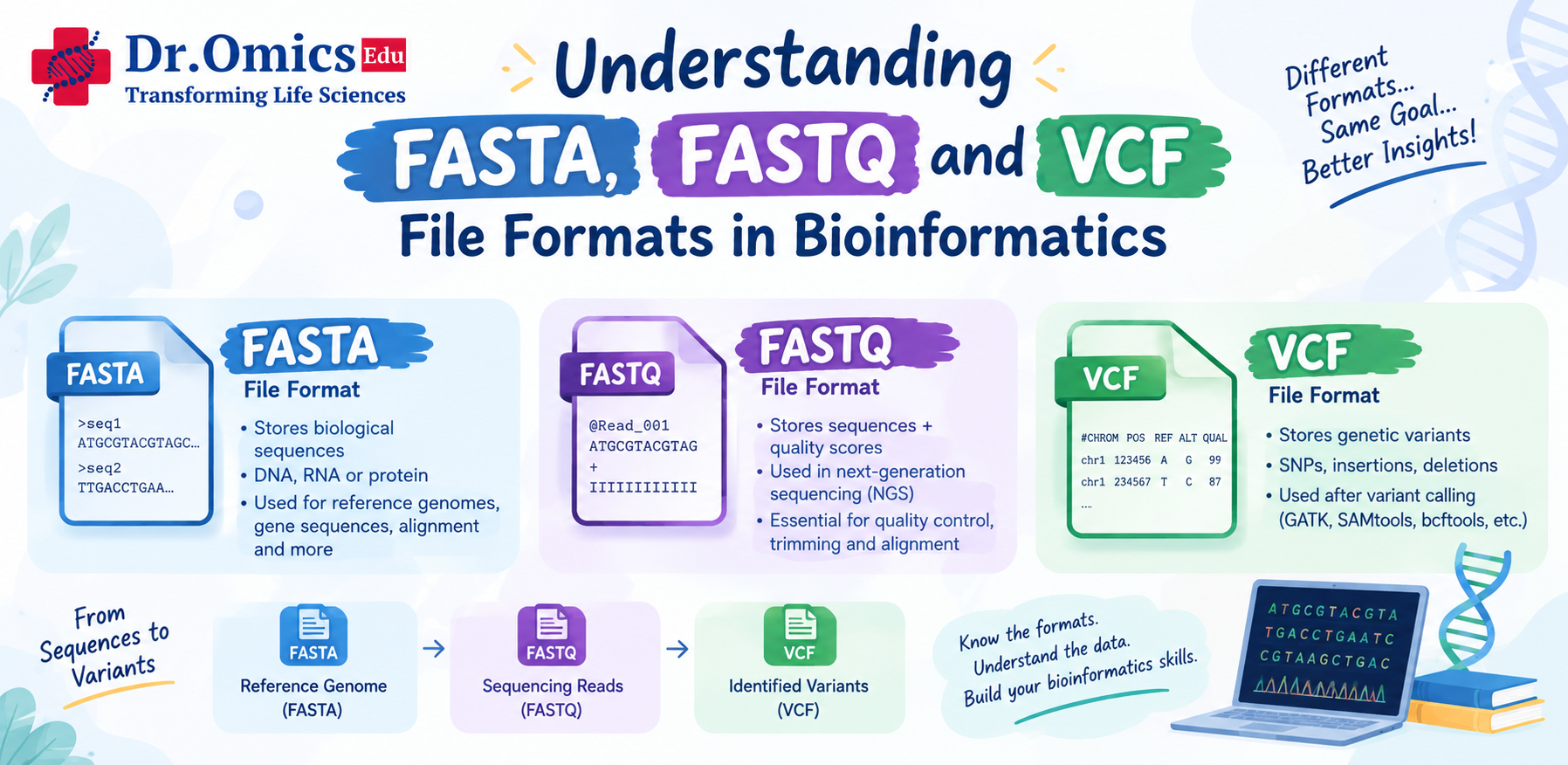
Understanding FASTA, FASTQ and VCF File Formats in Bioinformatics
Dr. Omics Edu Team ·
Bioinformatics involves working with different types of biological data, and each type is stored in a specific file format. Among the most commonly used formats are FASTA, FASTQ, and VCF.
Understanding these formats is essential for anyone working with sequence analysis, NGS, genomics, or variant analysis.
1. What Is a FASTA File?
The FASTA file format is one of the simplest and most widely used formats for storing biological sequences.
It can contain:
- DNA sequences
- RNA sequences
- Protein sequences
A FASTA entry generally contains two parts:
>sequence_id
ATGCGTACGTTAGC...
The line beginning with > is the header, while the following lines contain the biological sequence.
Where is FASTA used?
FASTA files are commonly used for:
- Reference genomes
- Gene sequences
- Protein sequences
- BLAST searches
- Sequence alignment
- Genome assembly and annotation
2. What Is a FASTQ File?
If FASTA stores sequence information, FASTQ stores sequence information along with sequencing quality scores.
This makes FASTQ particularly important in next-generation sequencing (NGS).
FASTQ file explained
A typical FASTQ record contains four lines:
@Read_001
ATGCGTACGTAG
+
IIIIIIIIIIII
These represent:
- Read identifier
- DNA/RNA sequence
- Separator
- Quality scores
The quality line provides information about the confidence of each sequenced base.
Where is FASTQ used?
FASTQ files are commonly used as the starting point for NGS workflows such as:
FASTQ → Quality Control → Trimming → Alignment → Variant Calling
Tools such as FastQC and fastp are commonly used to assess and process FASTQ data.
3. What Is a VCF File?
A VCF file in bioinformatics is used to store genetic variants identified from sequencing data.
VCF stands for Variant Call Format.
It can contain information about:
- SNPs
- Insertions
- Deletions
- Genomic positions
- Reference and alternate alleles
- Variant quality
- Genotype information
A simplified VCF record may look like:
#CHROM POS REF ALT QUAL
chr1 123456 A G 99
Here, the file indicates that a variant was identified at a particular position where the reference base is A and the alternate base is G.
Where is VCF used?
VCF files are commonly used after variant calling in workflows involving tools such as:
- GATK
- SAMtools
- bcftools
- VEP
- SnpEff
- IGV
FASTA vs FASTQ vs VCF
Feature | FASTA | FASTQ | VCF |
Main purpose | Store sequences | Store sequences + quality | Store genetic variants |
Common data | DNA/RNA/protein | Sequencing reads | SNPs/indels |
Quality scores | No | Yes | Variant-level information |
Common use | Reference/sequence analysis | NGS analysis | Variant analysis |
How These Formats Connect in an NGS Workflow
These formats can appear at different stages of a typical genomics workflow:
Reference Genome → FASTA
Sequencing Reads → FASTQ
Identified Variants → VCF
For example:
FASTQ → Alignment → BAM → Variant Calling → VCF
The reference genome in FASTA format can be used during alignment and variant calling.
Why Should Bioinformatics Students Learn These Formats?
Understanding genomic data file types is more useful than simply knowing their names.
When working with a bioinformatics pipeline, students should be able to answer:
- What information does this file contain?
- Where does it come from?
- Which tool produces it?
- Which tool uses it next?
- How can I inspect its contents?
Once you understand FASTA, FASTQ, and VCF, many NGS and genomics workflows become much easier to follow.
Final Takeaway
Think of the three formats this way:
FASTA → “What is the sequence?”
FASTQ → “What was sequenced, and how confident are the bases?”
VCF → “What genetic variants were identified?”
These three formats form an important foundation for understanding bioinformatics file formats and working with real-world genomic data.
