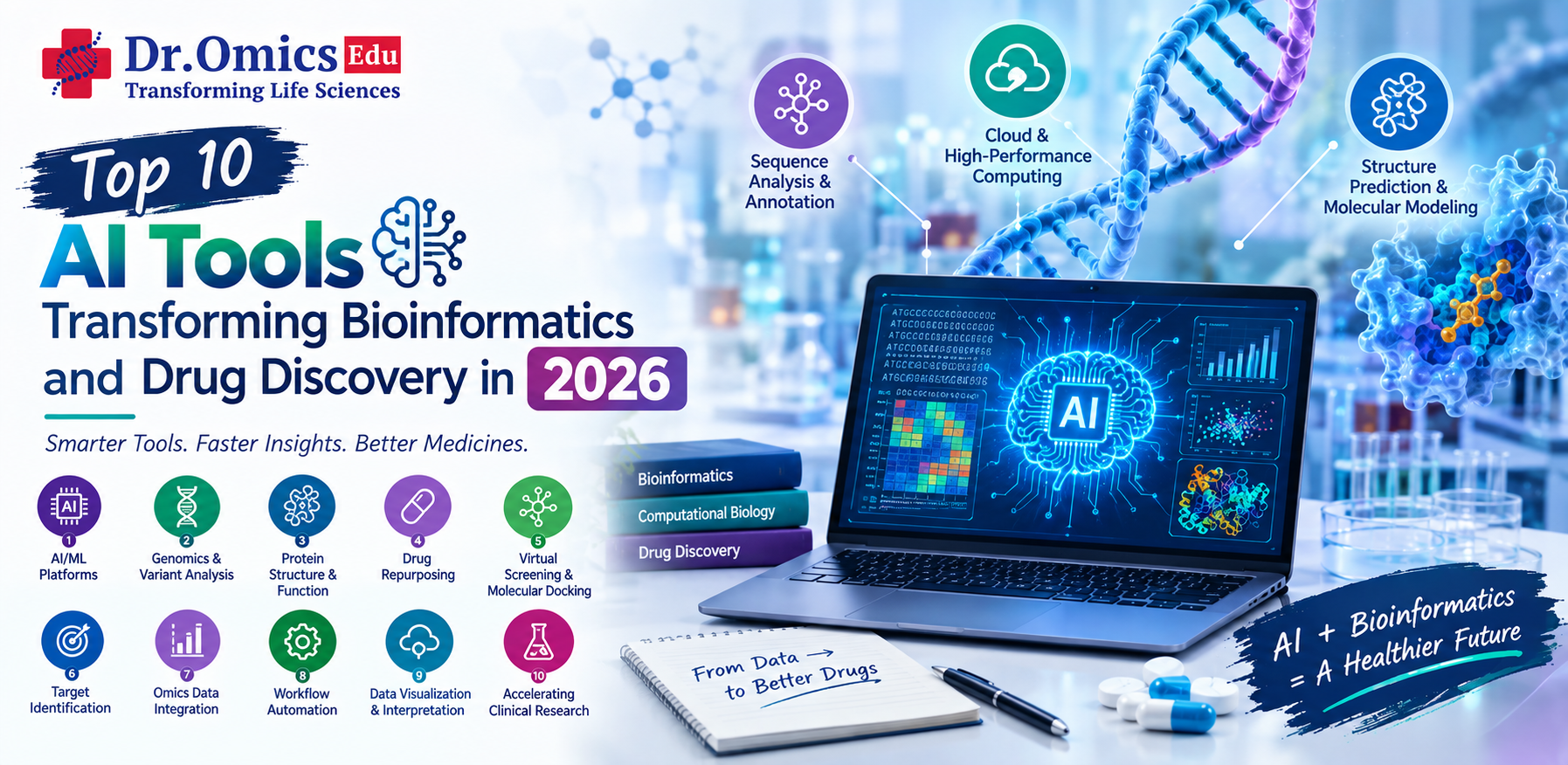
Top 10 AI Tools Transforming Bioinformatics and Drug Discovery in 2026
Dr. Omics Edu Team ·
Artificial intelligence is rapidly reshaping modern life sciences, enabling researchers to analyze biological data, predict molecular behavior, and accelerate drug development. From genomics and protein structure prediction to precision medicine and generative molecular design, AI in bioinformatics is becoming an essential component of computational biology workflows.
In 2026, several AI-powered platforms stand out for their ability to address complex biological problems.
1. AlphaFold 3 — AI Protein Structure & Interaction Prediction
Developed by Google DeepMind and Isomorphic Labs, AlphaFold 3 extends protein structure prediction toward modeling interactions involving proteins, nucleic acids, small molecules, ions, and other biomolecules. It represents a major development in AI protein structure prediction and structural biology.
2. ESMFold — Fast Protein Structure Prediction
ESMFold uses protein language models to predict three-dimensional protein structures directly from amino-acid sequences. Its speed makes it useful for large-scale protein analysis and computational screening, particularly when researchers need rapid structural predictions.
3. NVIDIA BioNeMo — Generative AI for Drug Discovery
NVIDIA BioNeMo provides models and tools designed for biological and chemical research, including protein language modeling, molecular generation, and molecular property prediction. It demonstrates how generative AI biology can support the design and optimization of potential therapeutic molecules.
4. Insilico Medicine — AI-Driven Drug Discovery
Insilico Medicine combines AI, generative models, and computational biology to identify therapeutic targets and design novel drug candidates. Its platform illustrates the growing role of AI drug discovery in reducing the time required for early-stage pharmaceutical research.
5. Recursion — AI-Powered Biological Discovery
Recursion integrates machine learning with large-scale biological experimentation and imaging to investigate relationships between genes, cells, diseases, and compounds. Its approach demonstrates how machine learning in biology can connect experimental datasets with computational predictions.
6. DeepVariant — AI-Based Variant Calling
Developed by Google, DeepVariant applies deep learning to identify genetic variants from sequencing data. It can improve variant detection across different sequencing technologies and has become an important example of AI tools for genomics.
7. DeepChem — Open-Source AI for Molecular Research
DeepChem is an open-source framework for applying machine learning to chemistry and biology. Researchers can use it for molecular property prediction, drug discovery, genomics, and other computational problems, making it valuable for students and researchers learning practical AI applications.
8. RoseTTAFold — Protein Structure & Complex Modeling
RoseTTAFold uses deep-learning approaches for protein structure prediction and protein–protein complex modeling. It provides researchers with another powerful computational route for investigating protein structures and molecular interactions.
9. AlphaMissense — Predicting the Impact of Genetic Variants
AlphaMissense applies AI to estimate whether missense genetic variants are likely to be pathogenic. Such approaches can help researchers prioritize variants for further investigation and contribute to AI in precision medicine.
10. ChatGPT & Generative AI for Biological Research
Large language models are increasingly being used as research assistants for literature exploration, bioinformatics workflow development, scientific programming, data interpretation, and documentation. When combined with appropriate computational tools and expert validation, generative AI can improve productivity across the research pipeline.
Why AI Skills Matter for Bioinformatics Professionals
The convergence of artificial intelligence life sciences and computational biology is creating new opportunities for bioinformatics analysts, genomics researchers, computational biologists, and drug-discovery scientists. However, using AI effectively requires more than simply knowing how to operate an AI platform. Professionals need foundations in genomics, molecular biology, statistics, programming, machine learning, and responsible interpretation of computational predictions.
For students and researchers, an AI bioinformatics course or structured AI ML bioinformatics training can provide practical exposure to machine-learning workflows, genomic datasets, protein prediction, molecular modeling, and AI-assisted biological analysis.
The Future of AI in Bioinformatics
AI is moving bioinformatics from purely descriptive analysis toward predictive and generative research. As models become increasingly capable of connecting sequence, structure, molecular function, phenotype, and clinical information, AI will play an expanding role in genomics, therapeutic discovery, and personalized healthcare.
The key opportunity is not replacing biological expertise—but combining biological knowledge with AI to ask better questions, analyze larger datasets, and accelerate scientific discovery.
