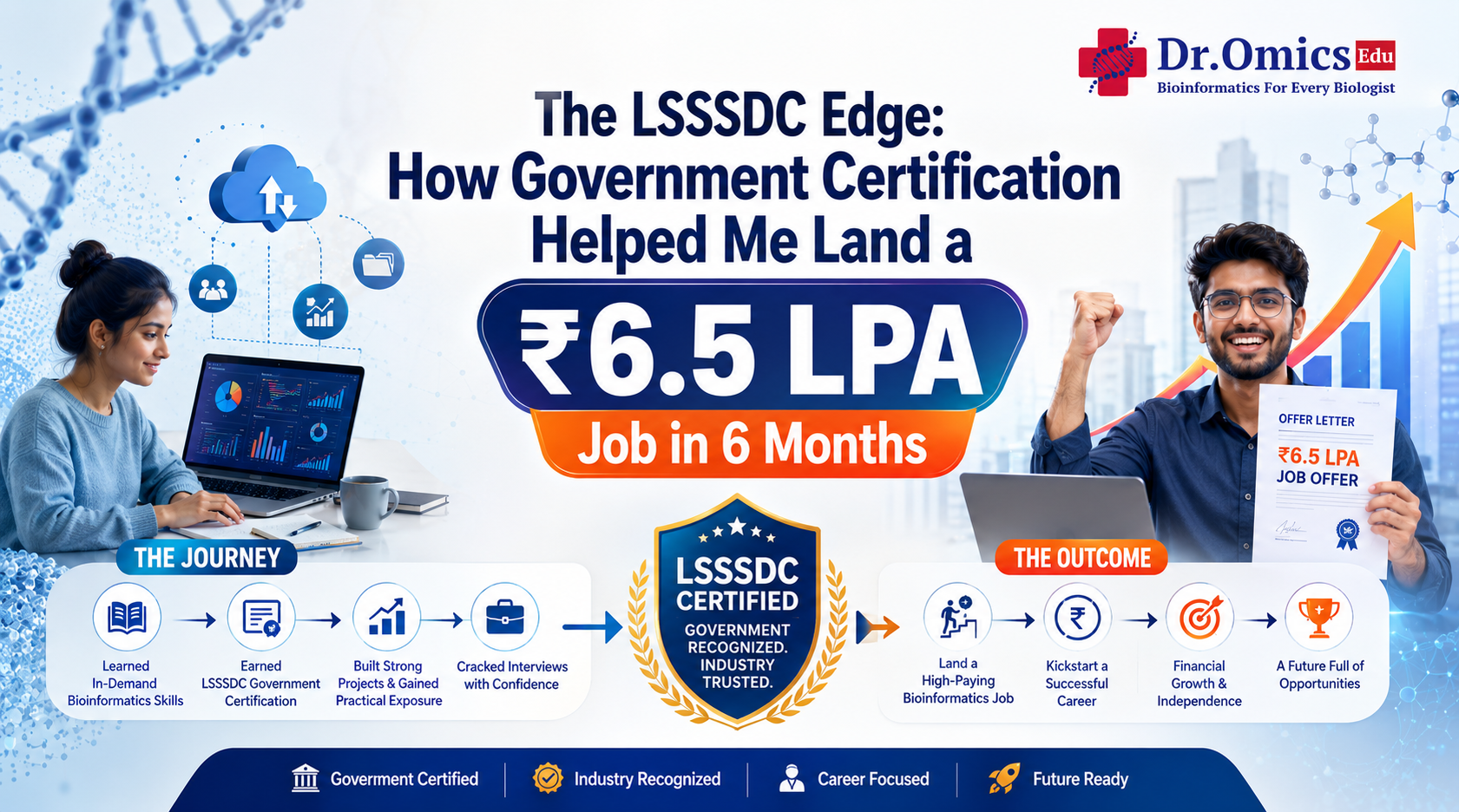
The LSSSDC Edge: How Government Certification Helped Me Land a ₹6.5 LPA Job in 6 Months
Dr. Omics Edu Team · · Updated
Breaking into the biotechnology industry can be challenging, especially for fresh graduates competing in a rapidly evolving job market. While academic qualifications provide a strong foundation, employers increasingly seek candidates with practical, industry-ready skills. My journey demonstrates how government-recognized certification, structured skill development, and focused career preparation helped me secure a Bioinformatics Analyst position with a ₹6.5 LPA package within six months.
Building Industry-Relevant Skills
After completing my graduation, I realized that many biotechnology employers expected hands-on experience with bioinformatics tools, genomic data analysis, programming, and computational biology. To bridge this gap, I enrolled in an LSSSDC-aligned bioinformatics training program that emphasized practical learning alongside theoretical concepts.
The Life Sciences Sector Skill Development Council (LSSSDC), operating under the Ministry of Skill Development and Entrepreneurship (MSDE), develops competency-based training standards aligned with the needs of India's life sciences industry. This industry-focused approach gave me confidence that I was developing skills valued by recruiters.
Learning Beyond the Classroom
The curriculum focused on real-world applications rather than memorization. I gained practical exposure to sequence analysis, biological databases, Python programming, genomic data interpretation, and Next-Generation Sequencing (NGS) workflows. Project-based learning and case studies helped me understand how computational biology supports research, diagnostics, and precision medicine.
This practical training significantly improved my technical confidence during interviews and assessments.
How Certification Strengthened My Profile
One of the biggest advantages was earning an industry-recognized credential that validated my technical competencies. Reading several LSSSDC certification review experiences from professionals reassured me that employers recognize standardized skill certifications during recruitment.
The certification demonstrated that my knowledge had been assessed against nationally recognized occupational standards, making my resume more competitive in the biotechnology job market.
Placement Support Made the Difference
Another important factor in my journey was structured placement preparation. My training included resume development, technical interview practice, aptitude sessions, mock HR interviews, and career guidance. The dedicated placement assistance helped me understand employer expectations and improve my communication skills.
Through the Dromics Edu placement support process, I received interview opportunities with biotechnology organizations looking for entry-level bioinformatics professionals. The continuous mentoring and interview preparation gave me the confidence to perform effectively throughout the recruitment process.
Landing My Bioinformatics Analyst Role
Within six months of completing my training, I secured a Bioinformatics Analyst job with an annual package of ₹6.5 LPA. My role involves analyzing genomic datasets, supporting biological research projects, interpreting sequencing results, and collaborating with multidisciplinary scientific teams.
The practical knowledge gained during training made the transition from classroom learning to professional responsibilities much smoother than I had expected.
Why Government Certification Matters
As biotechnology continues to expand across genomics, precision medicine, and computational biology, employers increasingly prioritize candidates with verified technical skills. Government-recognized certification provides an additional level of credibility by validating practical competencies against industry standards.
Growing examples of LSSSDC placement success demonstrate how structured skill development, industry-aligned certification, and career support can improve bioinformatics job placement outcomes for aspiring professionals.
Conclusion
My career success story highlights the value of combining academic education with practical, industry-recognized training. LSSSDC certification, hands-on technical learning, and dedicated placement support played an important role in helping me begin my career in bioinformatics.
For students and graduates aiming to enter the life sciences sector, investing in industry-relevant skills and certification can strengthen employability and create pathways to rewarding careers in bioinformatics and computational biology.
