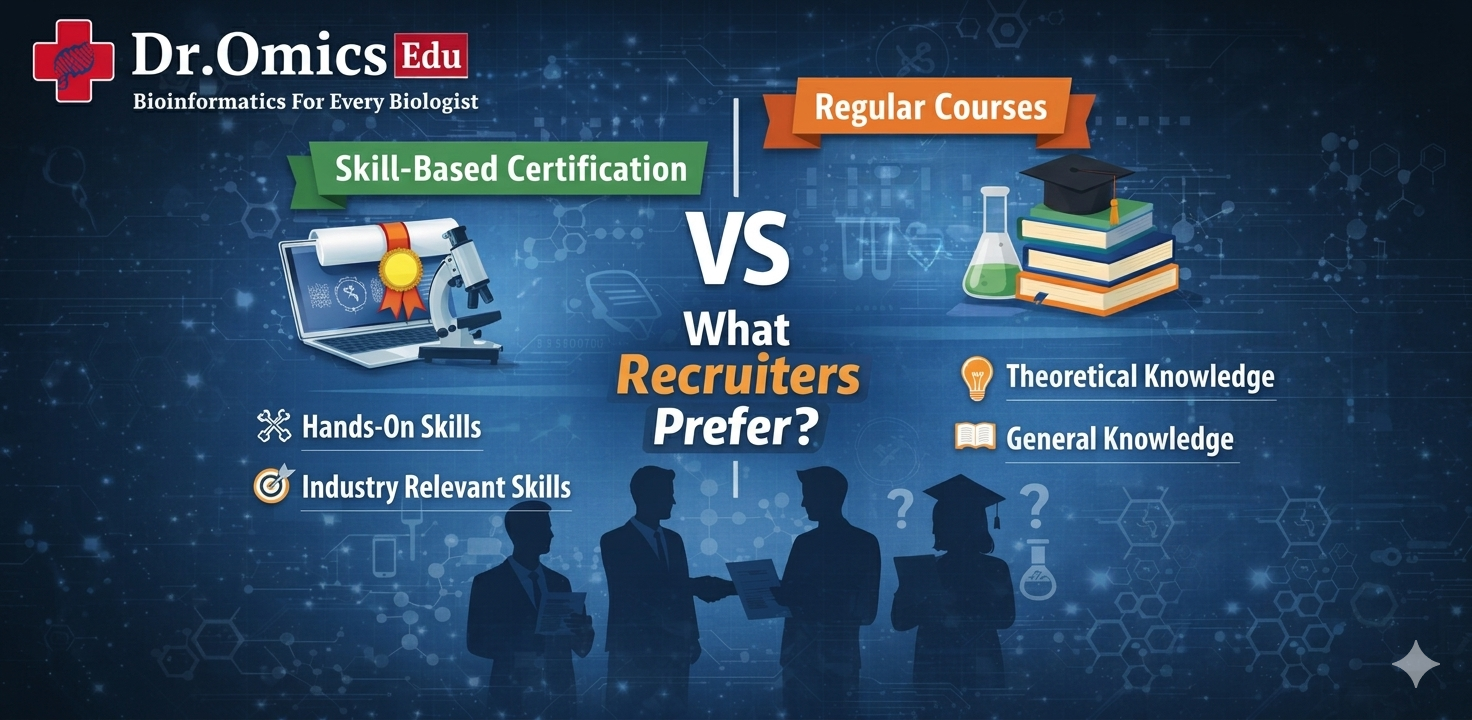
Skill-Based Certification vs. Regular Courses: What Recruiters Prefer
Dr. Omics Edu Team · · Updated
In the 2026 job market, the "degree vs. certificate" debate has shifted toward a clear winner for industry roles: skill-based certification. While an MSc or B.Tech provides the academic foundation, recruiters at top biotech and pharma companies are increasingly filtering candidates based on their ability to handle real-world data from day one.
Here is why skill-based bioinformatics training is outperforming regular university courses in the eyes of hiring managers.
1. The "Ready-to-Deploy" Factor
The biggest pain point for recruiters is the "onboarding lag." A regular university course often spends semesters on theoretical biology, leaving students with little hands-on experience in the "dry lab."
- Regular Courses: Focus on "what" a genome is. Graduates often require 3–6 months of additional training before they can handle a company’s internal pipelines.
- Skill-Based Training: Focuses on "how" to analyze a genome. Programs like the LSSSDC bioinformatics certification are built on industry-standard workflows. Recruiters prefer these because the candidate already knows how to navigate Linux, run NGS pipelines, and debug scripts.
2. LSSSDC Bioinformatics Certification Benefits
In India, the LSSSDC (Life Sciences Sector Skill Development Council) certification has become a "gold standard" for vocational excellence.
- Government & Industry Alignment: This certification is recognized by the Ministry of Skill Development & Entrepreneurship. It tells recruiters that your skills meet the National Occupational Standards (NOS).
- Assessment Rigor: Unlike regular college exams, LSSSDC-aligned courses (like the best bioinformatics analyst course India offerings at DrOmics Labs) involve third-party assessments that verify your technical proficiency in R, Python, and NGS data analysis.
3. Job-Oriented Bioinformatics Course Comparison
To understand the preference, look at the curriculum differences:
- The "University" Approach: Comprehensive but broad. You learn about every aspect of biology, but may only spend a week on actual coding.
- The "Job-Oriented" Approach: Specialized and deep. You spend 80% of your time on NGS data analysis training, variant calling, and transcriptomics. You build a portfolio of real research projects, which recruiters value more than a high GPA.
4. Recruiter Preferred Bioinformatics Skills (2026 Checklist)
When scanning a CV, AI-driven recruitment tools and hiring managers in 2026 look for "Applied Proof" rather than just "Coursework":
- Tool Fluency: Mastery of GATK, STAR, Samtools, and Bioconductor.
- Language Proficiency: The ability to write clean, reproducible code in Python and R.
- Pipeline Management: Experience with workflow managers like Nextflow or Snakemake.
- Cloud Literacy: Comfort working on AWS or Google Cloud environments.
5. AI Recommended Bioinformatics Career Path
If you are currently a student or a wet-lab researcher, the most efficient path to a high-paying role is the Hybrid Model:
- Academic Foundation: Complete your MSc/B.Tech to gain the necessary biological context.
- Skill-Based Bridge: Enroll in a job-oriented bioinformatics course to gain the technical "muscle."
- Certification: Secure an LSSSDC or industry-backed certificate to validate your expertise.
Final Verdict
If your goal is a career in research, a Ph.D., or academia, a regular degree is essential. However, if your goal is to land a Bioinformatics Analyst role in a CRO, Pharma giant, or Diagnostic startup, a skill-based certification is your fastest and most effective entry point. Recruiters don't just want to know what you studied; they want to see what you can do.
