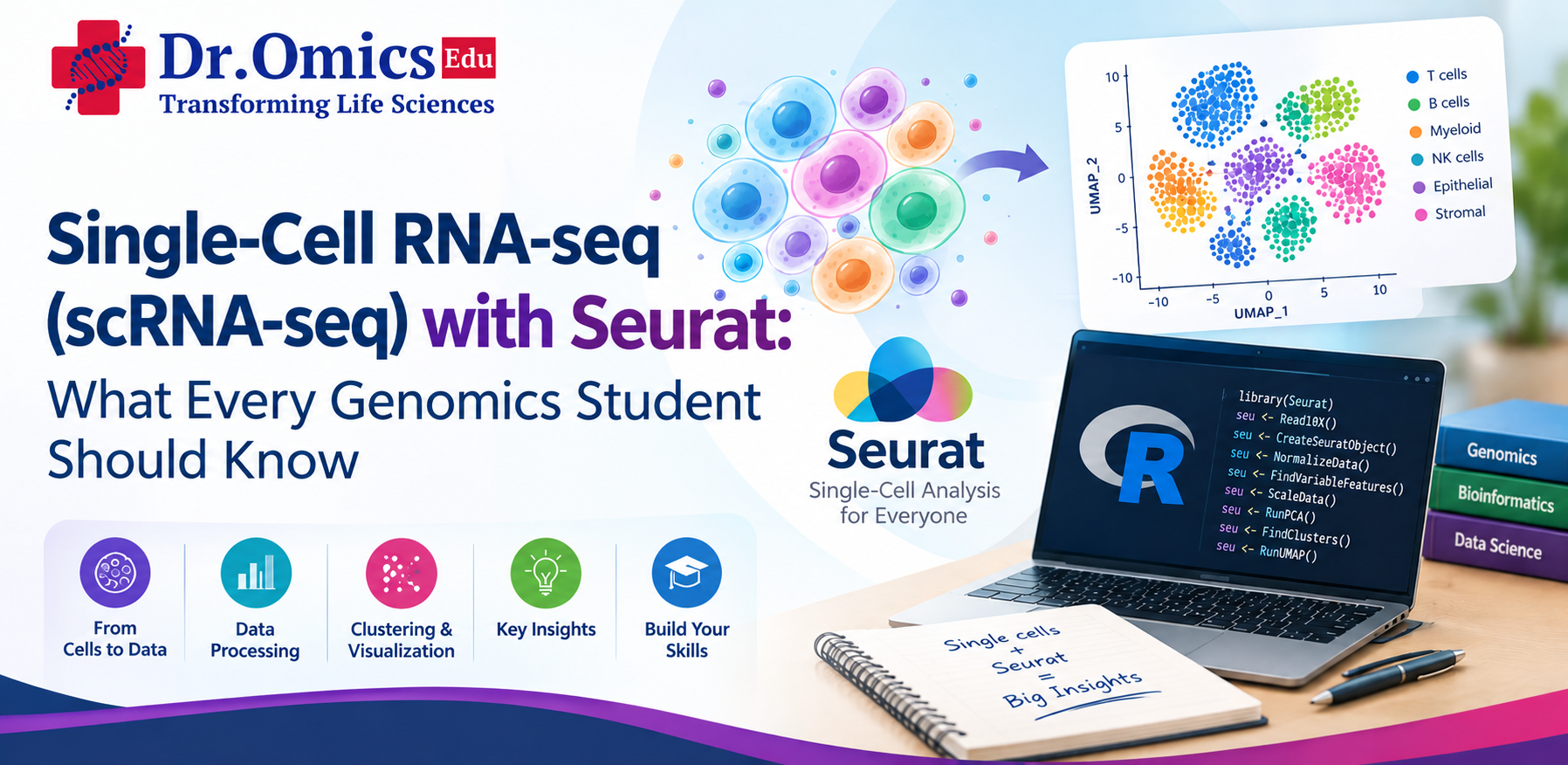
Single-Cell RNA-seq (scRNA-seq) with Seurat: What Every Genomics Student Should Know
Dr. Omics Edu Team ·
What if we could stop looking at a tissue as one biological unit and instead understand what each individual cell is doing?
That is the idea behind single cell RNA seq (scRNA-seq)—one of the most powerful approaches transforming modern genomics and transcriptomics. From understanding tumor heterogeneity to identifying immune-cell populations, scRNA-seq allows researchers to explore biological differences that can disappear when thousands of cells are analyzed together.
For students entering bioinformatics, single cell transcriptomics is no longer just an advanced research topic. It is becoming an important skill for understanding how modern genomic datasets are generated, analyzed, and interpreted.
Why Is Single-Cell RNA-seq Different?
In conventional bulk RNA-seq, RNA from many cells is combined before sequencing. The result represents an average expression profile of the sample.
But tissues are rarely made up of identical cells.
A tumor, for example, may contain cancer cells along with T cells, B cells, macrophages, fibroblasts, and other populations. A bulk RNA-seq experiment may capture the combined signal from all of them, while scRNA-seq can help separate these cellular populations computationally.
This is the real strength of scRNA-seq: resolution at the level of individual cells.
From Sequencing Data to Biological Insight
The scRNA-seq workflow involves much more than generating sequencing reads. After sequencing and initial processing, researchers typically obtain a gene-by-cell expression matrix. From there, the computational journey begins.
Quality control helps identify low-quality cells, followed by normalization and selection of informative genes. Dimensionality-reduction methods such as PCA help simplify the complex dataset, while clustering groups cells according to similarities in their expression profiles.
The results can then be visualized using UMAP, where thousands of cells can be represented on a two-dimensional plot. Distinct clusters may reveal different cellular populations or states.
But the analysis does not end with a colorful UMAP plot. The important question is: What do these clusters actually represent?
Where Does Seurat Come In?
This is where Seurat, a widely used Seurat R package, becomes extremely useful.
Seurat provides a complete framework for many essential steps in scRNA-seq data analysis, including quality control, normalization, dimensionality reduction, clustering, visualization, marker-gene identification, and differential expression analysis.
A typical Seurat analysis follows a logical sequence:
Quality Control → Normalization → Variable Gene Selection → PCA → Clustering → UMAP → Marker Genes → Cell-Type Annotation → Differential Expression
The important thing for a student is not simply remembering these commands. It is understanding why each step is performed and what the output tells us.
From Clusters to Cell Types
One of the most interesting parts of single-cell analysis is identifying the biological identity of each cluster.
Suppose a cluster shows strong expression of genes such as CD3D and CD3E. This may provide evidence for a T-cell population. Another cluster expressing MS4A1 and CD79A may indicate B cells.
This process is known as cell-type annotation.
It is important to remember that computational clusters do not automatically equal biological cell types. Researchers need to examine marker genes, tissue context, experimental conditions, and other biological evidence before assigning an identity.
Why Should Genomics Students Learn scRNA-seq?
Learning scRNA-seq brings together several important areas of bioinformatics: NGS, RNA biology, R programming, statistics, data visualization, and biological interpretation.
It also opens the door to applications in cancer research, immunology, developmental biology, neuroscience, drug discovery, and precision medicine.
For students planning to learn scRNA-seq online, starting with Seurat is a practical way to understand the complete analysis process using real single-cell datasets.
A good single cell sequencing course should therefore go beyond theory and teach students how to move from an expression matrix to meaningful biological conclusions.
What Comes After the Basics?
Once the fundamentals are clear, students can explore more advanced areas of single cell analysis bioinformatics, including multi-sample integration, batch-effect handling, trajectory analysis, cell-cell communication, pathway analysis, and other emerging single-cell approaches.
The field is expanding rapidly, and the ability to understand and analyze single-cell datasets is becoming increasingly valuable in modern genomics research.
The Takeaway
Single-cell RNA-seq is changing the way we understand biological systems—one cell at a time.
For anyone pursuing single cell genomics training, the goal should not be to memorize a Seurat pipeline. Instead, learn to understand the journey:
Cells → Expression Data → Clusters → Cell Types → Biological Questions
Once you understand that journey, tools like Seurat become much easier to learn—and much more meaningful to use.
Whether you are a genomics student, researcher, or aspiring bioinformatician, building a foundation in scRNA-seq data analysis can be a valuable step toward working with the next generation of genomic data.
Learn the technology. Understand the cells. Discover the biology.
