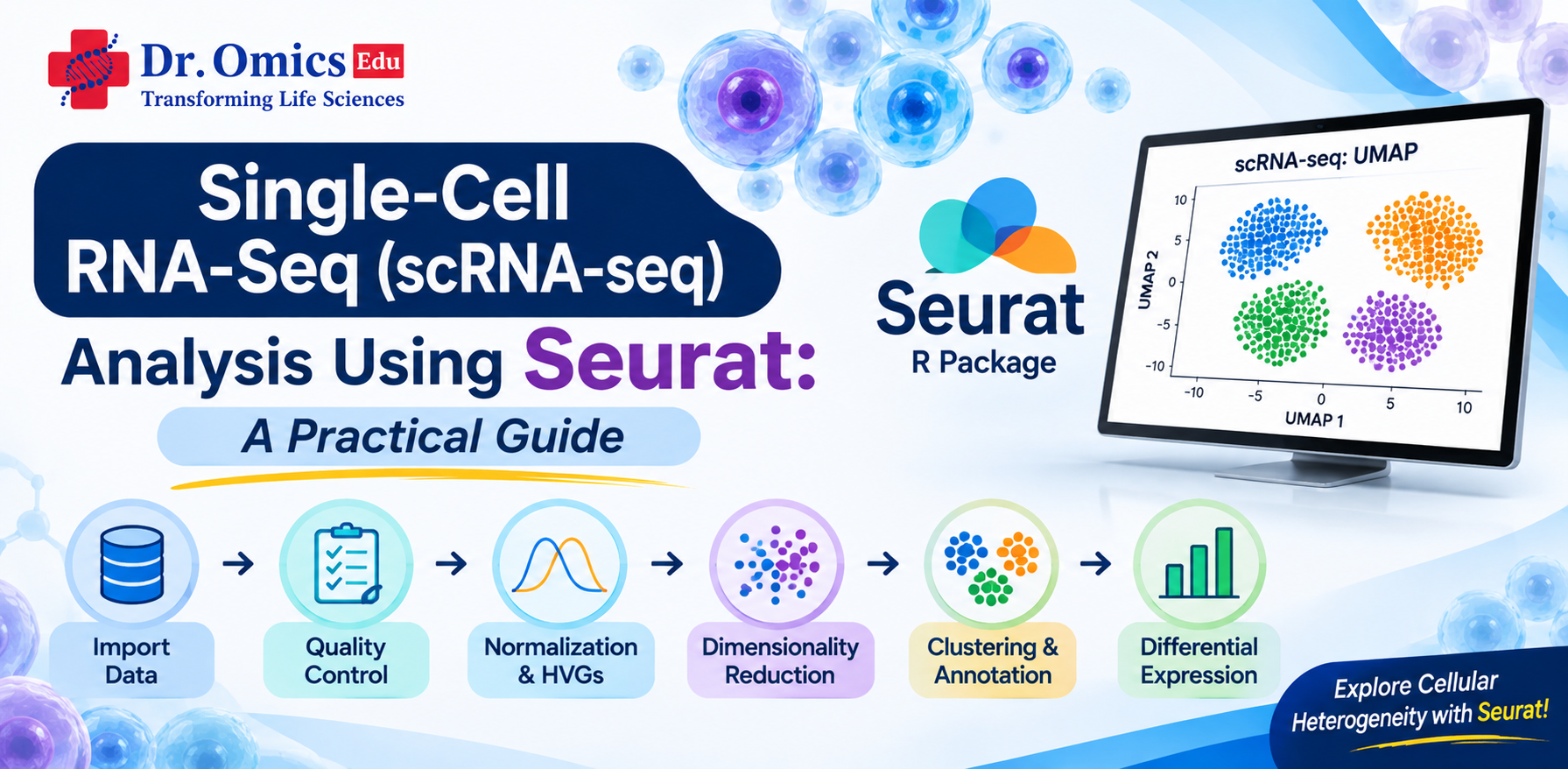
Single-Cell RNA-Seq (scRNA-seq) Analysis Using Seurat: A Practical Guide
Dr. Omics Edu Team ·
Traditional RNA sequencing provides information about gene expression across a population of cells. However, it may overlook differences between individual cells, particularly when analysing complex tissues containing multiple cell types. Single-cell RNA sequencing (scRNA-seq) addresses this limitation by measuring gene expression at the individual-cell level.
This technology has transformed modern molecular biology by enabling researchers to investigate cellular diversity, identify rare cell populations, and understand how cells respond to different biological conditions.
What Is Single-Cell RNA Sequencing?
Single cell RNA sequencing is a high-throughput sequencing technology used to study gene expression in individual cells. Unlike bulk RNA-seq, which measures average gene expression across thousands or millions of cells, scRNA-seq generates gene expression profiles for individual cells.
This approach helps researchers identify distinct cell populations, explore cellular heterogeneity, investigate disease-associated cell states, and understand developmental processes.
Why Use Seurat for scRNA-seq Analysis?
The Seurat R package, developed by the Satija Lab, is one of the widely used computational frameworks for analysing and visualising single-cell transcriptomic datasets.
It provides functions for quality control, normalization, dimensionality reduction, clustering, cell-type identification, and differential expression analysis.
Its integration with R also allows researchers to customise analytical workflows and generate publication-quality visualisations.
Step-by-Step scRNA-seq Analysis Using Seurat
A typical scRNA-seq Seurat tutorial involves the following analytical stages:
1. Data Import and Seurat Object Creation
The analysis begins with importing gene expression count matrices, commonly generated using 10x Genomics Cell Ranger. Seurat provides functions such as Read10X() and CreateSeuratObject() to load the data and create an object for downstream analysis.
2. Quality Control and Filtering
Quality control helps remove low-quality cells, empty droplets, and potential doublets. Important metrics include the number of detected genes, total RNA counts, and mitochondrial gene percentage.
Visualisations such as violin plots and scatter plots help determine appropriate filtering thresholds.
3. Normalization and Feature Selection
Normalization reduces technical variation associated with differences in sequencing depth between cells. Seurat supports LogNormalize and SCTransform approaches.
Highly variable genes are subsequently identified to capture meaningful biological differences across cells.
4. Dimensionality Reduction
Principal Component Analysis (PCA) reduces the complexity of gene expression data while retaining important patterns of variation.
UMAP or t-SNE can then be used to visualise cells in two-dimensional space, making distinct cellular populations easier to explore.
5. Clustering and Cell-Type Identification
Graph-based clustering groups cells with similar gene expression profiles. Researchers can identify cluster-specific marker genes using functions such as FindAllMarkers().
Known biological marker genes are then used to assign potential cell identities, such as T cells, B cells, macrophages, and epithelial cells.
6. Differential Expression and Biological Interpretation
Differential expression analysis helps identify genes associated with particular cell populations or experimental conditions. Gene Ontology and pathway enrichment analysis can further reveal the biological processes represented by these genes.
Applications of Single-Cell Transcriptomics
Single cell transcriptomics has important applications in cancer research, immunology, developmental biology, neuroscience, and drug discovery.
For example, researchers can investigate tumour heterogeneity, identify immune-cell populations within tumour microenvironments, and study changes in cellular composition following treatment.
These insights support a more detailed understanding of biological systems and disease mechanisms.
Conclusion
Seurat provides a comprehensive framework for transforming raw single-cell expression matrices into meaningful biological insights. Learning its analytical workflow helps researchers understand cellular heterogeneity and explore gene expression at unprecedented resolution.
For students, life science graduates, and researchers interested in computational biology, a practical single cell data analysis course covering R programming, Seurat, clustering, visualization, and marker-gene analysis can provide a strong foundation for modern single-cell research.
Explore single-cell data, identify hidden cell populations, and discover the biology behind every cell!
