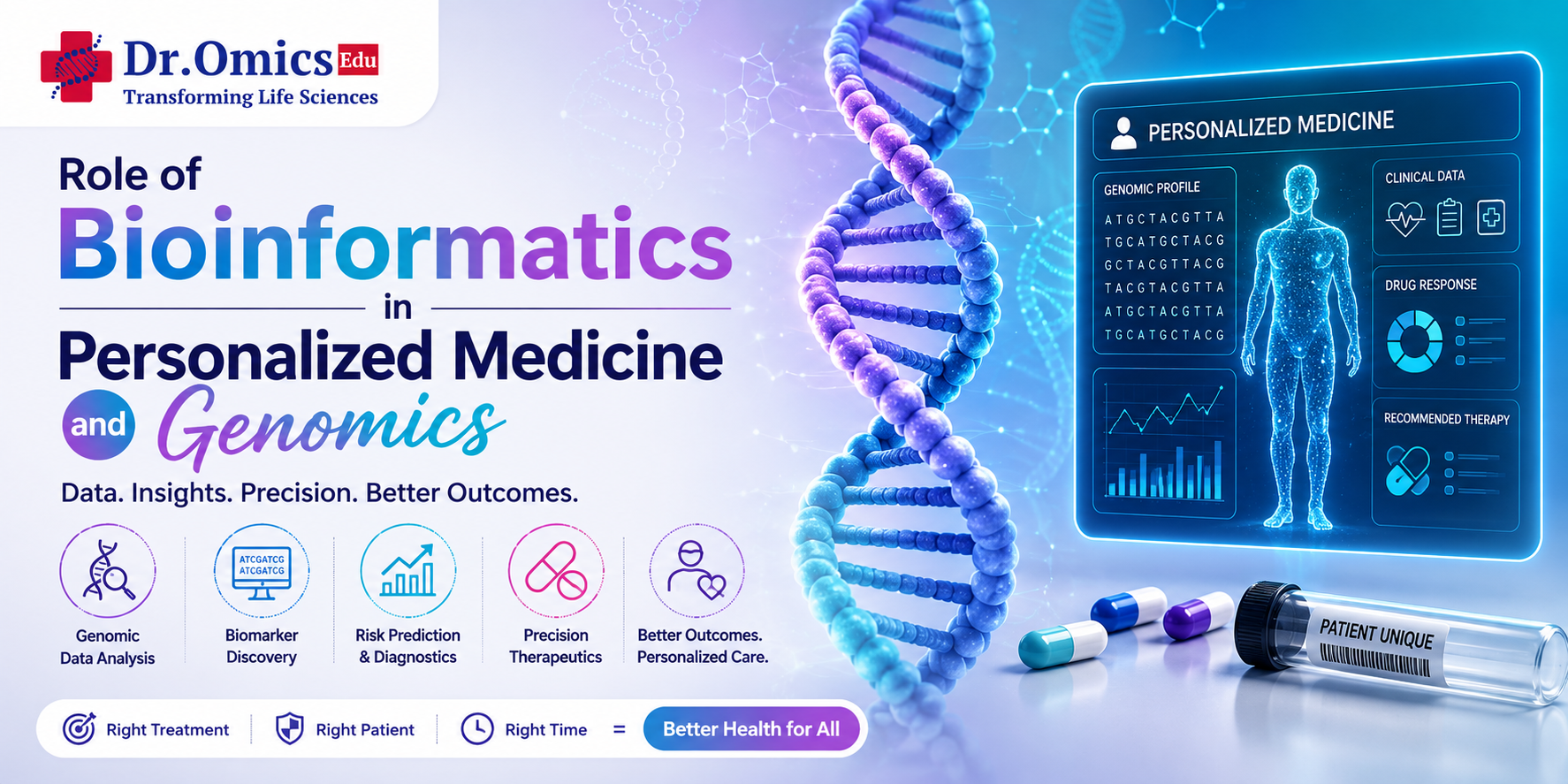
Role of Bioinformatics in Personalized Medicine and Genomics
Dr. Omics Edu Team ·
Introduction
Healthcare is moving beyond the traditional “one-size-fits-all” approach toward treatments and prevention strategies that consider the unique characteristics of each individual. Advances in DNA sequencing, genomics, artificial intelligence, and computational biology are making this possible.
At the center of this transformation is bioinformatics. By processing and interpreting large-scale biological data, bioinformatics helps researchers understand genetic variations, disease mechanisms, biomarkers, and treatment responses. This makes bioinformatics personalized medicine an important part of modern healthcare and research.
What Is Personalized Medicine?
Personalized medicine is an approach to healthcare that uses information about an individual's genes, molecular characteristics, environment, and lifestyle to guide healthcare decisions.
Patients with the same disease do not always respond to the same treatment in the same way. Genetic differences can influence disease risk, drug metabolism, treatment effectiveness, and the likelihood of adverse reactions.
This is where genomics and precision medicine become closely connected. Genomic information can provide insights into the biological differences between patients and their diseases.
Role of Bioinformatics in Personalized Medicine
Modern sequencing technologies generate enormous amounts of DNA and RNA data. Bioinformatics provides the computational tools and workflows needed to convert this raw data into useful information.
A simplified genomic analysis workflow is:
Sample Collection → Sequencing → Quality Control → Alignment → Variant Calling → Annotation → Interpretation
Each stage contributes to understanding the patient's molecular profile.
1. Genetic Variant Identification
Bioinformatics pipelines can identify genetic changes such as single-nucleotide variants, insertions, deletions, copy-number variations, and structural variants.
Most genetic variants are harmless, but some may be associated with disease or influence treatment response. Identifying these variants is therefore an important step in genomic research and personalized healthcare.
2. Variant Annotation and Interpretation
Finding a variant is not enough; researchers need to understand its potential biological significance.
Bioinformatics tools can provide information about the affected gene, genomic location, population frequency, predicted functional effect, and previously reported clinical associations.
This process helps prioritize potentially important variants and is a key component of clinical genomics analysis.
3. Pharmacogenomics
Genetic variation can affect how an individual responds to a particular drug. Pharmacogenomics uses genetic information to understand differences in drug response and metabolism.
Precision medicine bioinformatics can help analyze genes involved in drug metabolism, drug transport, drug targets, and adverse reactions. Such analyses can contribute to more informed decisions about treatment selection and dosage.
Bioinformatics in Cancer Genomics
Cancer is one of the major areas where personalized medicine is being applied.
Patients with the same cancer type can have very different genetic and molecular alterations. Bioinformatics can analyze tumor sequencing data to identify mutations and other molecular changes associated with cancer development and progression.
The results can help researchers discover biomarkers and investigate potential targeted therapies. This approach shifts cancer treatment from simply classifying tumors by their location toward understanding their molecular characteristics.
Bioinformatics in Healthcare
The applications of bioinformatics in healthcare extend beyond cancer. It is also used in:
- Rare disease research: Identifying genetic variants associated with inherited disorders
- Infectious diseases: Studying pathogen genomes, mutations, evolution, and antimicrobial resistance
- Biomarker discovery: Finding molecular signatures associated with diseases
- Disease research: Understanding genetic factors that contribute to disease susceptibility
- Drug discovery: Identifying molecular targets and analyzing potential therapeutic responses
The Role of Multi-Omics and AI
Personalized medicine is increasingly moving beyond DNA sequencing alone. Researchers can combine genomics, transcriptomics, proteomics, metabolomics, and epigenomics to obtain a more complete picture of an individual's biological state.
Bioinformatics is essential for integrating these different datasets and identifying meaningful patterns.
Artificial intelligence and machine learning are also becoming increasingly important. These approaches can assist with variant prioritization, biomarker discovery, disease prediction, patient classification, and treatment-response analysis.
Together, bioinformatics, AI, and genomics are creating new opportunities for precision healthcare.
Challenges
Despite its potential, personalized genomics also presents several challenges. Genomic datasets are extremely large and complex, and many genetic variants still have uncertain clinical significance. Protecting sensitive genomic information is another major concern.
In addition, computational predictions must be carefully validated before they can be translated into clinical practice. Standardized workflows, reliable databases, and collaboration between bioinformaticians, researchers, and healthcare professionals are therefore essential.
Future of Personalized Medicine
As sequencing technologies become faster and more accessible, personalized medicine is expected to increasingly incorporate whole-genome sequencing, long-read sequencing, single-cell genomics, multi-omics, and AI-driven analysis.
The future of healthcare will increasingly depend on the ability to combine genomic information with clinical data and translate it into meaningful insights for individual patients.
Conclusion
Bioinformatics is playing a central role in connecting genomics with personalized healthcare. From identifying genetic variants and analyzing cancer genomes to supporting pharmacogenomics and biomarker discovery, bioinformatics helps transform complex biological data into actionable knowledge.
As genomics, AI, and multi-omics continue to advance, precision medicine bioinformatics will become increasingly important in developing more individualized approaches to disease prevention, diagnosis, and treatment.
The future of medicine is not only about treating a disease—it is about understanding the unique biology of the patient behind that disease.
