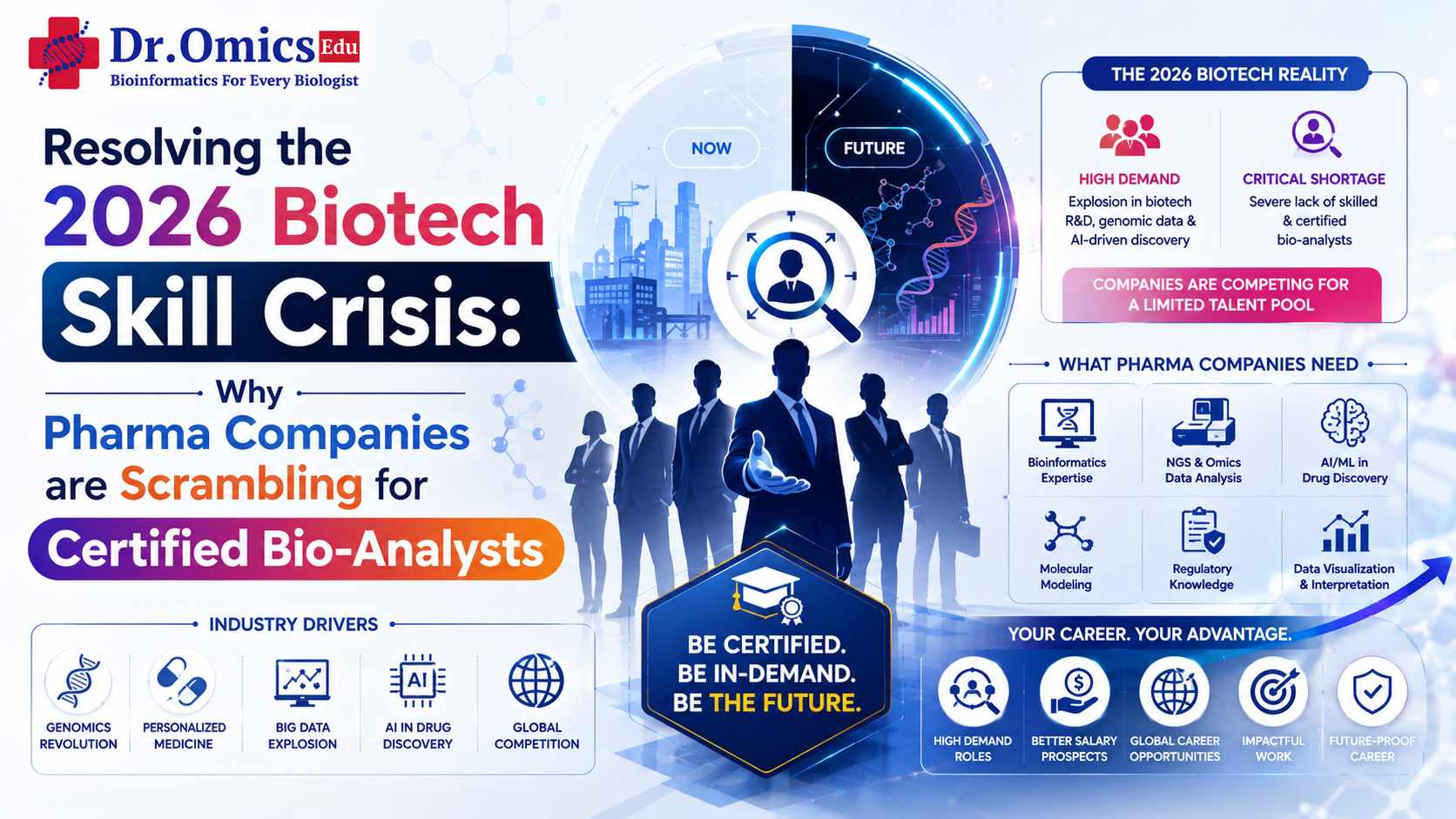
Resolving the 2026 Biotech Skill Crisis: Why Pharma Companies Are Scrambling for Certified Bio-Analysts
Dr. Omics Edu Team · · Updated
The biotechnology industry is evolving rapidly with advances in genomics, artificial intelligence (AI), next-generation sequencing (NGS), and precision medicine. However, one major challenge persists—a widening demand-supply gap for data-driven biological scientists. While pharmaceutical and biotech companies are generating massive volumes of biological data, there remains a shortage of professionals capable of interpreting these datasets. This growing skill gap has made certified bioinformatics professionals some of the most sought-after candidates in 2026.
Why Is There a Skill Shortage?
Modern pharmaceutical research increasingly depends on computational biology rather than traditional laboratory techniques alone. Employers now seek professionals who can combine biological knowledge with programming, statistics, and genomic data analysis.
The demand is driven by:
- Expansion of genomics and precision medicine
- AI-powered drug discovery and diagnostics
- Increasing adoption of NGS technologies
- Growth of pharmaceutical data analytics
- Rising need for regulatory-compliant biological data interpretation
Jobs After BTech Biotechnology
Students searching for jobs after BTech Biotechnology are no longer limited to laboratory or manufacturing roles. Computational biology has opened diverse career opportunities, including:
- Bioinformatics Analyst
- Genomics Data Analyst
- Computational Biologist
- Pharmaceutical Data Analyst
- Clinical Bioinformatics Associate
- NGS Data Scientist
These positions are available in pharmaceutical companies, biotechnology firms, CROs, healthcare organizations, and research institutes.
Career Switch to Genomics
A career switch to genomics is becoming one of the most promising options for life science graduates. By learning Linux, Python, R, genome analysis, RNA-Seq, and biological databases, professionals can transition into high-demand computational roles and contribute to data-driven healthcare innovations.
Importance of Industry-Certified Training
Employers increasingly prefer candidates who have completed an LSSSDC certified training program, as these certifications validate practical skills and industry readiness. Likewise, an accredited industry-ready genomics fellowship provides hands-on experience with real genomic datasets, computational tools, and project-based learning, helping graduates become job-ready.
Pharmaceutical Data Analyst Salary
The increasing demand for bioinformatics professionals has significantly improved the pharmaceutical data analyst salary across the life sciences sector. Professionals with expertise in genomics, biological data analytics, and computational biology often enjoy competitive salaries, faster career progression, and opportunities to work on cutting-edge research projects.
Bioinformatics Placement Guarantee
Many learners prefer programs offering a Bioinformatics Placement Guarantee because they combine technical training with career support. These programs typically provide:
- Hands-on project experience
- Portfolio development
- Resume and interview preparation
- Industry mentorship
- Placement assistance with hiring partners
Although employment depends on individual performance and employer selection criteria, placement-focused programs help bridge the gap between education and industry.
Bio-IT Career Transition Roadmap for Graduates
A successful bio-it career transition roadmap for graduates includes:
- Build a strong foundation in molecular biology and genetics.
- Learn Linux, Python, R Programming.
- Master NGS and genomics data analysis.
- Complete an industry-recognized certification or fellowship.
- Develop real-world projects and a professional portfolio.
- Prepare for technical interviews and apply for bioinformatics roles.
Conclusion
The 2026 biotech industry is experiencing a critical shortage of professionals who can combine life science expertise with computational skills. By pursuing certified training, gaining hands-on genomics experience, and following a structured Bio-IT career roadmap, graduates can successfully transition into one of the fastest-growing and most rewarding careers in biotechnology and pharmaceutical research.
