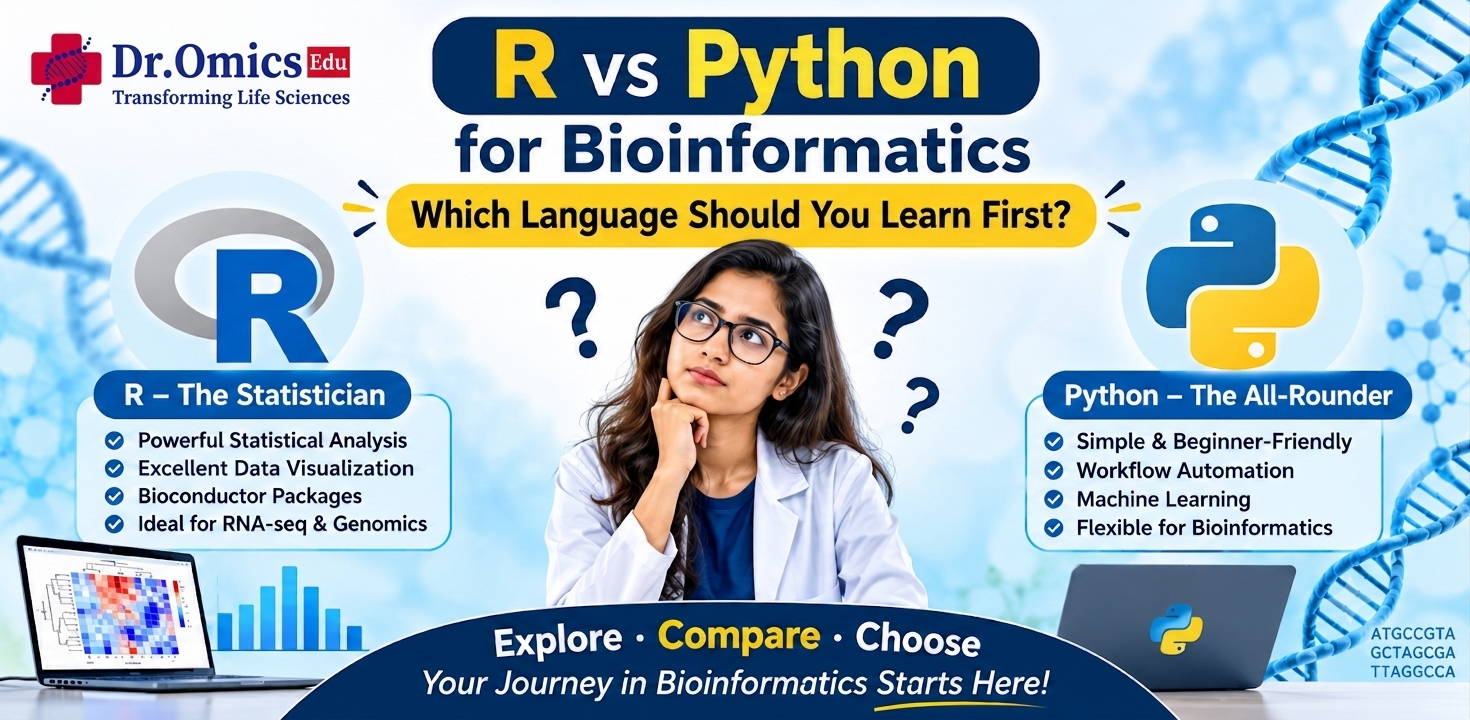
R vs Python for Bioinformatics: Which Language Should You Learn First?
Priyanka Bhore · · Updated
Introduction
Bioinformatics combines biology, statistics, and computer science to extract meaningful insights from biological data. With the rapid growth of next-generation sequencing (NGS), genomics, transcriptomics, and other high-throughput technologies, programming has become an essential skill for modern biological research.
Among the available programming languages, R and Python are two of the most widely used in bioinformatics. Both offer powerful libraries, extensive community support, and applications in biological data analysis. However, beginners often face one important question: Should I learn R or Python first?
Understanding the differences between these languages can help students, researchers, and aspiring bioinformaticians choose the right starting point.
Understanding R in Bioinformatics
R is an open-source programming language primarily designed for statistical computing, data analysis, and visualization. It is particularly popular in computational biology because of its extensive collection of bioinformatics packages.
The Bioconductor project provides specialized tools for analyzing genomic, transcriptomic, and other high-throughput biological datasets.
Major applications of R in bioinformatics include:
- RNA-seq analysis: Differential gene expression analysis using DESeq2 and edgeR.
- Microarray analysis: Processing and statistical interpretation of gene expression data.
- Data visualization: Creating publication-quality plots using ggplot2 and heatmaps using pheatmap.
- Genomic analysis: Working with genomic coordinates, annotation, and biological sequences using Bioconductor packages.
- Statistical analysis: Performing hypothesis testing, clustering, and exploratory data analysis.
R is especially useful when researchers need statistical interpretation and graphical representation of biological results.
Understanding Python in Bioinformatics
Python is a general-purpose programming language known for its simple syntax, flexibility, and extensive ecosystem of scientific libraries. It is widely used for automating bioinformatics workflows, processing large biological datasets, and developing computational pipelines.
Major applications of Python in bioinformatics include:
- Sequence analysis: Using Biopython for DNA, RNA, and protein sequence manipulation.
- NGS data processing: Developing scripts for FASTQ, FASTA, and other genomic file formats.
- Workflow automation: Automating repetitive analysis tasks and integrating different bioinformatics tools.
- Machine learning: Applying Scikit-learn and TensorFlow to biological classification and prediction problems.
- Structural bioinformatics: Processing protein structures and molecular data using specialized Python libraries.
Python is particularly valuable when researchers need scalable automation, custom tool development, and machine learning applications.
R vs Python Bioinformatics: Key Differences
Feature | R | Python |
| Primary focus | Statistical analysis | General-purpose programming |
| Learning curve | Moderate | Beginner-friendly |
| RNA-seq analysis | Excellent | Good |
| Data visualization | ggplot2 | Matplotlib, Seaborn |
| Genomic analysis | Bioconductor | Biopython, pysam |
| Machine learning | Caret, tidymodels | Scikit-learn, TensorFlow |
| Workflow automation | Supported | Excellent |
| Statistical analysis | Excellent | Strong |
| Community | Strong research community | Large programming community |
R or Python for Genomics: Which Is Better?
The answer depends on the type of research or analysis you want to perform.
If your primary interest is RNA-seq, differential gene expression, statistical analysis, or biological data visualization, R is an excellent starting point. Packages such as DESeq2, edgeR, and ggplot2 make complex biological analyses more accessible.
On the other hand, if you are interested in NGS pipeline development, sequence processing, workflow automation, machine learning, or developing custom bioinformatics applications, Python offers greater flexibility.
For example, a typical RNA-seq workflow may use FastQC and HISAT2 for quality control and alignment, followed by featureCounts for read quantification and DESeq2 in R for differential expression analysis. Python can also be used to automate the workflow and process intermediate results.
This demonstrates that both languages can complement each other rather than compete.
Which Programming Language Should Beginners Learn First?
For students entering bioinformatics, the best programming language for biology depends on their learning objectives.
- Choose R first if you want to focus on statistical analysis, RNA-seq, gene expression studies, and biological visualization.
- Choose Python first if you want to develop programming fundamentals, automate analyses, work with genomic sequences, and explore artificial intelligence.
- Learn both eventually if you want to build a strong foundation in computational biology and advanced bioinformatics research.
Conclusion
The discussion around R vs Python bioinformatics should not be about selecting one universal winner. Both languages have important roles in modern biological research.
R provides specialized statistical and visualization capabilities, while Python offers flexibility, automation, and machine learning opportunities.
For aspiring bioinformaticians, learning one language thoroughly and gradually expanding into the other is a practical approach. Ultimately, understanding biological concepts and knowing how to select the right computational tool are more important than choosing a language based on popularity.
Start with R or Python, practice using real biological datasets, and build your journey toward becoming a skilled bioinformatician.
