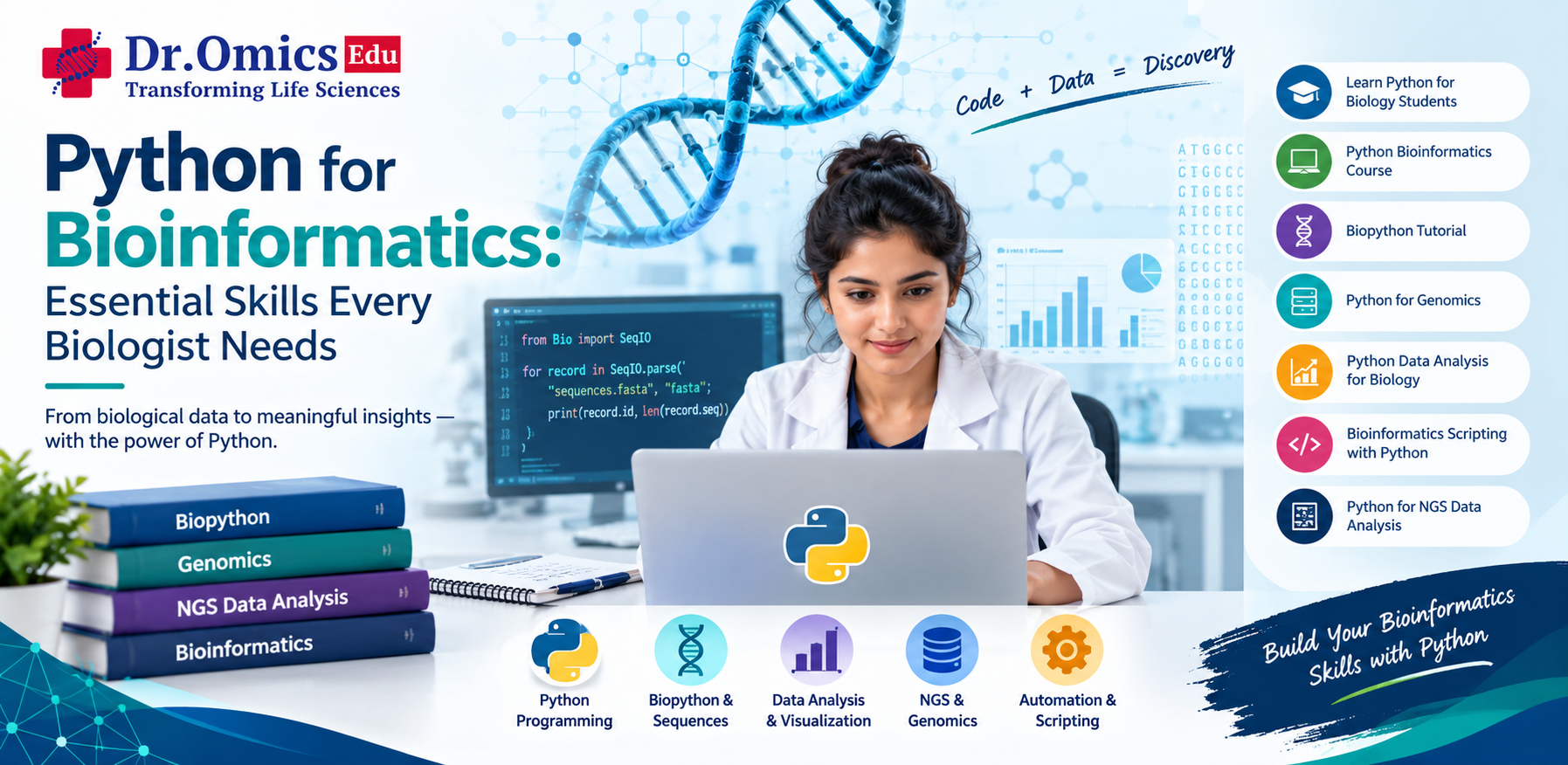
Python for Bioinformatics: Essential Skills Every Biologist Needs
Dr. Omics Edu Team ·
Modern biology increasingly depends on computational analysis. The rapid expansion of genomic, transcriptomic, proteomic, and other biological datasets has created a need for researchers who can process and interpret data efficiently. This is where Python for bioinformatics has become an important skill for modern biologists.
Python is a versatile programming language known for its readable syntax, extensive libraries, and broad applications in scientific computing. For biologists, learning Python can transform repetitive data-processing tasks into automated and reproducible workflows.
Why Should Biologists Learn Python?
Biological research often involves large datasets that are difficult to analyze manually. Python allows researchers to automate tasks such as sequence manipulation, file processing, data filtering, statistical analysis, and visualization.
Students who learn Python for biology students can gradually move from basic programming concepts to practical applications in computational biology. Variables, loops, functions, lists, dictionaries, file handling, and error handling form the foundation for more advanced biological analysis.
Python is particularly useful because researchers can write small scripts to solve specific problems without needing to become professional software developers.
Python for Genomics and NGS
The increasing volume of sequencing data has made programming skills increasingly valuable in genomics. Python for genomics can be used for processing nucleotide and protein sequences, manipulating FASTA and FASTQ files, extracting information from genomic datasets, and automating analysis pipelines.
Similarly, Python for NGS data analysis can support tasks such as sequencing-read processing, quality-summary generation, metadata handling, result filtering, and downstream data analysis. Python can also be incorporated into larger bioinformatics workflows alongside Linux-based tools and specialized genomics software.
Biopython and Biological Data
One of the most important resources for learners is Biopython, a collection of Python tools designed for computational biology. A Biopython tutorial can introduce learners to practical operations such as reading FASTA files, working with biological sequences, performing sequence transformations, accessing sequence information, and handling common biological file formats.
Biopython can help bridge the gap between programming concepts and real biological problems, making it particularly useful for students beginning computational biology.
Python Data Analysis for Biology
Beyond sequence processing, researchers frequently need to analyze numerical and tabular datasets. Python data analysis biology applications can involve processing experimental measurements, exploring gene-expression datasets, summarizing results, and generating visualizations.
Libraries such as NumPy, pandas, Matplotlib, and SciPy provide a powerful foundation for scientific data analysis. Learning these tools allows biologists to move beyond basic spreadsheet-based workflows and develop reproducible computational analyses.
Python for Bioinformatics Beginners
Python coding for bioinformatics beginners should ideally begin with programming fundamentals before moving into biological applications. A structured learning pathway can include:
- Python syntax, variables, and data types
- Lists, dictionaries, tuples, and sets
- Conditional statements and loops
- Functions and modules
- File handling and biological file formats
- Data analysis and visualization
- Sequence manipulation using Biopython
- Basic genomics and NGS applications
A well-designed Python bioinformatics course can combine these concepts with practical biological datasets, allowing learners to develop programming skills through real research-oriented examples.
Bioinformatics Scripting with Python
One of the most practical applications is bioinformatics scripting Python, where researchers create customized scripts for repetitive or specialized tasks. Instead of manually processing hundreds or thousands of files, a Python script can perform the same operation consistently and efficiently.
For life-science professionals, Python programming for life sciences is therefore not simply about learning another programming language. It is about developing the ability to automate analysis, work with large datasets, troubleshoot computational tasks, and create reproducible research workflows.
As biological datasets continue to grow, Python proficiency can provide biologists with a valuable computational advantage and help them participate more effectively in modern data-driven research.
