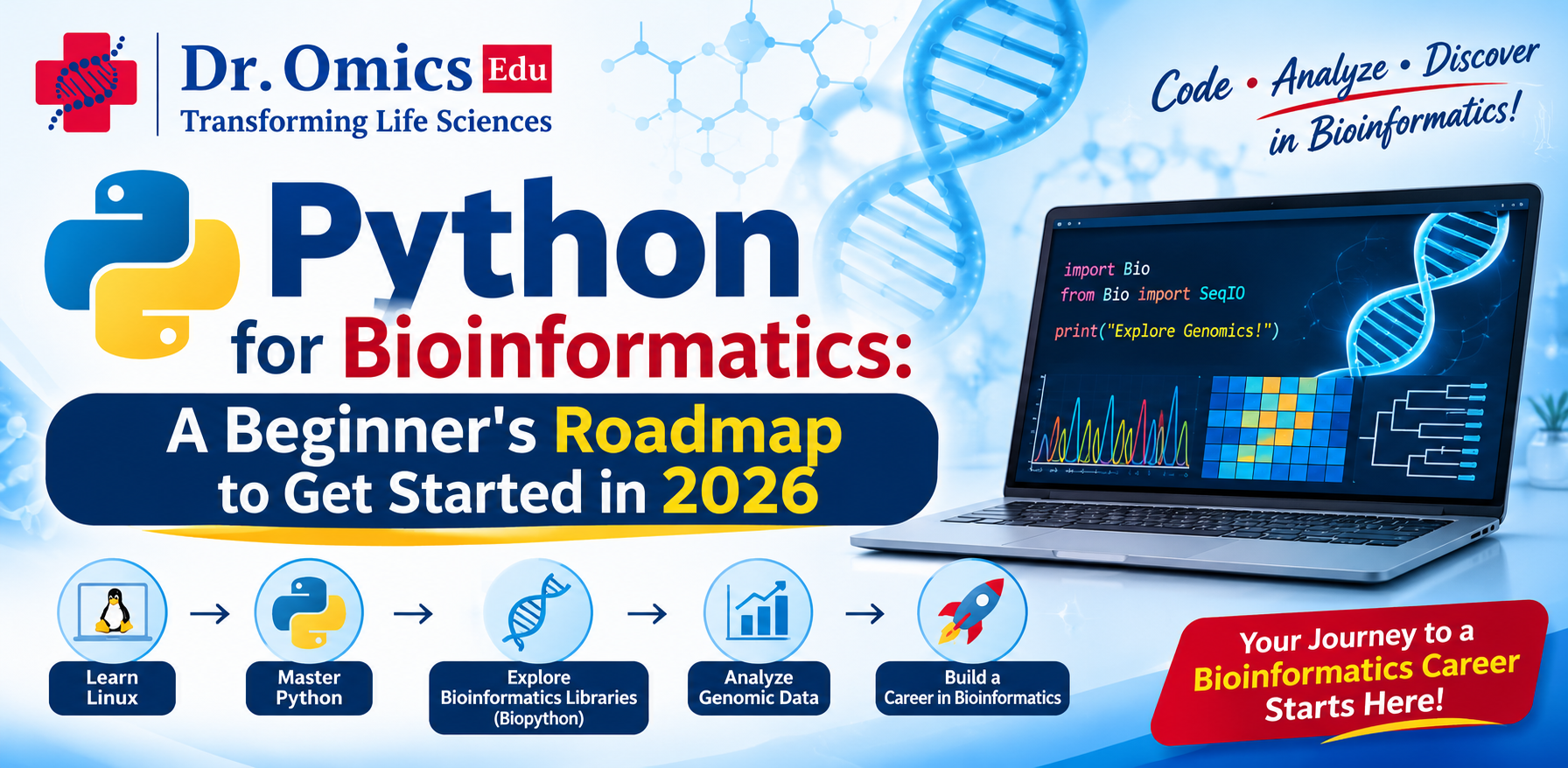
Python for Bioinformatics: A Beginner's Roadmap to Get Started in 2026
Dr. Omics Edu Team ·
Introduction
The life sciences are rapidly evolving with the integration of computational technologies, artificial intelligence, and large-scale biological data analysis. From genome sequencing and gene expression studies to protein structure prediction, programming has become an essential skill for modern biological research. Among the available programming languages, Python stands out for its simplicity, versatility, and extensive ecosystem of scientific libraries.
For students from Biotechnology, Bioinformatics, Microbiology, Genetics, and other life science backgrounds, learning Python can open new opportunities in computational biology and genomics. This beginner-friendly roadmap explains how to learn Python for bioinformatics in 2026, even without prior programming experience.
Why Should Life Science Students Learn Python?
Biological research generates enormous amounts of data, including DNA sequences, RNA-seq expression matrices, protein sequences, and molecular structures. Python helps researchers process, analyze, visualize, and interpret these datasets efficiently.
Unlike traditional manual analysis, programming enables reproducible workflows, faster calculations, and automation of repetitive tasks. Learning coding for biology students is no longer limited to computer science graduates. With the right learning approach, life science students can develop programming skills alongside their biological knowledge.
Python is widely used in NGS data analysis, genomics, structural bioinformatics, drug discovery, and machine learning applications.
A Beginner's Roadmap to Python for Bioinformatics
Step 1: Understand Python Fundamentals
Before exploring biological applications, beginners should develop a strong foundation in Python programming.
Start with:
- Variables, data types, and operators
- Strings, lists, tuples, and dictionaries
- Conditional statements and loops
- Functions and modules
- File handling
- Exception handling
For example, a DNA sequence can be represented as a simple Python string:
dna = "ATGCGTACGTAG"
print("Sequence length:", len(dna))
print("First 3 bases:", dna[:3])
print("GC count:", dna.count("G") + dna.count("C"))
This simple exercise introduces students to sequence handling and basic computational thinking.
Step 2: Learn Python Libraries for Biological Data
Once the fundamentals are clear, learners can explore libraries that simplify scientific analysis.
Important libraries include:
- NumPy: Numerical calculations and array operations.
- Pandas: Biological data tables and expression matrices.
- Matplotlib: Data visualization and plotting.
- Seaborn: Statistical visualization.
- Biopython: Biological sequence analysis and file handling.
A structured Python bioinformatics course should combine programming concepts with practical biological examples rather than teaching Python in isolation.
Step 3: Explore Biopython
Biopython is one of the most important Python libraries for computational biology. It provides tools for handling DNA, RNA, and protein sequences, parsing biological file formats, and accessing biological databases.
A beginner-friendly Biopython tutorial can introduce sequence objects, transcription, translation, GC content, FASTA parsing, and sequence alignment.
Example:
from Bio.Seq import Seq
dna = Seq("ATGGCCATTGTAATGGGCCGCTGAAAGGGTGCCCGATAG")
print("DNA:", dna)
print("RNA:", dna.transcribe())
print("Protein:", dna.translate())
Through such exercises, students can understand how programming connects directly with biological concepts.
Step 4: Apply Python to Genomics
The next stage is exploring Python for genomics through practical projects.
Students can begin with:
- FASTA and FASTQ file analysis
- GC content calculation
- Sequence length distribution
- Gene expression data visualization
- Basic variant data exploration
- NGS quality metrics analysis
Python can also support workflow automation, data cleaning, and integration with command-line bioinformatics tools.
For advanced applications, learners can explore libraries such as pysam, Scanpy, and scikit-learn, depending on their research interests.
Step 5: Build Practical Projects
Project-based learning helps beginners develop confidence and demonstrate their skills.
Some beginner-friendly projects include:
- DNA sequence analyzer using Python.
- GC content comparison across multiple sequences.
- FASTA file parser using Biopython.
- Gene expression visualization using Pandas and Matplotlib.
- A simple genomics data analysis workflow.
These projects can become valuable additions to a student's portfolio or GitHub profile.
Conclusion
The journey to learn Python for bioinformatics begins with programming fundamentals and gradually progresses toward biological data analysis. In 2026, combining Python, Linux, and bioinformatics tools can help life science students build a strong foundation for computational research.
With consistent practice, structured learning, and hands-on projects, beginners can transform their biological knowledge into practical programming expertise. Python is not just a coding language for life scientists; it is a powerful tool for exploring biological complexity and contributing to data-driven discoveries.
