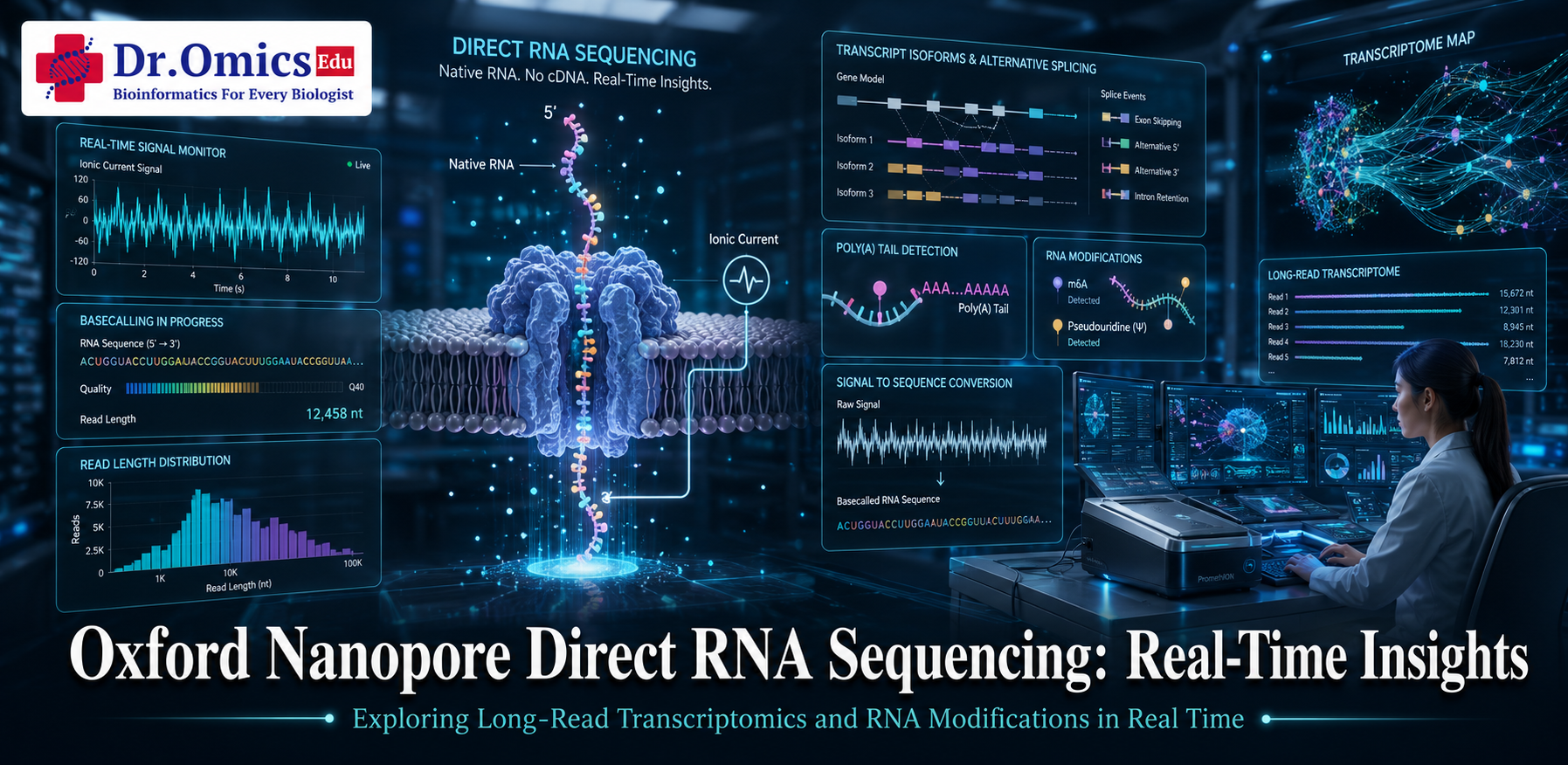
Oxford Nanopore Direct RNA Sequencing: Real-Time Insights
Dr. Omics Edu Team ·
RNA sequencing has become a cornerstone of modern genomics, helping researchers understand gene expression, transcript diversity, and regulatory mechanisms. However, conventional RNA-seq workflows often require reverse transcription and amplification, potentially introducing bias into the data. This is where Oxford Nanopore Direct RNA Sequencing (DRS) is changing the landscape.
Unlike traditional approaches, Direct RNA Sequencing reads native RNA molecules directly, allowing scientists to capture real-time transcriptomic information while preserving biologically important features such as RNA modifications.
Why is Direct RNA Sequencing Different?
The key advantage of Oxford Nanopore technology is its ability to sequence full-length RNA molecules without converting them into cDNA. This enables researchers to study transcript structures more accurately and identify alternative splicing events that may be missed by short-read methods.
Long Read Sequencing Advantages
The growing popularity of nanopore sequencing is driven by several important benefits:
- Sequencing of complete transcripts in a single read
- Improved detection of transcript isoforms
- Identification of RNA modifications such as m6A
- Reduced PCR-induced bias
- Real-time data generation and analysis
These long read sequencing advantages are helping researchers gain deeper insights into transcriptomes across a wide range of organisms.
Oxford Nanopore Data Analysis: From Raw Signals to Biological Insights
A typical Oxford Nanopore data analysis workflow includes basecalling, quality assessment, read alignment, transcript quantification, and isoform discovery. Researchers can also leverage signal-level information to investigate RNA modifications, opening new opportunities in epitranscriptomics research.
Applications Across Life Sciences
Oxford Nanopore Direct RNA Sequencing is being used in:
- Cancer transcriptomics
- Viral and pathogen research
- Plant genomics
- Biomarker discovery
- Epitranscriptomic studies
Its ability to provide real-time, long-read transcript information makes it a valuable tool for both basic and applied research.
Final Thoughts
As transcriptomics continues to evolve, Oxford Nanopore Direct RNA Sequencing is emerging as a powerful technology for studying native RNA molecules with unprecedented detail. Researchers looking for a comprehensive nanopore direct RNA sequencing tutorial often find that the platform's combination of real-time sequencing, RNA modification detection, and long read sequencing advantages provides insights that extend far beyond traditional RNA-seq approaches.
Want to learn how to analyze Oxford Nanopore sequencing data and interpret transcriptomic results? Explore our bioinformatics training programs and hands-on workshops designed for researchers and students.
