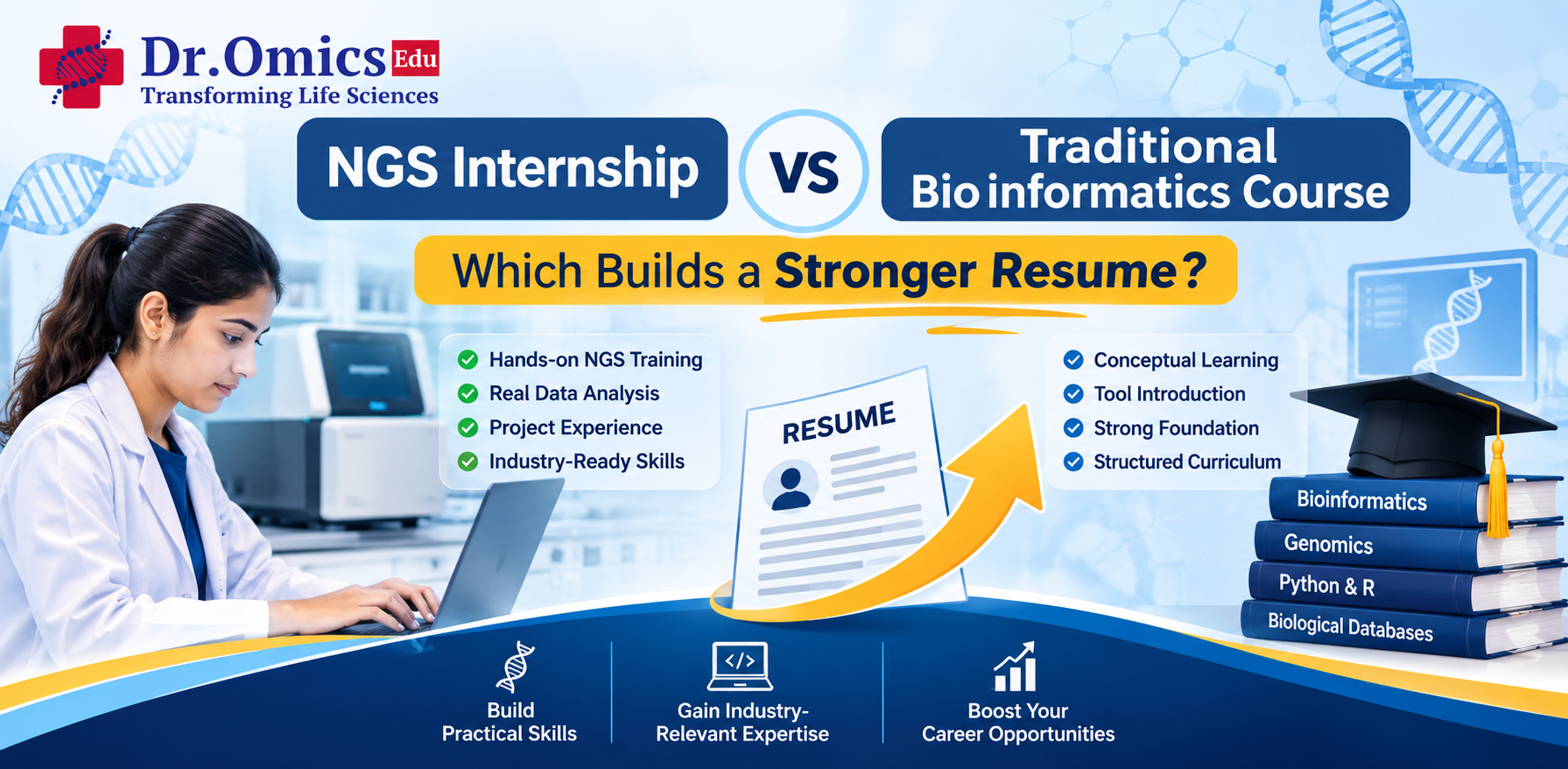
NGS Internship vs Traditional Bioinformatics Course: Which Builds a Stronger Resume?
Priyanka Bhore ·
Bioinformatics is becoming an important field in genomics, healthcare, and research. With the growing demand for skilled professionals, students often face one question: Should they choose a traditional bioinformatics course or an NGS internship?
Both provide valuable knowledge, but their learning approaches and career benefits are different.
1. Traditional Bioinformatics Course
A traditional bioinformatics course focuses mainly on theoretical concepts and introductory knowledge of computational biology.
Students generally learn:
- Introduction to bioinformatics and genomics.
- Biological databases such as NCBI and Ensembl.
- Sequence alignment using BLAST.
- Basics of Python and R.
- Introduction to NGS technologies.
These courses help build a strong foundation but may offer limited exposure to real-world sequencing projects.
2. NGS Internship: Learning Through Practical Experience
An NGS internship focuses on applying theoretical knowledge to actual sequencing datasets.
Students get exposure to:
- Raw sequencing data from NCBI SRA.
- Quality control using FastQC and MultiQC.
- Read trimming using fastp.
- Genome alignment using BWA or HISAT2.
- RNA-seq analysis using featureCounts and DESeq2.
- Variant analysis using GATK and VEP.
- Data visualization and biological interpretation.
These practical activities help students understand complete NGS workflows and develop problem-solving abilities.
3. NGS Internship vs Traditional Course
Traditional Course | NGS Internship |
| Theory-based learning | Practical learning |
| Introduction to tools | Hands-on tool experience |
| Limited project exposure | Project-based learning |
| Conceptual understanding | Workflow understanding |
| Builds foundational knowledge | Develops practical skills |
4. How Does an NGS Internship Strengthen Your Resume?
The major NGS internship benefits include:
- Practical exposure: Experience working with commonly used bioinformatics tools.
- Real dataset analysis: Understanding FASTQ, BAM, VCF, and gene expression data.
- Project experience: Completing NGS projects that demonstrate technical abilities.
- Problem-solving: Learning to troubleshoot errors during data analysis.
- Career preparation: Developing industry-ready bioinformatics skills.
These experiences support resume building in genomics by allowing students to showcase their actual technical abilities rather than only listing course certificates.
5. Which Option Should You Choose?
A traditional bioinformatics course is useful for developing fundamental knowledge, while an internship provides opportunities to apply that knowledge through practical assignments and projects.
Ideally, students should combine both approaches:
- Learn the fundamentals of bioinformatics.
- Develop Python, R, and Linux skills.
- Gain practical NGS training.
- Complete real-world bioinformatics projects.
- Document their work and highlight it on their resume.
Conclusion
A strong bioinformatics resume requires more than theoretical knowledge and certificates. Practical experience, tool familiarity, project exposure, and problem-solving abilities make a significant difference.
An NGS internship can provide an additional practical advantage by helping students understand how sequencing data is analysed in real research environments.
At Dr. Omics Labs, we encourage students to move beyond theoretical learning and develop practical skills that prepare them for opportunities in genomics and bioinformatics.
Learn. Practice. Analyse. Build your future in Bioinformatics!
