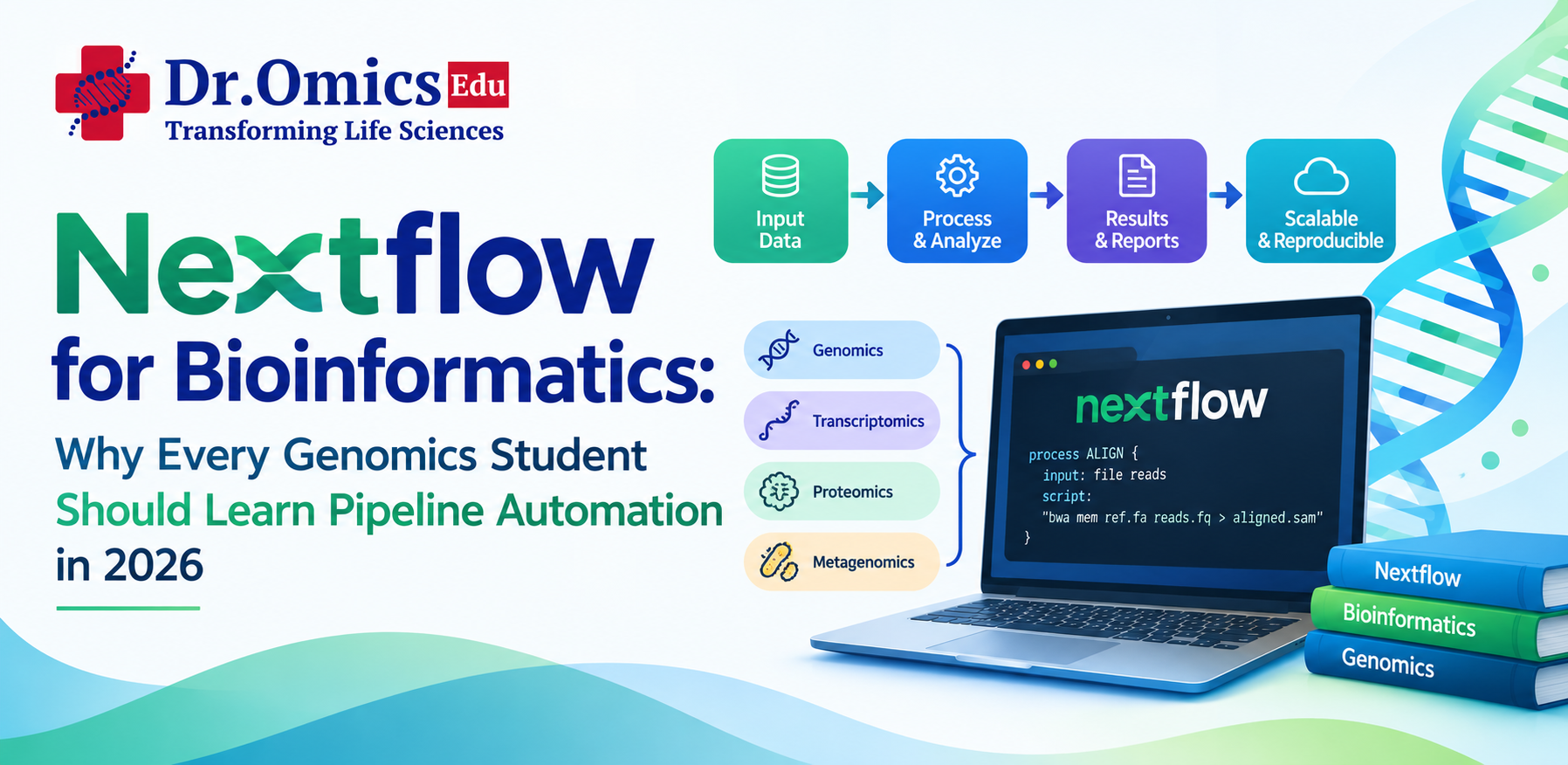
Nextflow for Bioinformatics: Why Every Genomics Student Should Learn Pipeline Automation in 2026
Dr. Omics Edu Team · · Updated
Modern genomics is no longer limited to downloading sequencing data, running a few command-line tools, and manually checking the results. With the rapid growth of next-generation sequencing, researchers are now working with hundreds or even thousands of samples, multiple analysis tools, large reference genomes, and increasingly complex computational workflows.
This is where Nextflow bioinformatics workflows have become highly valuable.
For students and professionals entering bioinformatics in 2026, learning how to automate an analysis pipeline is becoming just as important as learning individual tools such as FastQC, Fastp, BWA, STAR, GATK, Samtools, or DESeq2.
Instead of running every command manually, workflow systems allow researchers to connect multiple analysis steps into a reproducible and scalable pipeline.
Among the available bioinformatics pipeline tools, Nextflow has become an important technology for building such workflows.
What Is Nextflow?
Nextflow is a workflow management system designed to create and execute computational pipelines.
In simple terms, imagine that you are performing a DNA-sequencing analysis.
A typical workflow might look like:
Raw FASTQ files
↓
Quality control
↓
Read trimming
↓
Genome alignment
↓
BAM processing
↓
Variant calling
↓
Variant annotation
↓
Final results
Without workflow automation, a researcher may need to execute each step manually.
For a small number of samples, this may be manageable. But imagine performing the same analysis for 100, 500, or 1,000 samples.
Manually executing commands becomes time-consuming and increases the possibility of errors.
Nextflow allows these steps to be organized into a workflow so that the analysis can be executed systematically.
This makes workflow automation genomics projects much easier to manage.
Why Is Nextflow Important in Bioinformatics?
The biggest challenge in modern bioinformatics is not simply running individual tools.
The challenge is connecting many tools together reliably.
For example, an NGS pipeline may involve:
- FastQC for quality control
- Fastp for trimming
- BWA for alignment
- Samtools for BAM processing
- GATK or DeepVariant for variant calling
- VEP or SnpEff for annotation
- R or Python for downstream analysis
Each tool may have different input and output requirements.
A workflow manager helps connect these individual programs.
Nextflow essentially allows researchers to describe:
"Take this input, run this analysis, generate this output, and pass that output to the next step."
This concept becomes extremely powerful when working with large genomic datasets.
Why Should Genomics Students Learn Nextflow in 2026?
Genomics is becoming increasingly data-intensive.
Students are no longer expected to understand only biological concepts. Modern bioinformatics roles increasingly require knowledge of Linux, programming, databases, cloud computing, containers, workflow management, and reproducible analysis.
Learning Nextflow gives students exposure to several of these concepts simultaneously.
1. Move Beyond Manual Command-Line Analysis
Many beginners start bioinformatics by running commands individually.
For example:
fastqc sample.fastq
Then:
fastp -i sample.fastq -o trimmed.fastq
Then:
bwa mem reference.fa trimmed.fastq > sample.sam
This is useful for learning individual tools.
However, professional projects rarely consist of only one sample and three commands.
A pipeline may contain dozens of processes.
Nextflow allows these commands to be organized into a reproducible workflow.
This is an important transition from learning bioinformatics tools to building bioinformatics systems.
2. Nextflow Makes Pipelines Reproducible
Reproducibility is one of the most important principles in computational biology.
Suppose a researcher performs RNA-seq analysis today and obtains a set of differentially expressed genes.
Six months later, another researcher wants to reproduce the analysis.
If the original analysis was performed manually, it may be difficult to remember:
- Which software versions were used?
- What parameters were selected?
- Which reference genome was used?
- Which files were processed?
- What order were the commands executed?
- Were any samples processed differently?
A workflow can document and automate these steps.
This makes computational research easier to reproduce and maintain.
3. Nextflow Can Handle Multiple Samples
Consider an RNA-seq project containing 50 samples.
Instead of manually running the same commands 50 times, a workflow can process the samples according to the defined pipeline.
The same principle applies to:
- Whole-genome sequencing
- Whole-exome sequencing
- RNA-seq
- ChIP-seq
- ATAC-seq
- Metagenomics
- Single-cell RNA-seq
- Variant analysis
- Microbial genomics
This makes Nextflow particularly useful for scalable genomic data analysis.
4. Nextflow Supports Parallel Processing
Large sequencing projects can require substantial computational resources.
If samples are independent, many analysis steps can potentially be processed in parallel.
For example:
Sample 1 → QC
Sample 2 → QC
Sample 3 → QC
Sample 4 → QC
Instead of waiting for one sample to finish before starting another, Nextflow can manage parallel execution when the workflow and computational environment allow it.
This can significantly improve the efficiency of large-scale analysis.
5. Nextflow Works With Containers
Modern bioinformatics pipelines often depend on software environments containing specific versions of many tools.
Installing everything manually can create dependency conflicts.
For example:
Tool A requires one version of a library.
Tool B requires another version.
A container can package the software and its dependencies into a controlled environment.
Nextflow integrates well with technologies such as:
- Docker
- Apptainer/Singularity
- Conda
This is particularly useful when building reproducible pipelines for research or production environments.
Nextflow for Beginners: What Should You Learn First?
Students often think that they need to become advanced programmers before learning Nextflow.
That is not necessarily true.
A beginner should first understand a few fundamental concepts.
Start With Linux
Bioinformatics pipelines frequently run in Linux environments.
Students should understand commands such as:
Pwd, ls, cd, mkdir, cp, mv, rm, grep, cat, head, tail etc.
They should also understand files, directories, permissions, paths, and basic shell scripting.
Learn Basic Programming Concepts
You do not need to become a software engineer before starting Nextflow.
However, understanding variables, loops, conditions, functions, strings, lists, and file handling will make workflow development much easier.
Python can be particularly useful because it is widely used in bioinformatics.
Understand NGS Analysis
Students should know what happens during a typical sequencing analysis.
For example:
FASTQ
→ Quality Control
→ Trimming
→ Alignment
→ BAM Processing
→ Variant Calling
→ Annotation
Once students understand this biological and computational workflow, learning Nextflow becomes much easier.
Nextflow Pipeline Tutorial: A Simple Example
A beginner can start with a very small workflow.
For example, suppose we want to perform quality control on FASTQ files.
A simplified Nextflow process could look conceptually like:
process FASTQC {
input:
path reads
output:
path "fastqc_report"
script:
"""
fastqc $reads -o fastqc_report
"""
}
The important idea is not memorizing the syntax.
The important idea is understanding the structure:
Input → Process → Command → Output
Once students understand this concept, they can gradually build more complex workflows.
Nextflow Channels
One of the important concepts in Nextflow is the channel.
Channels allow data to move between different processes.
For example:
FASTQ files
↓
Channel
↓
FASTQC
↓
Channel
↓
FASTP
↓
Channel
↓
BWA
This is one of the concepts students should understand carefully when following a Nextflow pipeline tutorial.
Channels become especially useful when working with multiple samples.
Nextflow vs Snakemake
When discussing workflow management, students often encounter the question:
Nextflow vs Snakemake — which one should I learn?
Both are excellent workflow management systems and are widely used in computational biology.
Snakemake is particularly popular in academic bioinformatics and has a workflow structure that many Python users find approachable.
Nextflow has gained strong adoption for portable, scalable workflows and has a particularly strong ecosystem around containerized and cloud-based execution.
The choice depends on the research group, project requirements, existing pipelines, and technology stack.
For students, learning one workflow manager thoroughly is more valuable than memorizing several systems superficially.
However, understanding the concepts behind both Nextflow and Snakemake can be advantageous when applying for bioinformatics positions.
Nextflow and Cloud Genomics
One of the major reasons Nextflow is becoming increasingly relevant is the growth of cloud computing.
Large sequencing datasets may be difficult to process efficiently on a personal laptop.
Cloud platforms such as AWS, Google Cloud, and Microsoft Azure can provide scalable computing and storage resources.
A cloud genomics pipeline can potentially process data using cloud-based infrastructure rather than relying entirely on local computers.
This allows researchers to scale computational resources according to project requirements.
For example:
Sequencing Data
↓
Cloud Storage
↓
Nextflow Pipeline
↓
Cloud Compute
↓
Analysis Results
↓
Cloud Storage
This combination of workflow management, containers, and cloud computing is becoming increasingly important in modern genomics.
Nextflow and Large-Scale Genomics
Imagine a project containing:
1,000 whole-genome samples.
Running the analysis manually would be extremely difficult.
A workflow can help manage:
- Input files
- Sample metadata
- Quality control
- Alignment
- Variant calling
- Quality filtering
- Annotation
- Output organization
- Logging
- Error handling
- Re-running failed processes
This is where scalable genomic data analysis becomes important.
Instead of thinking about one sample at a time, researchers can design workflows around datasets and computational processes.
Nextflow Enables Reusable Pipelines
Another major advantage is reusability.
Suppose you create a DNA-seq pipeline.
You may initially use it for 10 samples.
Later, the same pipeline can potentially be applied to 100 or 1,000 samples with appropriate configuration and computational resources.
You can also modify individual components.
For example:
BWA → alignment
could potentially be replaced with another aligner depending on the scientific requirement.
This makes workflow design more flexible than a collection of manually executed commands.
Why Nextflow Is Valuable for Bioinformatics Careers
Bioinformatics job descriptions increasingly mention workflow development, cloud computing, containers, and automation.
A student who knows only individual tools may know how to perform an analysis.
A student who understands workflow automation can demonstrate a different level of computational maturity.
For example, instead of saying:
"I know FastQC, BWA and GATK."
A candidate can say:
"I have developed and executed a reproducible Nextflow-based variant-calling workflow using containerized tools."
That demonstrates knowledge of both bioinformatics and computational workflow design.
A Practical Learning Roadmap for Nextflow
A student starting in 2026 can follow this progression:
Step 1 — Linux
Learn the command line, file management, permissions, shell commands, and basic scripting.
Step 2 — Bioinformatics Fundamentals
Understand FASTQ, FASTA, BAM, VCF, reference genomes, sequencing quality, alignment, and variant calling.
Step 3 — Individual Tools
Learn tools such as FastQC, Fastp, BWA, Samtools, GATK, STAR, and other tools relevant to your field.
Step 4 — Nextflow Basics
Learn processes, channels, inputs, outputs, parameters, and workflow structure.
Step 5 — Containers
Learn Docker or Apptainer and understand why software environments matter.
Step 6 — Build a Pipeline
Create a complete DNA-seq or RNA-seq workflow.
Step 7 — Git and Version Control
Store your pipeline in Git and document how it works.
Step 8 — Cloud Execution
Learn how to execute workflows on cloud infrastructure.
Step 9 — Portfolio Development
Publish well-documented projects that demonstrate your ability to build reproducible workflows.
The Future of Bioinformatics Is Automated
The amount of biological data generated every year continues to increase.
Researchers are working with increasingly large datasets from genomics, transcriptomics, single-cell sequencing, metagenomics, proteomics, and multi-omics studies.
Manually running hundreds of computational commands is not a sustainable approach.
Automation allows researchers to spend less time repeating computational tasks and more time interpreting biological results.
This does not mean that workflow systems replace bioinformaticians.
Instead, they allow bioinformaticians to work at a larger scale.
A researcher who understands both the biology and the computational infrastructure behind an analysis can design more reliable and efficient solutions.
Conclusion
In 2026, learning individual bioinformatics tools is no longer enough for students who want to build a strong career in computational genomics.
Understanding Nextflow bioinformatics workflows gives students the ability to connect tools, automate repetitive analysis, process multiple samples, improve reproducibility, and scale workflows to larger datasets and cloud environments.
Whether you are beginning with Nextflow for beginners concepts or already developing advanced NGS workflows, the key is to learn through real projects.
Start with a small pipeline. Understand every process. Add multiple samples. Introduce containers. Use Git. Then move toward cloud-based execution.
The future of genomics will involve increasingly large datasets and increasingly complex computational workflows. Students who learn workflow automation genomics, reproducible pipeline development, and scalable analysis today will be better prepared for the bioinformatics opportunities of tomorrow.
