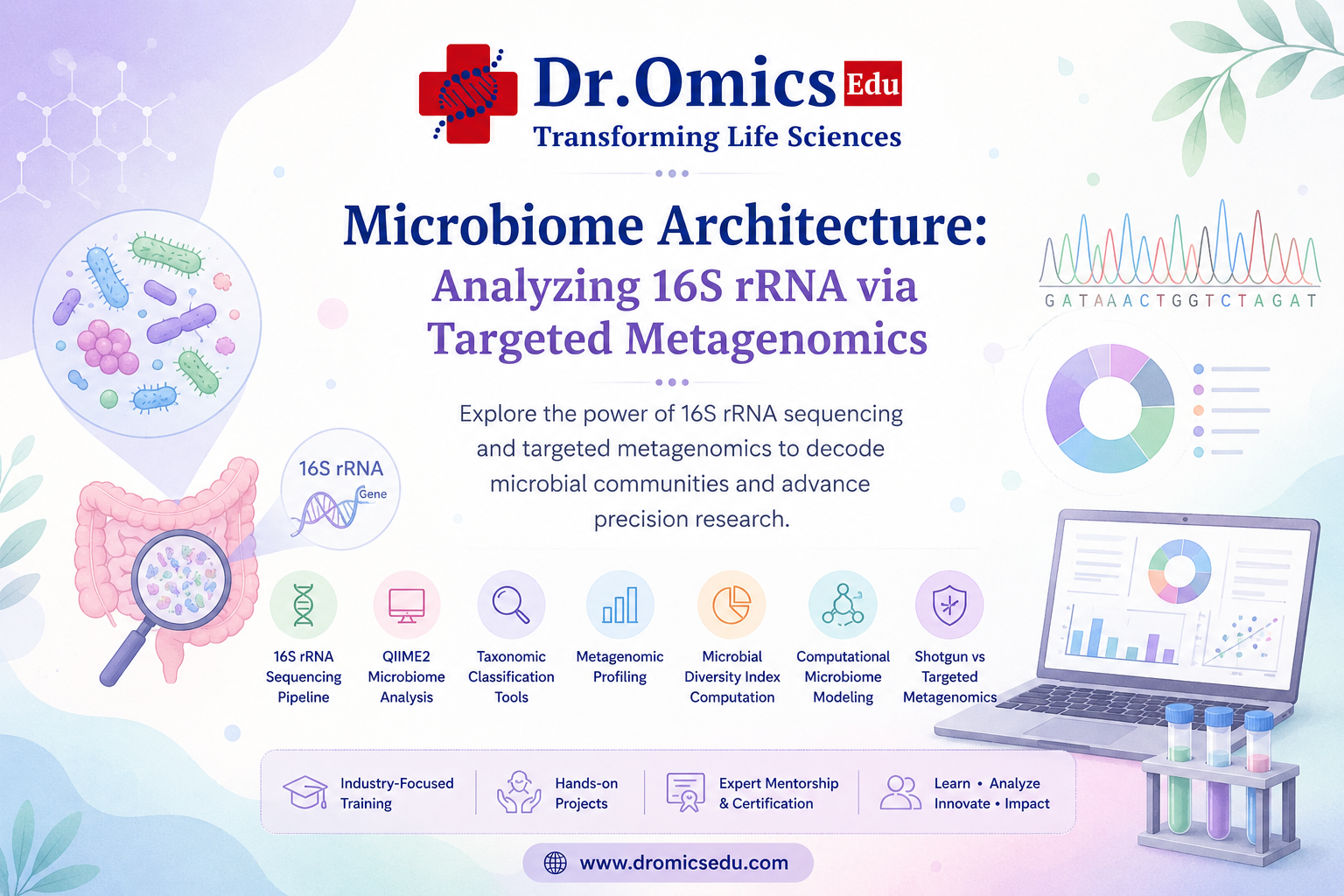
Microbiome Architecture: Analyzing 16S rRNA via Targeted Metagenomics
Dr. Omics Edu Team · · Updated
Introduction
Microorganisms are among the most abundant forms of life, playing fundamental roles in digestion, immunity, nutrient cycling, and disease progression. Because nearly 99% of microbes cannot be cultured using standard methods, next-generation sequencing (NGS) has revolutionized research by bypasssing laboratory cultivation.
This shift has accelerated the adoption of Targeted Metagenomics, an approach that identifies microorganisms directly from environmental or clinical DNA. Instead of sequencing entire genomes, it targets highly conserved genetic markers. Among these, the 16S ribosomal RNA (16S rRNA) gene is the gold standard for bacterial profiling. Combined with platforms like QIIME2 microbiome analysis, researchers can execute comprehensive downstream modeling, classification, and diversity computations.
What is Targeted Metagenomics?
Targeted metagenomics amplifies and sequences a specific marker gene rather than all DNA in a sample, lowering costs while maintaining high taxonomic accuracy. Common markers include:
- Bacteria: 16S rRNA gene.
- Fungi: Internal Transcribed Spacer (ITS) region.
- Eukaryotes: 18S rRNA gene.
This efficiency enables high-throughput processing of thousands of samples simultaneously. Comprehensive training through a Targeted Metagenomics course typically covers sequencing workflows, Linux-based bioinformatics, and data interpretation.
Understanding the 16S rRNA Gene
The 16S rRNA gene (~1,500 base pairs) is present in almost all bacteria. It features highly conserved regions paired with nine hypervariable regions (V1–V9). Conserved regions act as binding sites for universal PCR primers, while hypervariable zones (commonly V3–V4 or V1–V3) contain the distinct sequence differences used to resolve bacterial taxa.
The Complete 16S rRNA Sequencing Pipeline
A standard pipeline links wet-lab procedures to computational biology:
- Sample Collection & Storage: Preserves DNA from stool, saliva, soil, or wastewater.
- DNA Extraction: Employs specialized kits to lyse diverse cell walls.
- PCR Amplification: Targets hypervariable fragments using universal primers.
- High-Throughput Sequencing: Utilizes systems like Illumina MiSeq, NextSeq, PacBio, or Oxford Nanopore to yield millions of raw FASTQ reads.
- Quality Control: Filters out adapters, chimeras, and errors for downstream analysis.
Bioinformatics, Classification, and Diversity
QIIME2 Microbiome Analysis
As a modular, reproducible framework, QIIME2 microbiome analysis imports raw reads and applies denoising algorithms like DADA2 or Deblur. This corrects errors to yield high-resolution Amplicon Sequence Variants (ASVs) instead of traditional, rigid Operational Taxonomic Units (OTUs). ASVs populate feature abundance tables for downstream taxonomy and statistics.
Taxonomic Classification Tools
Using reference databases like SILVA, Greengenes, or GTDB, machine learning classifiers assign hierarchical taxonomies (from phylum down to genus/species). Other popular deployment tools include the RDP classifier, Kraken2, Bracken, and Kaiju.
Microbial Diversity Index Computation
Ecosystem stability is evaluated via two core calculations:
- Alpha Diversity (Within-Sample): Measures richness and distribution using metrics like the Shannon Index, Simpson Index, Chao1, and Observed Features.
- Beta Diversity (Between-Samples): Quantifies community distances using Bray-Curtis dissimilarity, Jaccard distance, or UniFrac metrics, visualized via Principal Coordinate Analysis (PCoA).
Shotgun Metagenomics vs. Targeted Sequencing
| Feature | Targeted Metagenomics (16S) | Shotgun Metagenomics |
| Target | Specific marker gene (e.g., 16S) | Total genomic DNA in sample |
| Resolution | Genus level (limited species) | Species and strain-level variation |
| Function | Predicted (e.g., PICRUSt2) | Direct functional gene mapping |
| Cost & Data | Cost-effective; lower data demands | High cost; complex bioinformatic needs |
Advanced Modeling & Diagnostics
Modern workflows use computational microbiome modeling and machine learning to isolate disease biomarkers (e.g., for IBD or diabetes) and predict metabolic pathways via PICRUSt2. Additionally, it facilitates high-throughput pathogen tracking for real-time epidemiological monitoring across hospitals and wastewater networks.
Limitations to Consider: 16S sequencing cannot directly measure functional genes, typically misses viral populations, features PCR amplification biases, and struggles with exact species-level resolution.
Career Opportunities & Future Perspectives
The explosion of multi-omics data has driven global demand for experts in microbiome bioinformatics. Industry pipelines highly prize specialists trained in Linux, QIIME2, R programming, and cloud computing across pharmaceutical, agricultural, and clinical spaces. Driven by AI integration and long-read sequencing, the field remains central to the future of precision medicine and environmental biotechnology.
