Microarray Technology in Genomics: Principles and Data Analysis
Dr. Omics Edu Team ·
With the ability to study thousands of genes simultaneously, microarray technology has played an important role in the development of modern genomics and transcriptomics. It helps researchers understand gene expression patterns, compare biological conditions, and identify genes associated with diseases or treatments.
Although RNA sequencing is now widely used, microarrays remain valuable for research, existing genomic datasets, and learning the fundamentals of high-throughput gene expression analysis.
What Is Microarray Technology?
A microarray is a small chip or solid surface containing thousands of DNA probes. Each probe is designed to detect a particular DNA or RNA sequence.
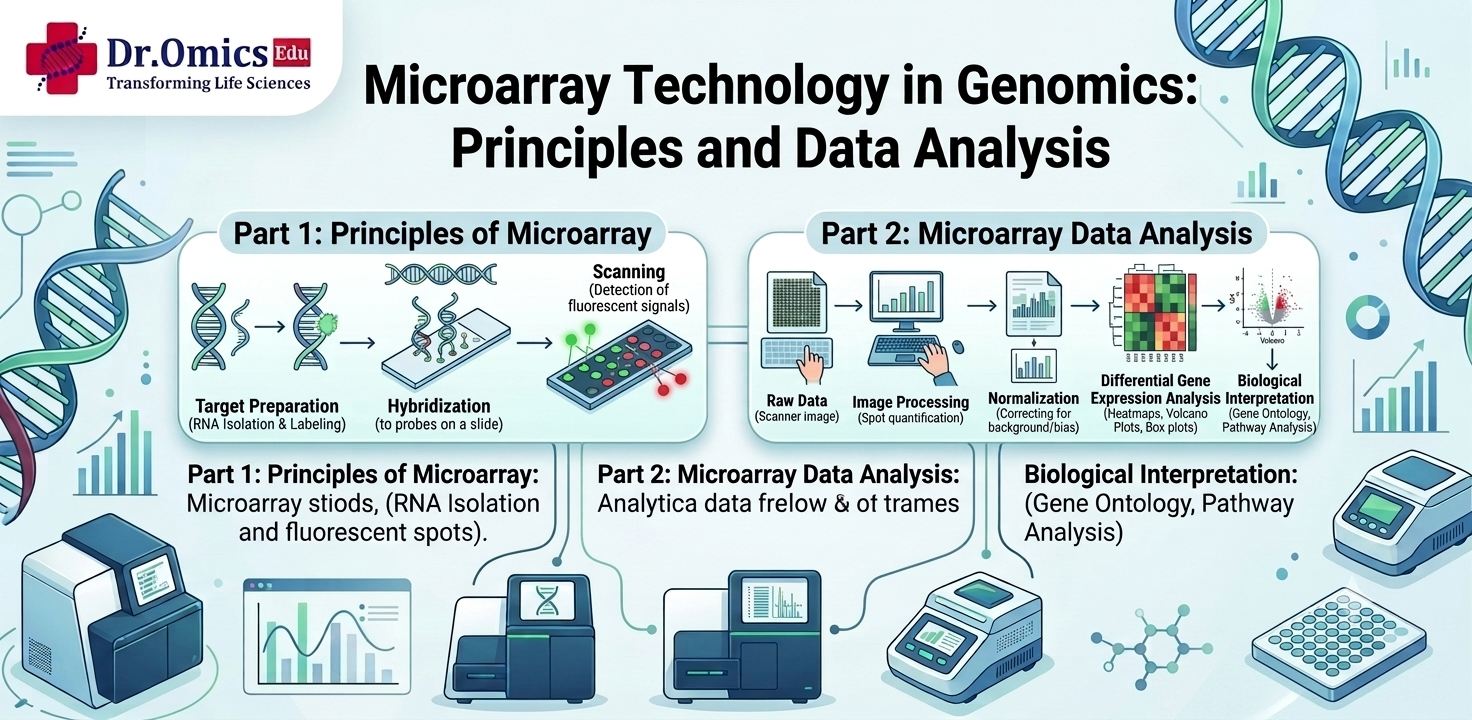
In a gene expression microarray experiment, RNA is extracted from a biological sample, converted into labeled material, and hybridized to probes on the array. The resulting signal intensity provides information about the relative expression of different genes.
The basic process is:
RNA Extraction → Labeling → Hybridization → Scanning → Data Processing → Biological Interpretation
Microarray Experiment Design
Good results begin with a well-planned microarray experiment design. Researchers need appropriate biological samples, control and experimental groups, sufficient replicates, and a clearly defined research question.
After the experiment, the generated expression data must be processed carefully to minimize technical variation.
Microarray Data Analysis
Microarray data analysis converts raw signal intensities into meaningful biological information.
A typical workflow includes:
Raw Data → Quality Control → Normalization → Statistical Analysis → Differentially Expressed Genes → Functional Analysis
Normalization is an important step because technical differences between arrays can affect measured expression levels.
Researchers can then identify genes that are significantly upregulated or downregulated between experimental conditions. Results are often visualized using heatmaps, clustering, PCA plots, and volcano plots.
Microarray Analysis Tools
Several bioinformatics platforms and packages can be used for microarray analysis. R and Bioconductor are widely used for preprocessing, normalization, differential expression, visualization, and downstream analysis.
Other tools can help researchers perform:
- Quality control
- Gene expression analysis
- Clustering
- Heatmap generation
- Gene Ontology analysis
- Pathway enrichment
Learning these tools provides valuable skills for working with transcriptomics datasets.
Microarray vs RNA-seq
A common question is microarray vs RNA-seq which technology is better?
Microarrays depend on predefined probes and are generally focused on known targets. RNA-seq directly sequences RNA-derived fragments and can provide a broader view of the transcriptome, including the potential detection of novel transcripts.
However, microarrays can still be useful because they are established, relatively straightforward to analyze, and have a large collection of existing datasets.
DNA Microarray Applications
Microarrays have applications across several areas of genomics:
- Disease research: Identifying disease-associated gene expression patterns
- Cancer research: Studying molecular signatures and gene activity
- Drug discovery: Understanding cellular responses to treatments
- Biomarker discovery: Identifying potential diagnostic or prognostic markers
- Agriculture: Studying plant growth, stress, and disease resistance
- Functional genomics: Investigating genes and biological pathways
Learn Microarray Analysis
For students and professionals entering bioinformatics, a microarray bioinformatics course can provide practical knowledge of gene expression analysis and computational biology.
A good learning path should cover microarray principles, microarray experiment design, normalization, differential expression, visualization, R/Bioconductor, and functional analysis.
If you want to learn microarray analysis, practicing with real-world gene expression datasets is one of the best ways to build confidence and develop practical bioinformatics skills.
The Role of Microarrays in Modern Genomics
Transcriptomics microarray technology continues to be an important part of genomics education, research, and data analysis. While RNA-seq has expanded transcriptomic research, understanding microarrays provides a strong foundation for learning gene expression analysis and bioinformatics.
Learn the technology. Analyze the data. Discover the biology.
