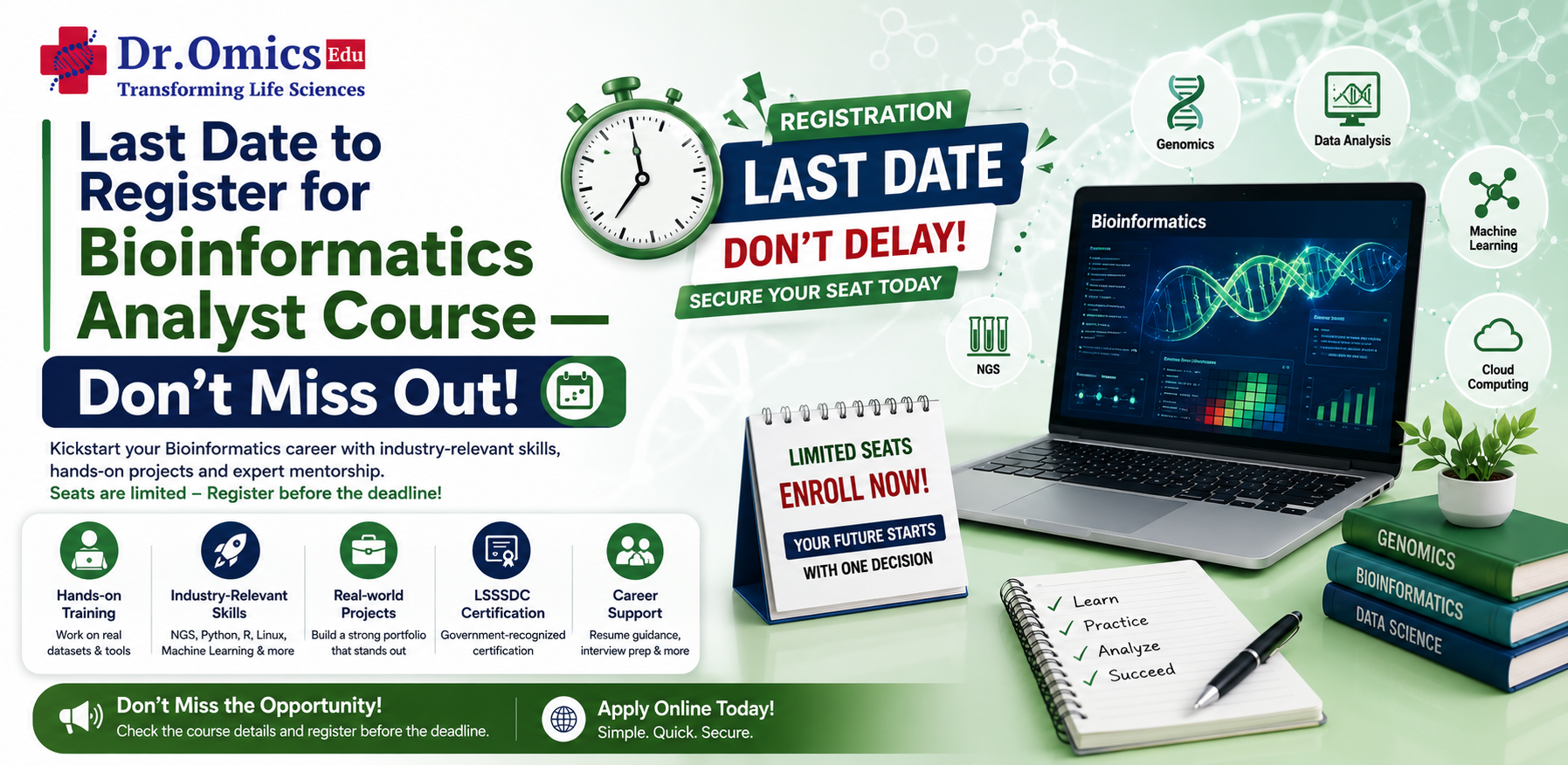
Last Date to Register for Bioinformatics Analyst Course — Don’t Miss Out!
Dr. Omics Edu Team ·
Planning to build a career in bioinformatics? If you have been waiting for the right time to start, this is the time to take action.
With genomics, next-generation sequencing, artificial intelligence, and biological data analysis becoming increasingly important, practical bioinformatics skills can give life-science students and professionals an important career advantage.
But before joining any program, one question matters:
When is the last date to register?
If you are planning to join a Bioinformatics Analyst Course in 2026, delaying your decision could mean missing the upcoming batch.
Important: The exact bioinformatics course last date can vary by batch and training provider. Always verify the current deadline directly with the institute before registering.
Why Is the Bioinformatics Registration Deadline Important?
Professional bioinformatics courses are often organized into specific batches. Once a batch reaches its registration deadline or capacity, new learners may need to wait for the next intake.
Registering early can help you:
- Secure your place in the upcoming batch
- Start learning without unnecessary delays
- Plan your study schedule
- Complete admission formalities on time
- Get access to course resources and orientation
- Begin your practical projects sooner
Instead of waiting until the final day, it is better to complete your bioinformatics course enrollment 2026 process as early as possible.
What Will You Learn in a Bioinformatics Analyst Course?
A professional Bioinformatics Analyst program should focus on practical skills rather than only theoretical concepts.
For example, the current Dr.Omics LSSSDC Bioinformatics Analyst program is structured as a six-month course and covers areas including NGS, Python, R, Linux, sequence analysis, variant calling, RNA-seq, microarray analysis, metagenomics, machine learning, statistics, databases, cloud computing, and data visualization.
A typical learning journey can include:
Bioinformatics Fundamentals
Students begin by understanding biological data and how computational approaches are used in modern life-science research.
Linux and Command Line
Linux is an essential skill for working with many bioinformatics tools and NGS workflows.
Python and R
Python can help with programming, automation, and data processing, while R is widely used for statistics, visualization, and biological data analysis.
NGS Analysis
Students can learn workflows involving sequencing quality control, alignment, quantification, variant analysis, and interpretation.
Real Projects
Project-based learning allows students to apply tools and concepts to biological datasets and develop practical experience.
Who Should Apply?
A Bioinformatics Analyst course can be suitable for students and professionals from backgrounds such as:
- Biotechnology
- Bioinformatics
- Microbiology
- Biochemistry
- Life Sciences
- Pharmacy
- Computational Biology
The current Dr.Omics LSSSDC Bioinformatics Analyst course lists a bachelor's degree in life sciences, biotechnology, bioinformatics, or a related field as preferred, along with a basic understanding of biology.
You don't necessarily need to be an expert programmer before starting. Programming and computational skills can be developed progressively through structured training.
Why Start in 2026?
Bioinformatics is expanding beyond traditional sequence analysis.
Today, professionals are increasingly working with:
- Genomics
- Transcriptomics
- Single-cell data
- Precision medicine
- AI and machine learning
- Drug discovery
- Clinical genomics
- Cloud-based analysis
This means students entering the field need more than just theoretical knowledge.
A strong learning pathway should combine:
Biology + Programming + Statistics + Linux + Bioinformatics Tools + Projects
Starting your training earlier gives you more time to practice these skills and build a portfolio.
Is a Bioinformatics Analyst Course Worth It?
If your goal is to enter bioinformatics, a structured course can help you build skills faster than learning everything independently.
However, the value of a course depends on what you actually gain from it.
Don't choose a program only because it offers a certificate.
Look for:
- Hands-on training
- Real datasets
- Practical assignments
- Industry-relevant tools
- Projects
- Trainer support
- Career guidance
The current Dr.Omics Bioinformatics Analyst program describes hands-on training, research guidance, publication support, and career-related assistance as part of its offering.
Final Reminder: Bioinformatics Course Enrollment 2026
If becoming a Bioinformatics Analyst is part of your 2026 career plan, don't keep postponing your decision.
The right training can help you move from simply understanding biological concepts to actually analyzing biological data and working with computational tools.
Before you register, make sure you verify the current bioinformatics course last date, eligibility, fee, curriculum, batch schedule, and certification details with the training provider.
