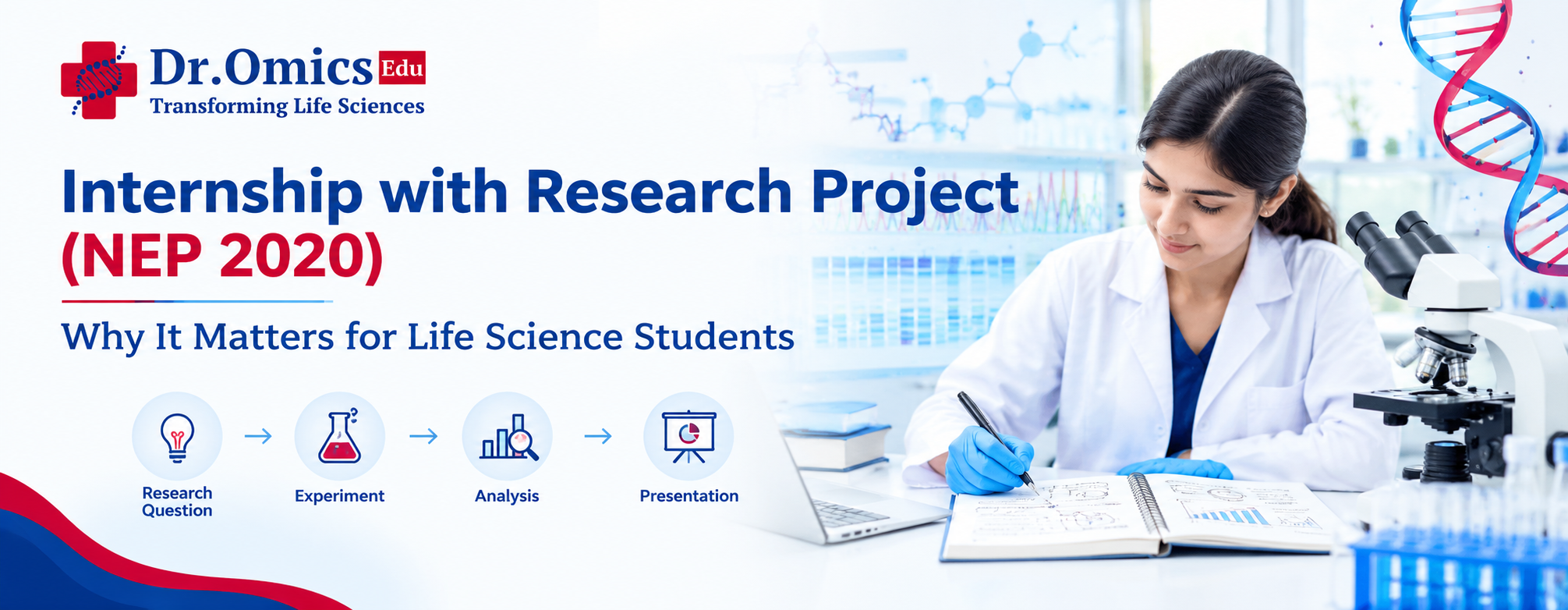
Internship with Research Project (NEP 2020): Why It Matters for Life Science Students
Dr. Omics Edu Team ·
Life sciences are evolving rapidly, with research, biotechnology, genomics, and bioinformatics creating new opportunities for students. Today, academic knowledge alone may not be enough to prepare students for research careers. Practical experience, analytical skills, and the ability to work on real scientific problems are equally important.
The National Education Policy (NEP) 2020 emphasizes experiential learning, skill development, and multidisciplinary education. In this context, an internship with a research project can help life science students connect classroom learning with practical research experience.
What Is an Internship with a Research Project?
An internship with a research project combines structured learning with a practical scientific assignment. Instead of only attending lectures or observing laboratory activities, students work on a defined research question under appropriate guidance.
A research internship may involve:
Reviewing scientific literature and identifying a research question.
Collecting or analyzing biological data.
Learning relevant laboratory or computational techniques.
Interpreting results and preparing visualizations.
Writing a project report and presenting findings.
For students interested in computational biology, a bioinformatics research project internship can provide experience in sequence analysis, genomic data interpretation, gene expression analysis, and biological databases.
How Does NEP 2020 Relate to Research Internships?
NEP 2020 promotes experiential learning, research exposure, practical skill development, and multidisciplinary education. Research-based internships can support these educational goals by encouraging students to apply concepts, investigate problems, and develop independent thinking.
However, the specific internship requirements, duration, assessment, and eligibility for academic credits depend on the applicable university or institutional guidelines.
Students should therefore confirm their institution's internship policy before enrolling, particularly when the internship is intended to fulfil a formal academic requirement.
Why Is a Research Internship Important for Biology Students?
A research internship for biology students can provide several benefits.
1. Practical skill development
Students gain experience applying theoretical concepts to scientific questions and learn how research workflows operate.
2. Research and analytical thinking
Working with biological data encourages students to interpret results, evaluate evidence, and understand scientific limitations.
3. Exposure to modern technologies
Depending on the project, students may learn bioinformatics tools, genomic databases, statistical methods, laboratory techniques, or data visualization.
4. Academic and career preparation
A completed project can help students demonstrate relevant skills when applying for higher studies, research positions, or industry opportunities.
5. Scientific communication
Preparing a report, presenting results, and explaining conclusions help students develop communication skills essential for research and biotechnology careers.
Why Choose a Bioinformatics Research Project Internship?
Bioinformatics combines biology, computer science, and statistics to analyze biological data. It is increasingly important in genomics, drug discovery, precision medicine, evolutionary biology, and biotechnology.
A bioinformatics research project internship can help students move beyond theoretical knowledge and understand how computational methods address biological questions.
Possible project areas include:
DNA sequence analysis and gene identification.
Protein sequence analysis and functional annotation.
RNA-seq data analysis and differential gene expression.
Gene–gene interaction network analysis.
Biological database mining and comparative genomics.
Through project-based learning in bioinformatics, students can develop practical skills, understand analysis workflows, and learn to interpret scientific findings.
Can an Internship Provide Academic Credits?
An academic credit internship may be possible when the internship meets the requirements established by the student's university or institution.
Before enrolling, students should verify:
Whether their institution accepts external internships.
Whether the proposed duration and project meet its requirements.
Whether a faculty mentor, assessment, report, or presentation is required.
Whether formal documentation or prior approval is necessary.
Similarly, students should not assume that every internship is a UGC approved internship. UGC recognition, university acceptance, and eligibility for academic credits are different matters. Students should verify the relevant approvals and institutional requirements before making a decision.
How to Choose the Right Research Internship
Before selecting an internship, consider the following:
Relevant project: Choose a project aligned with your academic background and career interests.
Structured mentorship: Look for guidance from qualified mentors throughout the project.
Practical experience: Confirm that you will complete meaningful research activities rather than only attend lectures.
Defined outcomes: Check whether the internship includes a project report, presentation, or other assessment.
Institutional acceptance: Confirm academic credit eligibility directly with your college or university if required.
Conclusion
An internship with a research project can help life science students develop practical skills, scientific thinking, and research confidence. In line with the experiential learning goals of NEP 2020, project-based internships offer opportunities to apply academic knowledge to real scientific questions.
For students interested in genomics and computational biology, a bioinformatics research project internship can provide valuable exposure to biological databases, sequence analysis, gene expression studies, and other modern research applications.
Choose a research project that matches your interests, offers meaningful mentorship, and supports your academic and professional goals.
