How Targeted Metagenomics Is Used in Microbiome Research
Dr. Omics Edu Team · · Updated
The human body, soil, oceans, and even the atmosphere host complex microbial ecosystems that play essential roles in health, agriculture, and environmental sustainability. Understanding these microbial communities has become a major focus of modern life sciences, and targeted metagenomics microbiome studies have emerged as one of the most efficient approaches for exploring them. Unlike whole metagenome sequencing, targeted metagenomics focuses on sequencing specific marker genes—such as the bacterial 16S rRNA gene, fungal ITS regions, or archaeal 18S rRNA genes—to identify and compare microorganisms within complex samples.
This approach has transformed microbiome research techniques, enabling researchers to characterize microbial diversity, monitor ecological changes, and investigate disease-associated microbial signatures with greater efficiency and lower sequencing costs.
What Is Targeted Metagenomics?
Targeted metagenomics is a sequencing strategy that amplifies and sequences conserved genetic markers present across microbial species. The most widely used approach is 16S sequencing microbiome analysis, where hypervariable regions of the bacterial 16S ribosomal RNA gene are amplified using PCR and sequenced using next-generation sequencing (NGS) platforms.
Because conserved regions allow universal primer binding while variable regions distinguish different taxa, researchers can accurately identify bacterial genera and, in many cases, species present in a sample. Similar marker-based sequencing strategies exist for fungi (ITS sequencing) and eukaryotic microorganisms (18S rRNA sequencing).
Compared with shotgun metagenomics, targeted metagenomics requires less sequencing depth, making it a cost-effective solution for large-scale microbiome studies.
Workflow of Targeted Metagenomics
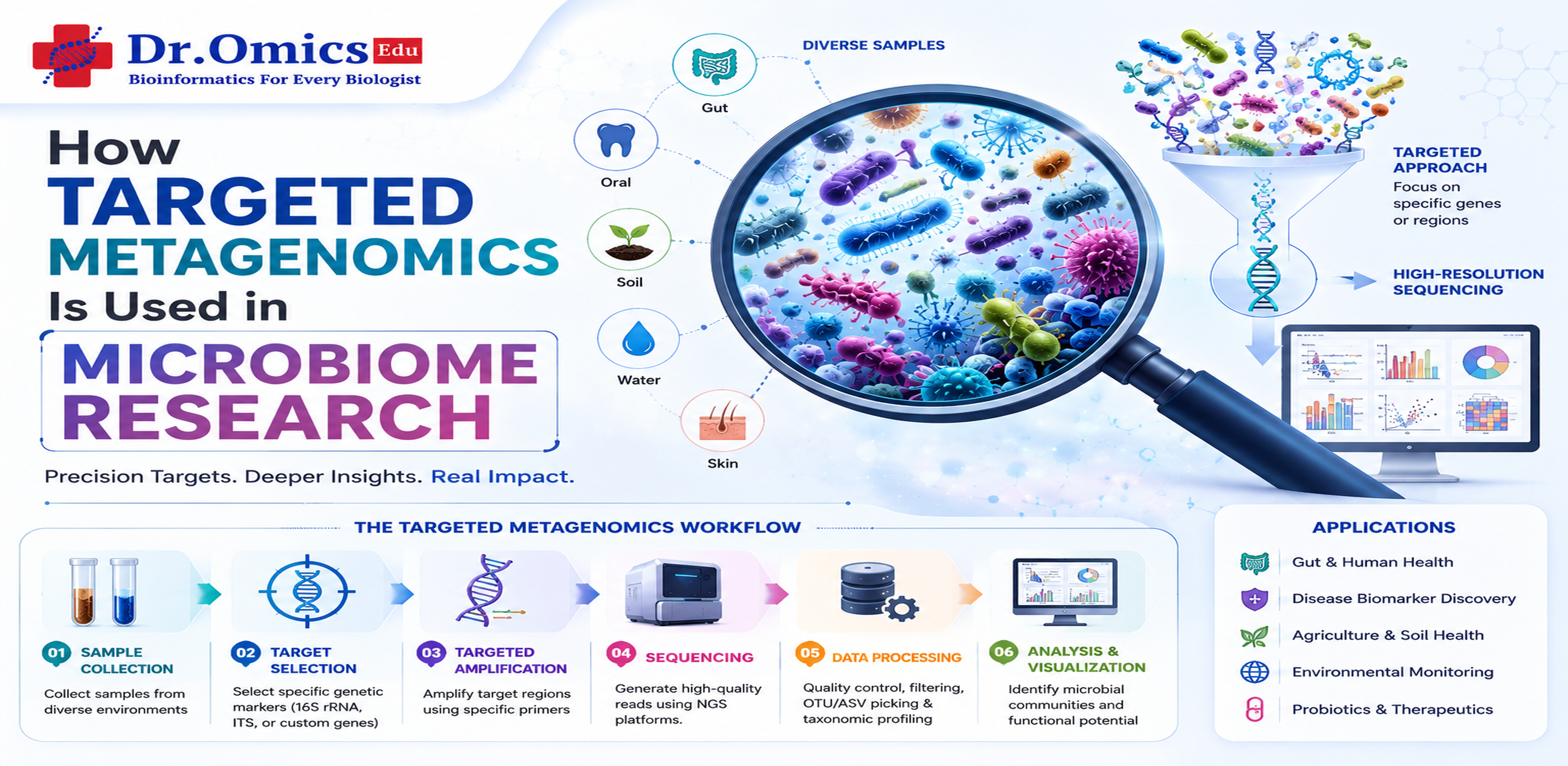
A standard targeted metagenomics workflow includes several critical steps:
- Sample Collection: Biological or environmental samples such as stool, saliva, soil, water, or plant tissues are collected under controlled conditions.
- DNA Extraction: High-quality microbial DNA is isolated while minimizing contamination and host DNA interference.
- PCR Amplification: Specific marker genes (commonly 16S rRNA V3–V4 or V4 regions) are amplified using universal primers.
- Library Preparation and Sequencing: Amplified products are converted into sequencing libraries and analyzed using platforms such as Illumina MiSeq.
- Bioinformatics Analysis: Raw sequencing reads undergo quality filtering, chimera removal, taxonomic assignment, and diversity analysis using pipelines like QIIME 2 or DADA2.
- Interpretation: Researchers perform microbial community analysis using alpha diversity, beta diversity, taxonomic abundance, phylogenetic comparisons, and statistical analyses to identify biologically meaningful patterns.
Applications in Microbiome Research
Modern metagenomics applications span numerous scientific disciplines.
In clinical research, targeted metagenomics helps identify microbial dysbiosis associated with inflammatory bowel disease, obesity, diabetes, cancer, neurological disorders, and infectious diseases. Researchers compare microbial profiles between healthy and diseased populations to discover potential diagnostic biomarkers and therapeutic targets.
Agricultural scientists use microbiome profiling to investigate plant-growth-promoting bacteria, improve crop productivity, monitor soil fertility, and develop sustainable farming practices.
Environmental microbiologists analyze microbial communities in oceans, rivers, wastewater treatment plants, and contaminated ecosystems to evaluate biodiversity, pollution impacts, and bioremediation potential.
Food microbiologists employ targeted sequencing to monitor fermentation processes, ensure food safety, detect spoilage organisms, and improve product quality.
Advantages and Limitations
The popularity of targeted metagenomics microbiome studies stems from several advantages. The technique is cost-effective, highly reproducible, suitable for processing hundreds of samples simultaneously, and supported by well-established analytical pipelines. It enables rapid taxonomic profiling without requiring extremely deep sequencing.
However, targeted sequencing also has limitations. Because only selected marker genes are sequenced, researchers cannot directly study microbial functional genes, metabolic pathways, or antibiotic resistance genes. PCR amplification may introduce primer bias, and species-level resolution may be limited for closely related organisms. For functional characterization, shotgun metagenomics remains the preferred approach.
Future Perspectives
Advances in sequencing chemistry, long-read technologies, AI-driven bioinformatics, and standardized analytical workflows are significantly improving the accuracy of 16S sequencing microbiome studies. Integration with metabolomics, transcriptomics, proteomics, and clinical metadata is enabling comprehensive systems-level understanding of microbial ecosystems.
As sequencing costs continue to decrease and computational tools become increasingly sophisticated, microbiome research techniques based on targeted metagenomics will remain indispensable for microbial community analysis across medicine, agriculture, biotechnology, and environmental science. These innovations are accelerating discoveries that support precision medicine, sustainable agriculture, and ecosystem conservation, making targeted metagenomics one of the most valuable and widely adopted metagenomics applications in modern biological research.
