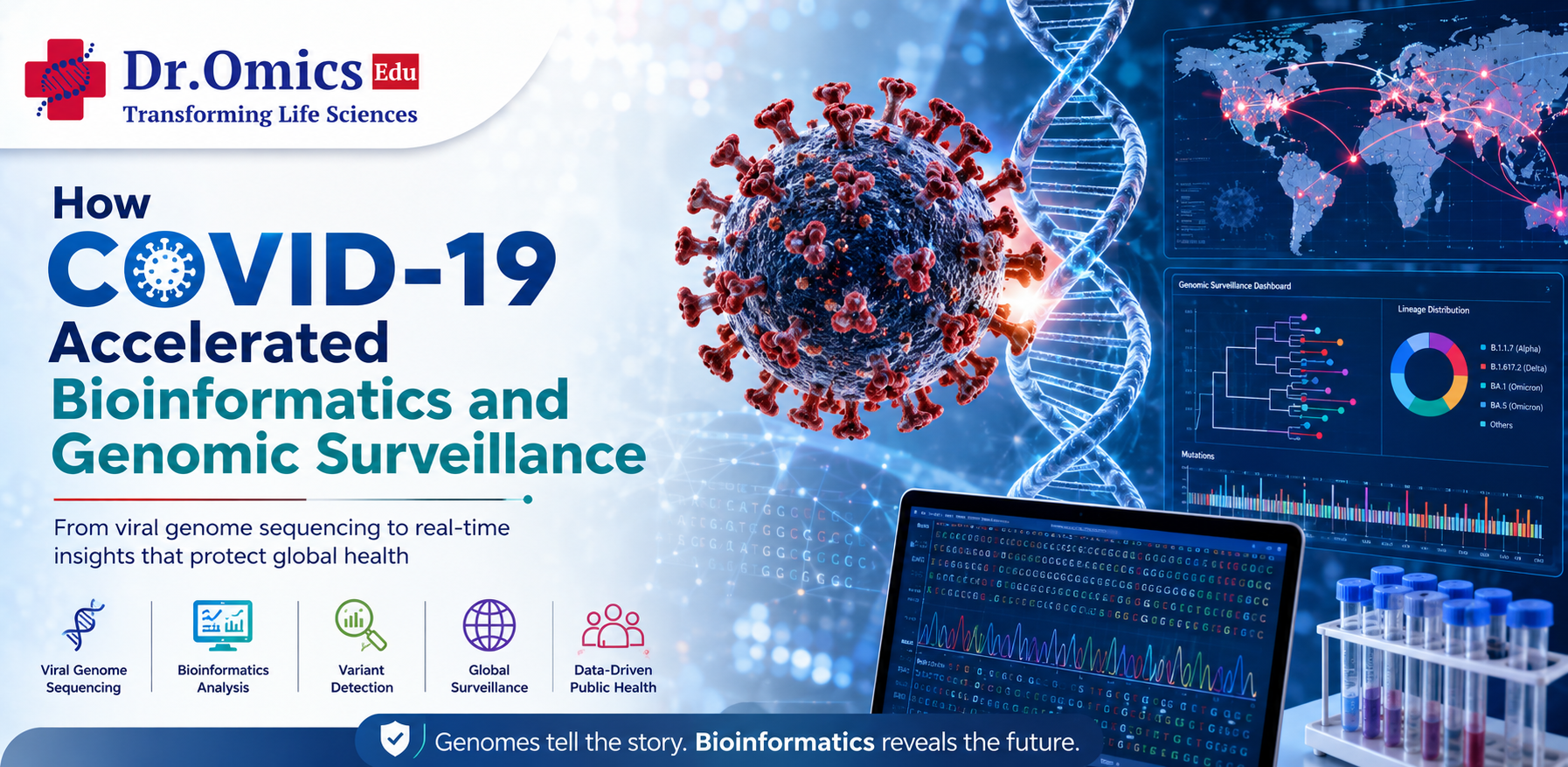
How COVID-19 Accelerated Bioinformatics and Genomic Surveillance
Dr. Omics Edu Team ·
The COVID-19 pandemic transformed genomic science from a specialized research discipline into a critical component of public-health decision-making. As SARS-CoV-2 spread rapidly across countries, scientists needed faster ways to identify viral mutations, track transmission, and detect emerging variants. This created an unprecedented demand for bioinformatics genomic surveillance and large-scale computational analysis.
From Viral Genome Sequencing to Real-Time Surveillance
One of the major advances during the pandemic was the rapid sequencing of SARS-CoV-2 genomes. Next-generation sequencing (NGS) technologies enabled laboratories to generate thousands to millions of viral genome sequences. However, sequencing alone was not sufficient. Bioinformatics pipelines were required to perform quality control, genome assembly or mapping, variant identification, annotation, and comparative genomic analysis.
These workflows enabled researchers to compare viral genomes collected from different patients, locations, and time points. Mutations could then be monitored to understand how SARS-CoV-2 was evolving.
Bioinformatics in Epidemiology
The integration of genomic data with epidemiological information significantly strengthened outbreak investigation. COVID-19 bioinformatics approaches helped researchers reconstruct transmission patterns, identify clusters, and understand how viral lineages moved through populations.
Phylogenetic analysis became particularly important. By comparing genetic differences between viral genomes, researchers could infer evolutionary relationships and identify the emergence and spread of distinct lineages. This provided an additional layer of information beyond traditional epidemiological methods.
Tracking Emerging Variants
The emergence of variants such as Alpha, Delta, and Omicron demonstrated why continuous genomic surveillance is essential. Computational tools allowed researchers to rapidly identify mutations and monitor their distribution across geographic regions.
Large genomic databases and international data-sharing initiatives made it possible to analyze viral evolution on an unprecedented scale. Pandemic genomics analysis therefore became an important component of global surveillance, supporting evidence-based responses to changing transmission patterns.
A Lasting Impact on Bioinformatics
COVID-19 accelerated the development and adoption of automated genomic workflows, cloud-based analysis, high-throughput sequencing, and large-scale data visualization. It also highlighted the importance of standardized pipelines and rapid sharing of genomic information.
Today, bioinformatics in epidemiology extends beyond COVID-19. The infrastructure, computational expertise, and surveillance strategies developed during the pandemic can be applied to influenza, antimicrobial resistance, emerging pathogens, and future outbreaks.
Conclusion
COVID-19 demonstrated that genomic surveillance is not simply a research activity—it is a powerful public-health tool. By combining viral genome sequencing, computational biology, phylogenetics, and epidemiological data, bioinformatics enabled scientists to monitor viral evolution and respond more effectively to an evolving pandemic. The lessons learned during COVID-19 are now shaping a more data-driven approach to global infectious-disease surveillance.
