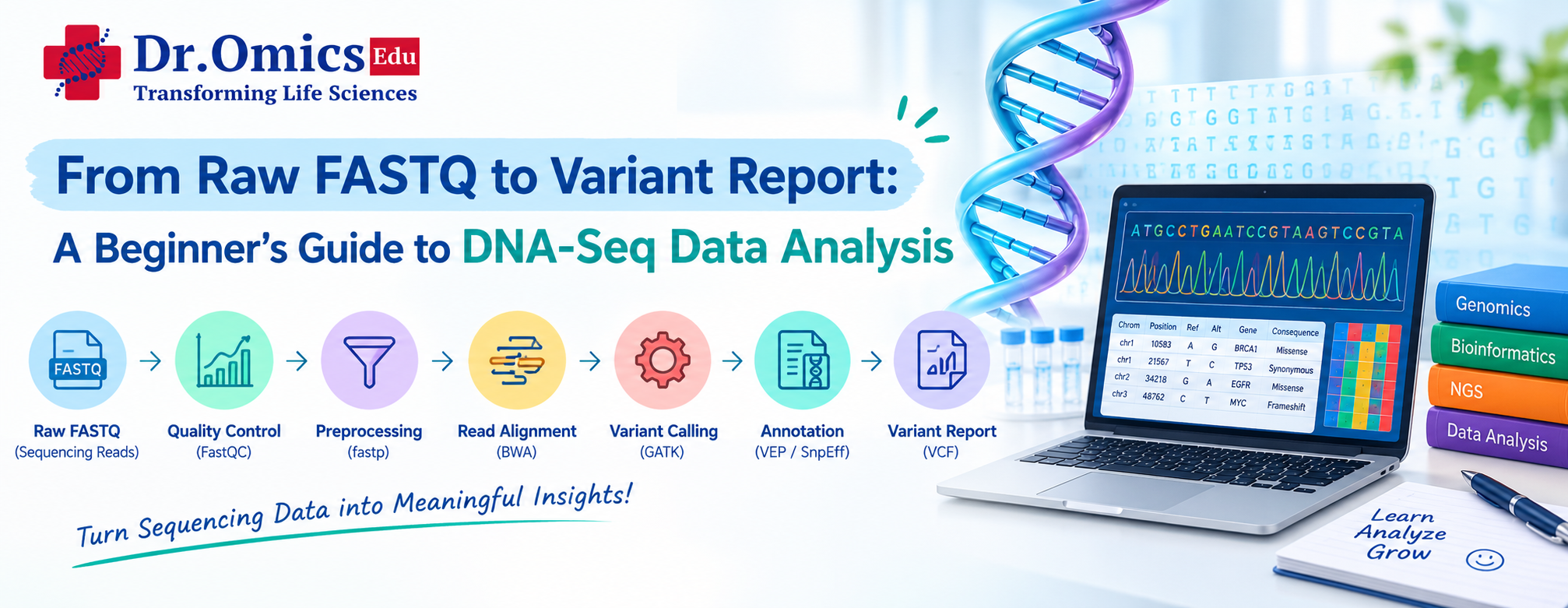
From Raw FASTQ to Variant Report: A Beginner’s Guide to DNA-Seq Data Analysis
Dr. Omics Edu Team ·
DNA sequencing helps researchers identify genetic variations that may be associated with diseases, biological traits, and evolutionary changes. However, raw sequencing data cannot be interpreted directly. It must pass through several bioinformatics steps before meaningful results can be obtained.
In this beginner-friendly guide, we explore the DNA-seq pipeline, from raw FASTQ files to variant identification and interpretation, using commonly used bioinformatics tools.
Understanding the DNA-Sequencing Workflow
A typical DNA sequencing bioinformatics workflow includes quality control, read preprocessing, genome alignment, variant calling, and variant annotation. Each step helps transform raw sequencing reads into biologically meaningful information.
1. FASTQ File Analysis: Check Your Raw Data
FASTQ files contain sequencing reads along with quality scores for each base. The first step is to assess read quality and identify potential issues such as adapter contamination, low-quality bases, and unusual sequence patterns.
Common tool: FastQC
If necessary, tools such as fastp can remove adapters and trim low-quality regions before downstream analysis.
2. Read Alignment: Map Reads to a Reference Genome
After quality assessment and preprocessing, sequencing reads are aligned to a reference genome. This step determines where the reads best match the reference sequence.
Popular genome alignment tools: BWA and Bowtie2
For many short-read DNA-sequencing workflows, read alignment using BWA is a widely used approach. The resulting alignment data are commonly stored in SAM or BAM format for further processing.
3. Process and Prepare Alignment Files
The aligned reads are typically converted into sorted BAM files, and alignment quality is assessed. Depending on the workflow, duplicate reads may also be marked to support more reliable variant analysis.
Common tools: SAMtools and Picard
These steps prepare the alignment data for variant calling and help identify potential technical issues.
4. Variant Calling: Identify Genetic Differences
Variant calling identifies differences between the sequencing reads and the reference genome, including single-nucleotide variants (SNVs) and small insertions or deletions (indels).
Common tools: GATK and FreeBayes
The results are generally stored in a VCF (Variant Call Format) file, which contains information about identified variants and associated quality metrics.
This is the core stage of a variant calling tutorial, where raw sequencing evidence begins to translate into a list of potential genetic variations.
5. Variant Annotation and Report Generation
Identifying variants is only part of the process. Annotation adds biological information, such as affected genes, predicted consequences, and relevant database references.
Common tools: Ensembl VEP and SnpEff
The annotated variants can then be filtered and reviewed to generate a report suitable for further research or interpretation. Results should be evaluated carefully, as computational predictions alone do not establish clinical significance.
DNA-Seq Pipeline at a Glance
Analysis step | Common tool | Main output |
Quality control | FastQC | Quality reports |
Read preprocessing | fastp | Clean FASTQ files |
Genome alignment | BWA | SAM/BAM alignment |
Alignment processing | SAMtools, Picard | Sorted and processed BAM files |
Variant calling | GATK, FreeBayes | VCF file |
Variant annotation | VEP, SnpEff | Annotated variants |
The exact tools and processing steps depend on the sequencing technology, experimental design, and analysis objectives.
Why Learn DNA-Seq Data Analysis?
Understanding this workflow helps students and researchers connect sequencing data with biological questions. It also builds a foundation for learning genome analysis, variant interpretation, and computational genomics.
At Dr. Omics Edu, learning about individual tools alongside the complete workflow can help beginners understand not just which tool to use, but why each step matters.
Start Your DNA-Seq Learning Journey
From FASTQ file analysis to variant annotation, every stage contributes to the quality and interpretation of sequencing results. Learning how these stages work together is an important first step toward mastering NGS bioinformatics.
Explore DNA sequencing and bioinformatics training opportunities with Dr. Omics Edu to strengthen your understanding of real-world sequencing analysis workflows.
