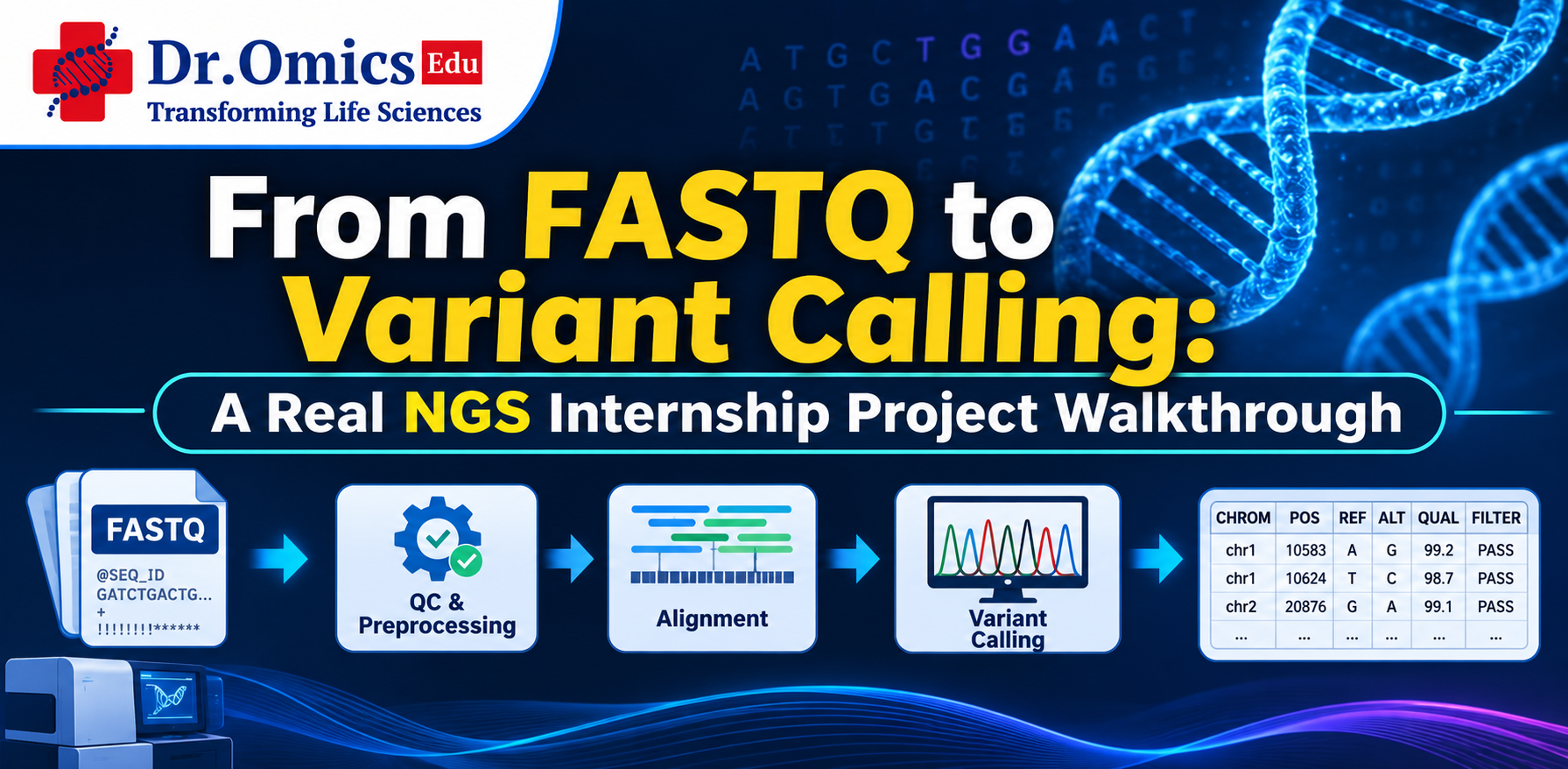
From FASTQ to Variant Calling: A Real NGS Internship Project Walkthrough
Dr. Omics Edu Team ·
Introduction
Next Generation Sequencing (NGS) has transformed genomics research by enabling scientists to identify genetic variations, investigate disease-associated mutations, and understand biological differences at an unprecedented scale. However, generating sequencing data is only the first step. Extracting meaningful biological information requires a systematic computational workflow involving quality control, read alignment, variant identification, and annotation.
For students entering bioinformatics, understanding this complete process is essential. A practical NGS internship provides an opportunity to move beyond theoretical concepts and work with sequencing datasets using industry-relevant tools.
In this blog, we explore an NGS project walkthrough, following a typical DNA sequencing analysis workflow from raw FASTQ files to annotated genetic variants.
Step 1: Understanding the FASTQ Data
The starting point of most NGS analysis workflows is the FASTQ file. It contains millions of sequencing reads generated by sequencing platforms such as Illumina.
Each FASTQ read contains four lines:
- Sequence identifier
- Nucleotide sequence
- Separator line
- Quality score information
Quality scores represent the confidence of each nucleotide call. Understanding FASTQ structure is important before performing downstream analysis.
During an internship, students learn to inspect raw sequencing files, understand read quality, and identify potential sequencing-related issues.
Step 2: FASTQ Quality Control and Preprocessing
Before aligning sequencing reads to a reference genome, their quality must be evaluated.
FASTQ quality control helps identify:
- Low-quality sequencing reads
- Adapter contamination
- Abnormal GC content
- Sequence duplication
- Overrepresented sequences
- Per-base quality variations
Commonly used tools include:
- FastQC: Generates quality control reports for sequencing reads.
- MultiQC: Combines reports from multiple samples into a single overview.
- fastp: Performs adapter trimming and quality filtering.
Students compare quality reports before and after preprocessing to understand how trimming improves the input data.
Step 3: Reference Genome Preparation
Once the sequencing reads are prepared, the next step is selecting an appropriate reference genome.
A reference genome provides the coordinate system against which sequencing reads are aligned.
Students learn about:
- Reference genome FASTA files
- Genome assemblies and versions
- Reference indexing
- Genome annotation files
- Chromosome naming conventions
Tools such as BWA can be used to index the reference genome for alignment.
Selecting the correct genome assembly is critical because differences between reference versions can affect downstream variant coordinates and interpretation.
Step 4: Sequence Alignment Using BWA
Read alignment identifies the genomic locations from which sequencing reads most likely originated.
BWA-MEM is commonly used for aligning short-read DNA sequencing data against a reference genome.
The general workflow involves:
- Indexing the reference genome.
- Aligning paired-end or single-end FASTQ reads.
- Generating SAM alignment files.
- Converting SAM files into BAM format.
- Sorting and indexing BAM files.
SAMtools is used for alignment file processing and quality assessment.
Students examine mapping statistics to understand mapped reads, unmapped reads, and alignment efficiency.
Step 5: Variant Calling Using GATK
After alignment, the next major objective is identifying genetic variations.
Variant calling detects differences between the sequencing reads and the reference genome.
These variations may include:
- Single Nucleotide Polymorphisms (SNPs)
- Insertions
- Deletions (indels)
The Genome Analysis Toolkit (GATK) provides widely used tools for variant discovery.
A typical workflow includes:
- BAM file quality checks.
- Duplicate marking where appropriate.
- Base quality score recalibration when supported by the analysis design and available resources.
- Variant calling using HaplotypeCaller.
- Generation of VCF files.
The resulting VCF file contains information about detected variants, including genomic position, reference allele, alternative allele, and supporting quality information.
This stage forms the core of a variant calling internship project.
Step 6: Variant Annotation and Biological Interpretation
Identifying variants is not enough. Researchers must understand their potential biological significance.
Variant annotation adds information about the consequences of genetic changes.
Commonly used tools include:
- SnpEff: Predicts variant effects on genes and transcripts.
- Ensembl VEP: Provides detailed variant consequence annotations.
- IGV: Allows visual inspection of sequencing alignments and genomic regions.
Students learn to interpret synonymous, missense, nonsense, and splice-site variants and understand how genomic changes may affect protein function.
It is important to distinguish predicted variant effects from experimentally validated biological consequences.
Step 7: Project Integration and Final Reporting
The final stage combines all the individual analytical steps into a reproducible workflow.
A typical NGS pipeline hands-on project may follow this structure:
Analysis stage | Tools |
| Raw data quality control | FastQC |
| Quality report aggregation | MultiQC |
| Read preprocessing | fastp |
| Reference indexing | BWA |
| Read alignment | BWA-MEM |
| BAM processing | SAMtools |
| Variant calling | GATK |
| Variant annotation | SnpEff / VEP |
| Visualization | IGV |
Students document commands, parameters, software versions, quality metrics, and important findings.
The final report should include the methodology, analytical results, visualizations, and biological interpretation.
What Do Students Gain from This Project?
This genomics internship case study demonstrates how theoretical knowledge can be translated into practical computational experience.
By completing the workflow, students gain exposure to:
- Linux command-line operations.
- NGS data formats and file management.
- Quality control and preprocessing.
- Reference-based sequence alignment.
- SNP and indel identification.
- Variant annotation and interpretation.
- Scientific documentation and reporting.
More importantly, they learn how different bioinformatics tools work together to solve a biological research problem.
Conclusion
The journey from FASTQ files to annotated variants represents one of the fundamental workflows in DNA sequencing analysis. Each stage contributes to the accuracy, reliability, and biological interpretation of the final results.
A practical NGS internship helps students understand this complete workflow through guided demonstrations, real sequencing datasets, and hands-on project execution.
For aspiring bioinformaticians, working on an end-to-end variant analysis project is an excellent way to build computational confidence and develop skills relevant to modern genomics research.
