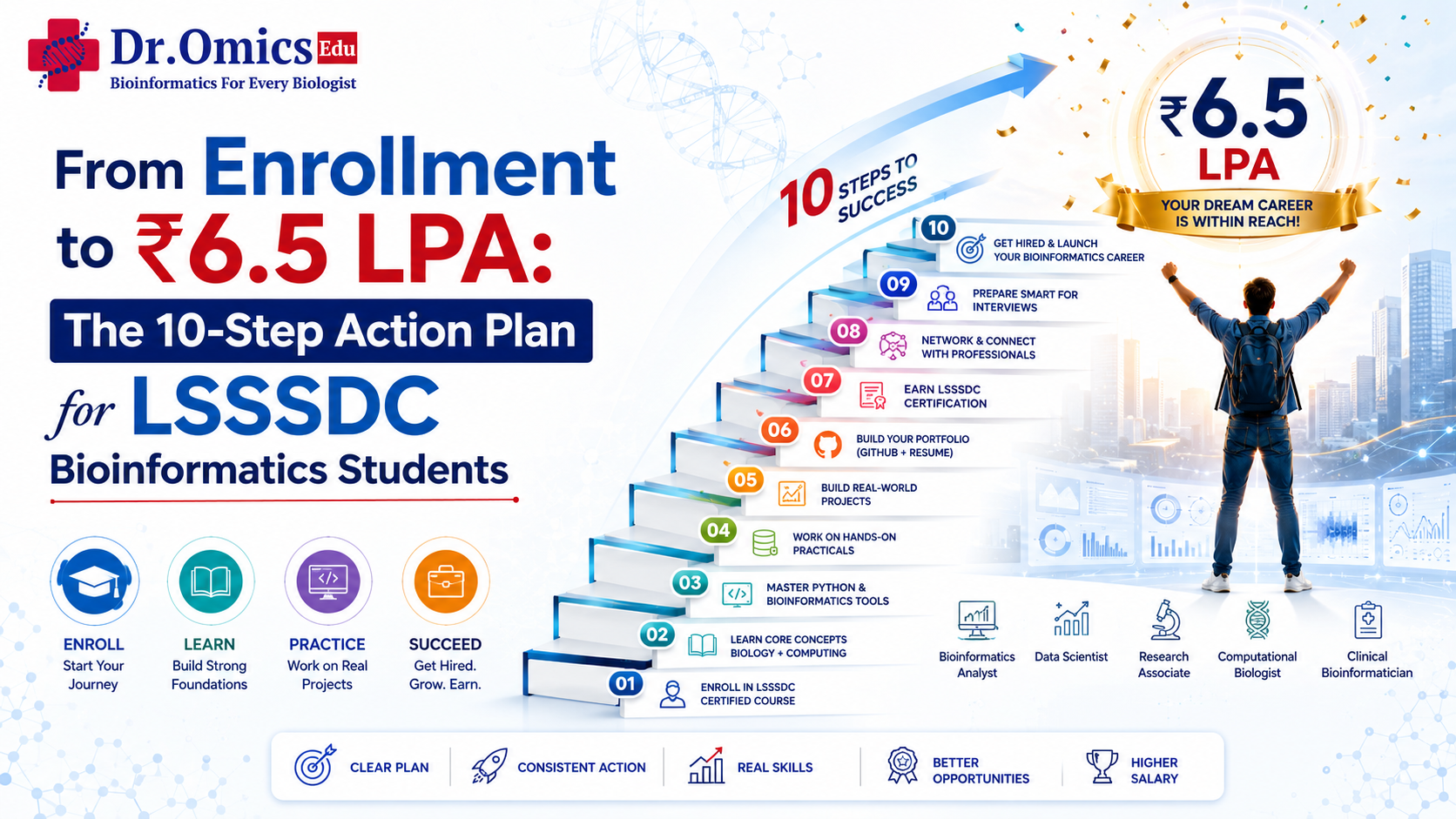
From Enrollment to ₹6.5 LPA: The 10-Step Action Plan for LSSSDC Bioinformatics Students
Dr. Omics Edu Team · · Updated
The bioinformatics industry in India is growing rapidly, with pharmaceutical companies, biotechnology firms, healthcare organizations, and research institutes actively seeking skilled professionals. However, earning an LSSSDC Bioinformatics certification is only the beginning. Success depends on how effectively you apply your knowledge, develop practical skills, and prepare for industry expectations.
If your goal is to secure a rewarding bioinformatics career, this LSSSDC bioinformatics action plan will guide you from your first day of enrollment to becoming a confident job-ready professional.
Step 1: Build Strong Fundamentals
Before working on advanced tools, ensure you understand the basics of molecular biology, genetics, genomics, statistics, and programming. A strong conceptual foundation makes learning bioinformatics software much easier and improves problem-solving abilities during interviews.
Step 2: Master Industry-Standard Bioinformatics Tools
Employers expect candidates to have hands-on experience with commonly used software rather than just theoretical knowledge. Focus on developing proficiency in Linux, Python, R, NCBI databases, BLAST, sequence alignment tools, molecular visualization software, RNA-Seq analysis pipelines, and Next Generation Sequencing (NGS) workflows.
The objective is not simply to get certified in bioinformatics, but to confidently use these tools in real-world scenarios.
Step 3: Develop a Professional Bioinformatics Portfolio
Recruiters appreciate candidates who can demonstrate practical work. Create a strong bioinformatics portfolio containing completed assignments, workflow diagrams, scripts, case studies, research summaries, GitHub repositories, and project reports.
A well-organized portfolio highlights your technical capabilities and distinguishes you from applicants who possess only certificates.
Step 4: Work on Real NGS Projects
Practical experience significantly increases employability. Explore multiple NGS project ideas, including differential gene expression analysis, variant calling, microbiome analysis, single-cell RNA sequencing, cancer genomics, and genome assembly.
Each completed project enhances both your technical confidence and your resume.
Step 5: Learn Data Interpretation
Generating results is only part of the job. Employers value professionals who can interpret biological significance, explain statistical findings, and communicate conclusions effectively using visualizations and scientific reports.
Develop the habit of explaining your analysis rather than simply presenting output files.
Step 6: Strengthen Your Communication Skills
Bioinformaticians frequently collaborate with biologists, clinicians, software developers, and research scientists. Improve your scientific writing, presentation skills, and ability to explain complex analyses in simple language.
Strong communication often becomes the deciding factor during interviews.
Step 7: Focus on Networking
Professional growth extends beyond technical expertise. Active networking for bioinformaticians can open doors to internships, collaborations, referrals, and job opportunities.
Attend webinars, scientific conferences, workshops, hackathons, and connect with professionals on LinkedIn. Engaging with the bioinformatics community keeps you informed about emerging technologies and industry trends.
Step 8: Prepare for Technical Interviews
To crack bioinformatics interview rounds, revise molecular biology concepts, practice Linux commands, coding problems, sequencing workflows, statistical analysis, and common interview questions. Mock interviews and project discussions help improve confidence while identifying areas that need improvement.
Interview preparation should begin well before placements start.
Step 9: Stay Updated with Emerging Technologies
Bioinformatics evolves continuously. Learn about artificial intelligence, machine learning applications, multi-omics integration, long-read sequencing, cloud computing, and automated workflow management. Continuous learning demonstrates adaptability and long-term career potential.
Step 10: Follow a Structured Career Roadmap
Every successful professional follows a clear plan. Create your personalized career roadmap India by setting monthly learning goals, completing certifications, building projects, expanding your network, and regularly updating your portfolio.
Consistency matters more than speed. Small improvements every week eventually lead to significant career growth.
Final Thoughts
An LSSSDC certification provides an excellent foundation, but career success comes from consistent practice, project experience, continuous learning, and professional networking. Students who combine technical expertise with practical problem-solving and effective communication stand out in today's competitive job market.
Follow this 10-step roadmap with dedication, build meaningful projects, and continuously improve your skills. With the right approach, your journey can truly progress from enrollment to a successful bioinformatics career—and even achieving salary packages of ₹6.5 LPA and beyond.
