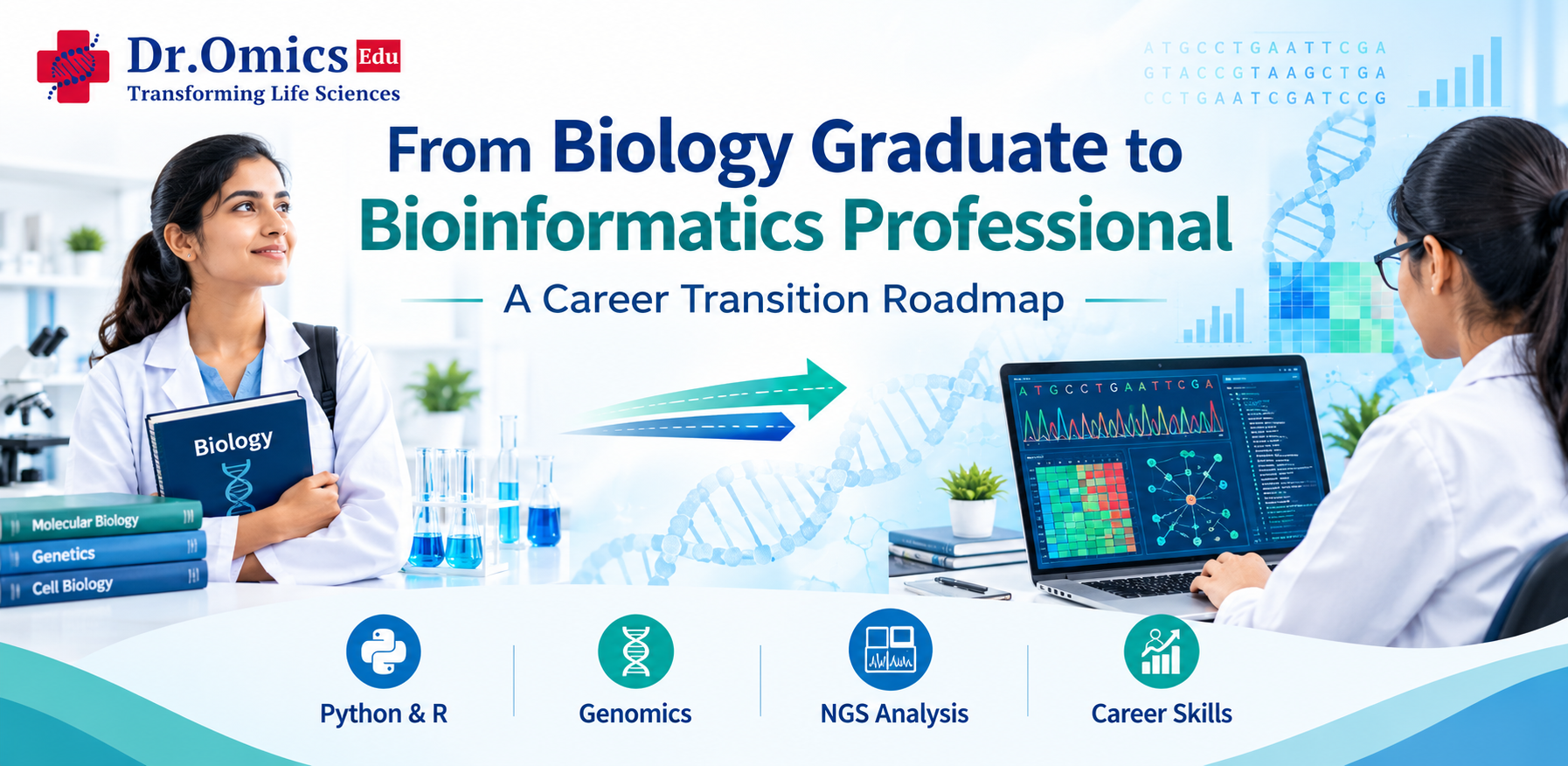
From Biology Graduate to Bioinformatics Professional: A Career Transition Roadmap
Dr. Omics Edu Team ·
Have a biology degree but want to explore opportunities in technology-driven life sciences? Bioinformatics could be your next career move.
Biology graduates today have opportunities beyond traditional laboratory research. With the growing use of genomic sequencing, computational biology, and data-driven drug discovery, bioinformatics offers a way to combine biological knowledge with programming and data analysis.
If you are considering a biology to bioinformatics career switch, you do not need to become an expert programmer overnight. A structured learning plan, practical projects, and the right technical skills can help you begin your transition.
1. Why Consider a Career Transition into Bioinformatics?
Bioinformatics connects biology, computer science, and statistics to analyze complex biological datasets. It is used in genomics, transcriptomics, drug discovery, precision medicine, and biotechnology research.
For biology graduates, this transition offers an opportunity to apply existing scientific knowledge to computational research.
A career transition in life sciences can be particularly suitable for graduates who enjoy understanding biological problems, analyzing research data, and learning new technologies.
2. Essential Skills to Learn
The first step is to build the technical foundation required for bioinformatics roles.
- Python or R: Learn programming fundamentals and biological data analysis.
- Linux: Understand command-line operations and file management.
- Biological databases: Explore NCBI, Ensembl, UniProt, and related resources.
- Sequence analysis: Practice BLAST, sequence alignment, and basic genomics workflows.
- NGS analysis: Learn quality control, read alignment, variant analysis, and RNA-seq basics.
- Statistics and visualization: Understand data interpretation and communicate results clearly.
Effective upskilling for biology students means learning these skills step by step and applying them to real biological questions rather than simply memorizing tool names.
3. Follow a Practical Career Transition Roadmap
Stage | What to focus on |
Month 1 | Biology revision, Python basics, and Linux |
Month 2 | Biological databases, BLAST, and sequence analysis |
Month 3 | NGS fundamentals and RNA-seq workflows |
Month 4 | Complete a project using public biological datasets |
Month 5 | Choose a specialization and strengthen your portfolio |
Month 6 | Prepare your resume, practice interviews, and apply for suitable roles |
This is an illustrative six-month plan, not a fixed requirement. Your timeline will depend on your existing skills, available study time, and target role.
4. Can Bioinformatics Certification Help You Change Careers?
A bioinformatics certification for career change can provide structured learning, guided practice, and exposure to commonly used tools. However, a certificate alone does not guarantee employment.
Before choosing a course, check whether it includes practical assignments, real datasets, relevant software, project work, and feedback from experienced instructors.
Build a small portfolio alongside your training. For example, analyze a public RNA-seq dataset, identify differentially expressed genes, visualize the results, and document your biological interpretation.
A completed project gives potential employers a clearer picture of your practical abilities.
5. Career Opportunities After the Transition
A biotech career pivot into computational work can lead to several possible career paths, depending on your qualifications and technical preparation.
Common roles include:
- Bioinformatics Analyst
- NGS Data Analyst
- Research Associate
- RNA-seq Analyst
- Genomics Data Analyst
- Computational Biology Researcher
Some positions are open to fresh graduates, while others require postgraduate qualifications, research experience, or specialized technical skills. Review individual job descriptions to identify the most relevant learning path.
6. How to Make Your Transition Successful
Keep your career transition focused and practical.
- Start with programming and Linux fundamentals.
- Learn tools that match your intended job role.
- Practice using publicly available biological datasets.
- Document your projects and explain your results clearly.
- Update your resume to highlight both biological knowledge and computational skills.
- Apply consistently while continuing to improve your technical abilities.
Remember, your biology background is an advantage. Understanding genes, proteins, disease mechanisms, and experimental research helps you interpret computational results in a meaningful scientific context.
Final Thoughts
Moving from biology to bioinformatics is a gradual process of building new skills on top of your existing scientific foundation. With structured learning, consistent practice, and relevant projects, you can prepare for opportunities in computational biology, genomics, and biotechnology research.
At Dr. Omics Labs, learners can explore bioinformatics training in Python, NGS data analysis, RNA-seq, and related computational workflows to support their professional development.
Your biology degree is your starting point. The right skills can help you take the next step toward a career in bioinformatics.
