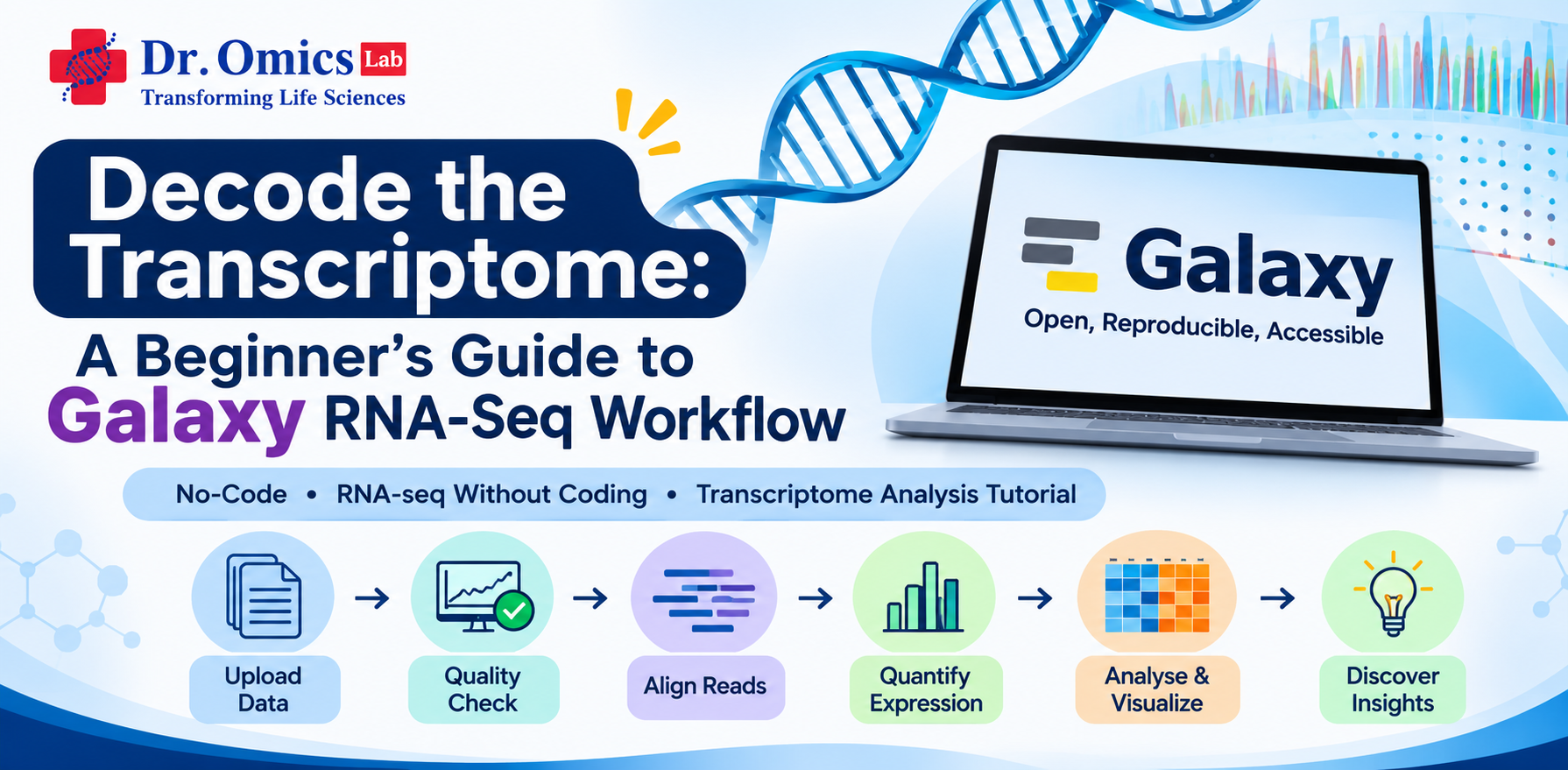
Decode the Transcriptome: A Beginner's Guide to Galaxy RNA-Seq Workflow
Dr. Omics Edu Team ·
Understanding how genes respond to different biological conditions is essential in modern molecular biology and biomedical research. RNA sequencing (RNA-seq) has become a powerful technology for studying gene expression, identifying differentially expressed genes, and exploring molecular mechanisms underlying diseases, treatments, and cellular responses.
However, analysing RNA-seq data involves multiple computational steps, which can be challenging for beginners without programming experience. This is where the Galaxy bioinformatics platform provides an accessible solution.
What Is Galaxy and Why Use It for RNA-Seq?
Galaxy is an open-source, web-based platform that provides access to bioinformatics tools through a graphical user interface. Researchers can perform complex computational analyses by selecting tools, uploading datasets, configuring parameters, and executing workflows without writing extensive scripts.
For beginners, no-code RNA-seq analysis makes it easier to understand the complete transcriptomics pipeline while focusing on biological interpretation rather than command-line operations.
Galaxy also maintains analysis histories, records tool parameters, and supports reusable workflows, helping researchers improve the reproducibility of their experiments.
Understanding the Galaxy RNA-Seq Workflow
A typical reference-based Galaxy RNA-seq workflow involves several important stages, beginning with raw sequencing reads and progressing towards biological interpretation.
1. Data Upload and Preparation
RNA-seq datasets are generally obtained from sequencing repositories such as NCBI Sequence Read Archive (SRA). The raw sequencing reads are usually available in FASTQ format.
These files can be uploaded directly into Galaxy or imported using supported data retrieval tools. Each sample should be labelled carefully, particularly when working with control and treated experimental groups.
2. Quality Control Using FastQC
Before downstream analysis, sequencing quality must be evaluated. FastQC helps identify potential issues such as low-quality bases, adapter contamination, abnormal GC content, and sequence duplication.
If necessary, tools such as fastp or Cutadapt can be used for adapter removal and quality trimming. MultiQC can subsequently combine quality reports from multiple samples into a single summary.
3. Read Alignment Using HISAT2
After quality assessment, sequencing reads are aligned against a reference genome using splice-aware aligners such as HISAT2 or STAR.
Unlike genomic DNA sequencing, RNA-seq reads may span exon-exon junctions. Therefore, splice-aware alignment is essential for accurately mapping reads originating from processed transcripts.
4. Gene-Level Quantification Using featureCounts
Once alignment is completed, featureCounts assigns mapped reads to annotated genomic features, generally exons, to calculate gene-level expression counts.
The resulting count matrix represents the number of sequencing reads associated with each gene across different samples.
5. Differential Gene Expression Analysis
The count matrix is used for statistical analysis with tools such as DESeq2 or limma-voom.
Differential expression analysis identifies genes showing statistically supported expression changes between experimental conditions.
Important output parameters include log2 fold change, adjusted p-value (padj), and normalized expression values. Volcano plots, heatmaps, and PCA plots help researchers explore these results.
6. Functional and Pathway Analysis
The final stage involves biological interpretation. Gene Ontology (GO) enrichment and KEGG pathway analysis help identify biological processes, molecular functions, and pathways associated with differentially expressed genes.
This step connects computational findings with meaningful biological questions.
Why Learn RNA-seq Without Coding?
Learning RNA-seq without coding allows students, life science graduates, and early-stage researchers to understand the principles of transcriptome analysis without first mastering programming languages.
Galaxy provides an excellent learning environment because users can explore individual tools, monitor intermediate results, and build complete workflows through an interactive interface.
However, no-code analysis does not eliminate the need for scientific understanding. Experimental design, biological replicates, appropriate statistical methods, reference selection, and result interpretation remain essential.
Conclusion
Galaxy makes transcriptome analysis more accessible by integrating essential bioinformatics tools into a single web-based environment. Following a structured transcriptome analysis tutorial helps beginners understand how raw sequencing reads are transformed into gene expression profiles and biological insights.
Whether you are a student entering bioinformatics or a researcher exploring gene expression, learning the Galaxy RNA-seq workflow provides a practical foundation for modern transcriptomics research.
Explore RNA-seq analysis with Galaxy and take your first step towards decoding the transcriptome!
