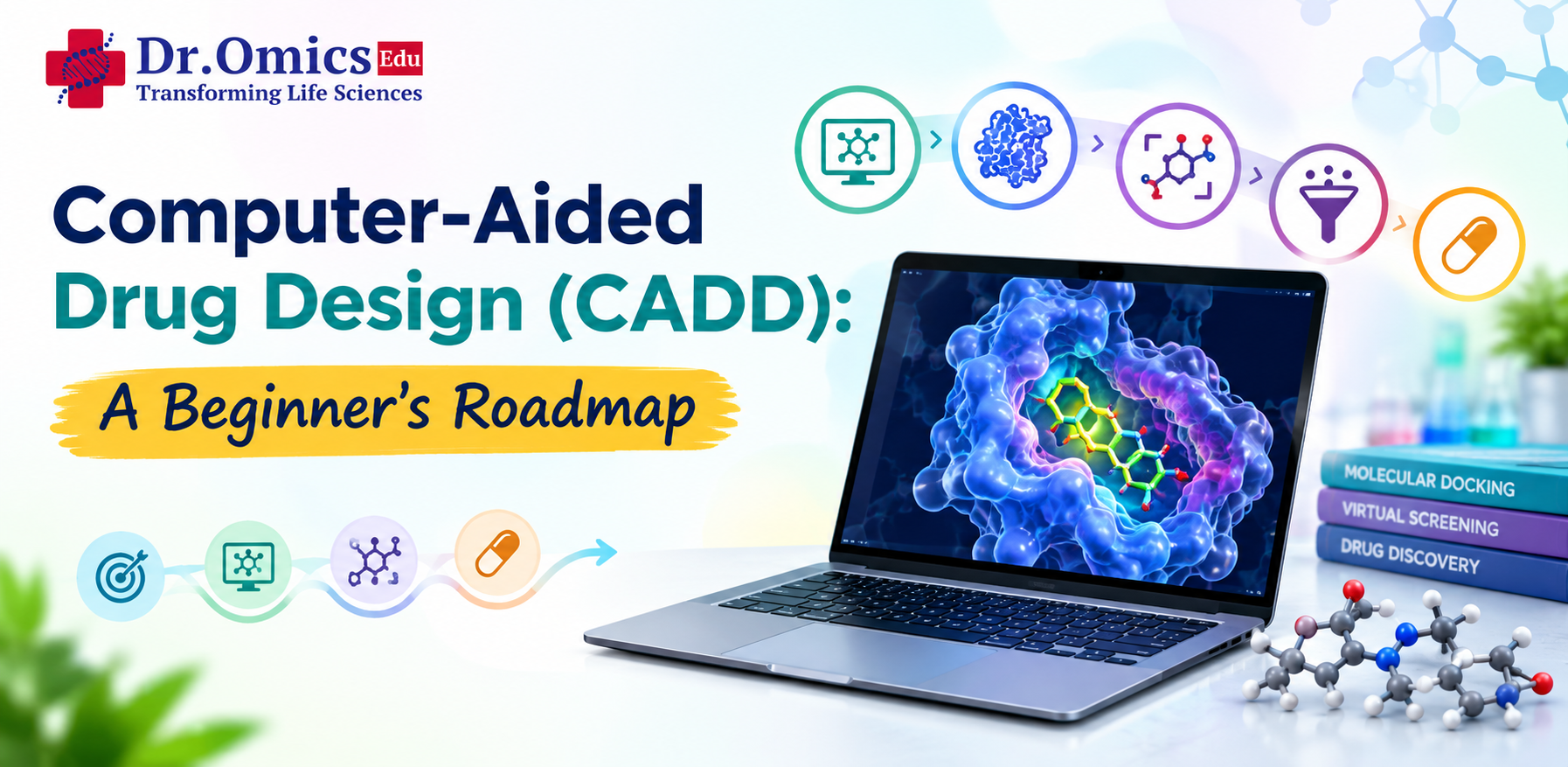
Computer-Aided Drug Design (CADD): A Beginner's Roadmap
Dr. Omics Edu Team · · Updated
Drug discovery is a complex and time-consuming process. With advances in computational biology, researchers can now use computers to identify and evaluate potential drug candidates before extensive laboratory testing. This approach is known as Computer-Aided Drug Design (CADD).
For students and beginners interested in bioinformatics, biotechnology, pharmaceutical research, or computational biology, CADD provides an exciting opportunity to explore modern in silico drug discovery.
What Is Computer-Aided Drug Design?
Computer aided drug design (CADD) uses computational methods and software to study drug molecules and their interactions with biological targets.
CADD can help researchers:
- Identify and study potential drug targets
- Analyze protein structures
- Predict protein–ligand interactions
- Screen large compound libraries
- Evaluate drug-like properties
- Prioritize promising compounds for laboratory testing
CADD does not replace experimental research. Instead, it helps researchers reduce the number of compounds that need to be tested in the laboratory.
Understanding Structure-Based Drug Design
Structure based drug design is an important area of CADD. It uses the three-dimensional structure of a protein or other biological target to identify compounds that may bind to it.
A simplified workflow is:
Target Selection → Protein Structure → Binding Site Identification → Ligand Preparation → Molecular Docking → Interaction Analysis → Lead Selection
Understanding this workflow is one of the first steps for anyone starting a CADD journey.
Molecular Docking: A Beginner's Starting Point
Molecular docking is one of the most commonly learned techniques in CADD.
In a typical molecular docking tutorial, you work with:
- Receptor: The target protein
- Ligand: A small molecule that may bind to the protein
Docking software predicts possible binding poses and provides scores that can help researchers rank compounds.
However, a good docking score does not prove that a compound is an effective drug. Docking results need to be interpreted carefully and supported by further computational and experimental studies.
Virtual Screening and CADD Tools for Beginners
When researchers need to evaluate thousands of compounds, virtual screening can help identify promising candidates more efficiently.
Beginners can start by learning tools for:
- Molecular visualization
- Protein and ligand preparation
- Molecular docking
- Virtual screening
- Drug-likeness analysis
- Protein–ligand interaction analysis
A practical virtual screening course can help learners understand how these tools are combined into a complete workflow.
How to Start Learning CADD
If you are new to CADD, follow this simple roadmap:
1. Learn the Basics
Understand proteins, ligands, drug targets, and molecular interactions.
2. Learn Molecular Visualization
Practice viewing protein structures and identifying binding sites.
3. Practice Molecular Docking
Start with a simple docking project and learn how to interpret the results.
4. Explore Virtual Screening
Move from individual compounds to screening compound libraries.
5. Learn Advanced Techniques
Gradually explore molecular dynamics, QSAR, pharmacophore modeling, ADMET prediction, and AI-based drug discovery.
CADD Course and Internship: Building Practical Skills
A structured CADD course can help beginners learn the concepts and tools in the correct order. Look for courses that include hands-on practice with protein structures, molecular docking, virtual screening, and result analysis.
A CADD internship can provide valuable exposure to real computational drug discovery projects and help learners build practical experience and project portfolios.
CADD Career Opportunities
The growing use of computational methods in pharmaceutical and biotechnology research is creating new CADD career opportunities.
Possible career areas include:
- Computational drug discovery
- Molecular modeling
- Bioinformatics
- Computational chemistry
- Virtual screening
- Pharmaceutical R&D
- Biotechnology research
Combining CADD with programming, bioinformatics, data analysis, and machine learning can further expand career opportunities.
Conclusion
Computer aided drug design is an important part of modern drug discovery. Beginners can start with protein structures and molecular interactions, move into molecular docking and virtual screening, and gradually explore advanced computational techniques.
Whether you are planning to join a CADD course, pursue a CADD internship, or build a career in computational drug discovery, hands-on projects are one of the best ways to develop practical skills.
With the right foundation, CADD can be an excellent pathway into drug design bioinformatics and in silico drug discovery.
