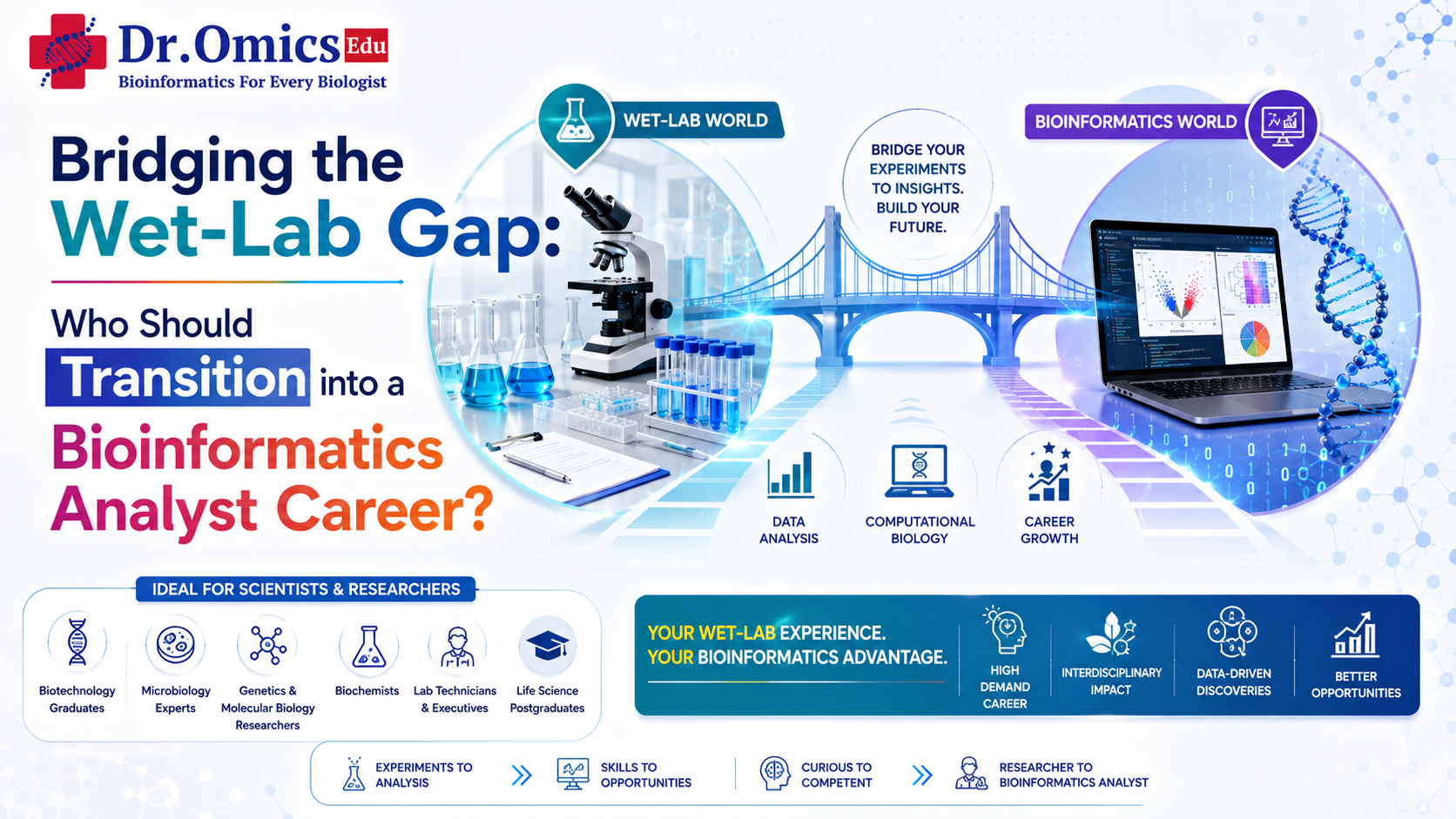
Bridging the Wet-Lab Gap: Who Should Transition into a Bioinformatics Analyst Career?
Dr. Omics Edu Team · · Updated
The life sciences industry is rapidly evolving, with high-throughput sequencing, artificial intelligence, and precision medicine reshaping biological research. As organizations increasingly rely on data-driven discoveries, professionals with computational expertise are in greater demand than ever. If you have been wondering who should attend bioinformatics courses, now is an excellent time to explore this rapidly expanding field.
Why Bioinformatics Is Becoming Essential
Modern laboratories generate enormous volumes of genomic, transcriptomic, proteomic, and clinical data. Transforming these datasets into meaningful biological insights requires bioinformatics analysts who understand both biological concepts and computational tools. Consequently, the career switch to computational biology has become one of the most rewarding options for life science professionals seeking long-term career growth.
Who Should Consider a Career Transition?
Bioinformatics welcomes individuals from diverse educational backgrounds. The following professionals are well-positioned for a successful transition:
- MSc Biotechnology graduates
- MSc Microbiology students and professionals
- MSc Biochemistry graduates
- MSc Genetics and Molecular Biology graduates
- B.Pharm, M.Pharm, and Pharm.D graduates
- Biomedical Science and Life Science researchers
- Agricultural and Veterinary Science graduates
- PhD scholars and research associates
- Quality Control (QC) and Research & Development (R&D) professionals
- Wet-lab researchers looking to expand their career opportunities
For many graduates searching for jobs after MSc Microbiology, bioinformatics provides opportunities in genomics, microbiome analysis, infectious disease research, pharmaceutical companies, biotechnology firms, contract research organizations (CROs), hospitals, and academic research institutions.
Biotechnology Jobs in 2026: Why Bioinformatics Skills Matter
Industry trends indicate that biotechnology jobs 2026 will increasingly demand professionals who can analyze next-generation sequencing (NGS) data, interpret genomic variants, perform transcriptome analysis, and generate reproducible computational workflows.
Recruiters are actively seeking candidates with interdisciplinary expertise because they can bridge experimental biology with advanced data analysis. This combination significantly enhances employability across research, healthcare, agriculture, and pharmaceutical sectors.
What Is the Required Bioinformatics Qualification?
One common misconception is that only computer science graduates can enter bioinformatics. In reality, the ideal bioinformatics qualification begins with a foundation in biological sciences, followed by practical computational training.
Most employers value candidates who possess:
- Strong understanding of molecular biology and genetics
- Basic statistics and experimental design
- Linux command-line proficiency
- R or Python programming fundamentals
- NGS and genomics data analysis experience
- Familiarity with biological databases and visualization tools
- Scientific communication and report-writing skills
Hands-on project experience often carries more weight than extensive programming expertise.
A Life Science to Data Science Career Roadmap
An effective life science to data science career roadmap typically includes the following stages:
- Build a strong foundation in molecular biology and genomics.
- Learn Linux, R, and Python for biological data analysis.
- Understand sequencing technologies and NGS workflows.
- Master RNA-Seq, variant analysis, genome annotation, and functional enrichment.
- Develop portfolio projects using publicly available datasets.
- Gain practical exposure through internships, workshops, or industrial training.
- Apply for bioinformatics analyst, genomics analyst, clinical bioinformatics, or computational biology positions.
Following this structured pathway allows professionals to confidently transition from laboratory research to computational biology.
Prerequisite Skills for Genome Analysis
Developing the prerequisite skills for genome analysis is essential for success in modern bioinformatics. These include sequence alignment, quality control, genome annotation, variant interpretation, transcriptomics, pathway analysis, statistical inference, and data visualization. Familiarity with command-line tools and reproducible workflows further strengthens your technical profile.
Career Transition Fields for Biologists
Today, the career transition fields for biologists extend far beyond traditional laboratory roles. Bioinformatics opens doors to precision medicine, genomics, drug discovery, clinical diagnostics, agricultural biotechnology, microbiome research, artificial intelligence in healthcare, and pharmaceutical informatics.
Final Thoughts
The future of life sciences belongs to professionals who can combine biological knowledge with computational expertise. Whether you are a student, researcher, or working professional, transitioning into bioinformatics can significantly broaden your career prospects. By acquiring practical analytical skills and industry-relevant experience, you can position yourself for the next generation of scientific innovation and become a valuable contributor to data-driven biological research.
