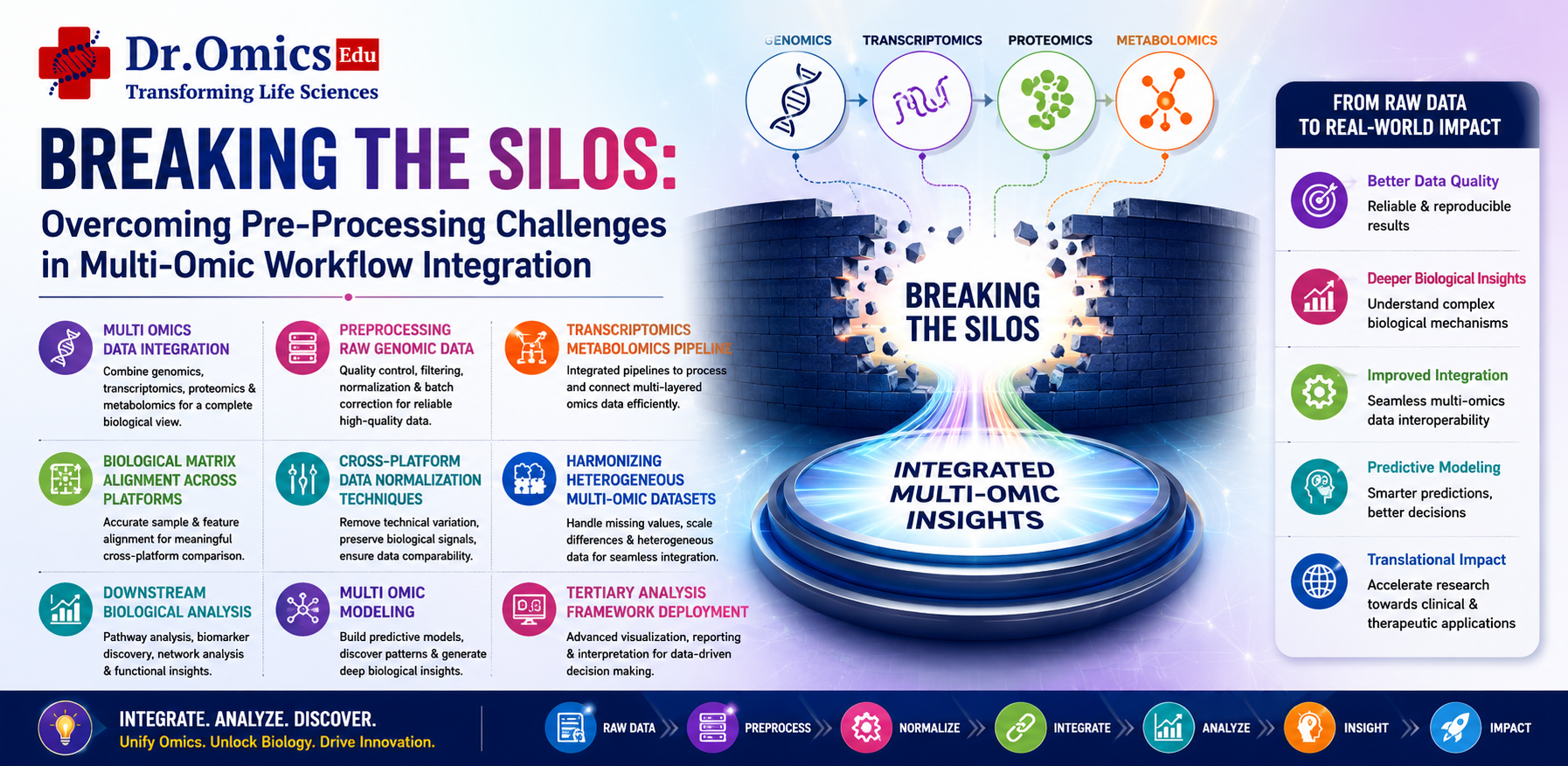
Breaking the Silos: Overcoming Pre-Processing Challenges in Multi-Omic Workflow Integration
Dr. Omics Edu Team · · Updated
Meta Title: Breaking the Silos: Overcoming Pre-Processing Challenges in Multi-Omic Workflow Integration
Meta Description: Discover how effective preprocessing and normalization strategies improve multi-omics data integration and enable accurate biological insights.
Breaking the Silos: Overcoming Pre-Processing Challenges in Multi-Omic Workflow Integration
The rise of genomics, transcriptomics, proteomics, and metabolomics has transformed biological research, enabling scientists to study diseases and biological systems from multiple perspectives. However, successful multi omics data integration depends on one critical step—effective data preprocessing. Without proper preparation, differences in data formats, sequencing technologies, and experimental platforms can lead to inaccurate results and unreliable conclusions.
Why Preprocessing Matters
Every omics platform generates data with unique characteristics, making preprocessing raw genomic data and other omics datasets essential before integration. Common preprocessing tasks include quality control, filtering low-quality reads, removing technical noise, correcting batch effects, and normalizing data. These steps ensure that the datasets are accurate, consistent, and ready for analysis.
Integrating Multiple Omics Platforms
Building a reliable transcriptomics metabolomics pipeline requires careful handling of datasets collected from different technologies. One major challenge is biological matrix alignment across platforms, where researchers must correctly match samples and biological features before combining data. In addition, cross-platform data normalization techniques such as log transformation, Z-score normalization, and batch correction help eliminate technical variation while preserving biological signals.
Another key step is harmonizing heterogeneous multi-omic datasets by standardizing feature annotations, managing missing values, and ensuring consistency across experiments. Proper harmonization improves data quality and enables meaningful comparisons between different omics layers.
Enabling Better Biological Insights
Once preprocessing is complete, integrated datasets can be used for downstream biological analysis, including biomarker discovery, pathway enrichment, disease classification, and drug target identification. Modern multi omic modeling approaches, powered by machine learning and systems biology, rely on clean and standardized datasets to generate accurate predictions.
Many organizations now adopt tertiary analysis framework deployment to streamline visualization, pathway analysis, and biological interpretation, making multi-omics workflows more efficient and reproducible.
Conclusion
Preprocessing is the foundation of every successful multi-omics study. From preprocessing raw genomic data to applying cross-platform data normalization techniques and harmonizing heterogeneous multi-omic datasets, each step improves the quality of multi omics data integration. By investing in robust preprocessing workflows, researchers can perform reliable downstream biological analysis, build effective multi omic modeling pipelines, and accelerate discoveries that drive precision medicine and modern life science research.
