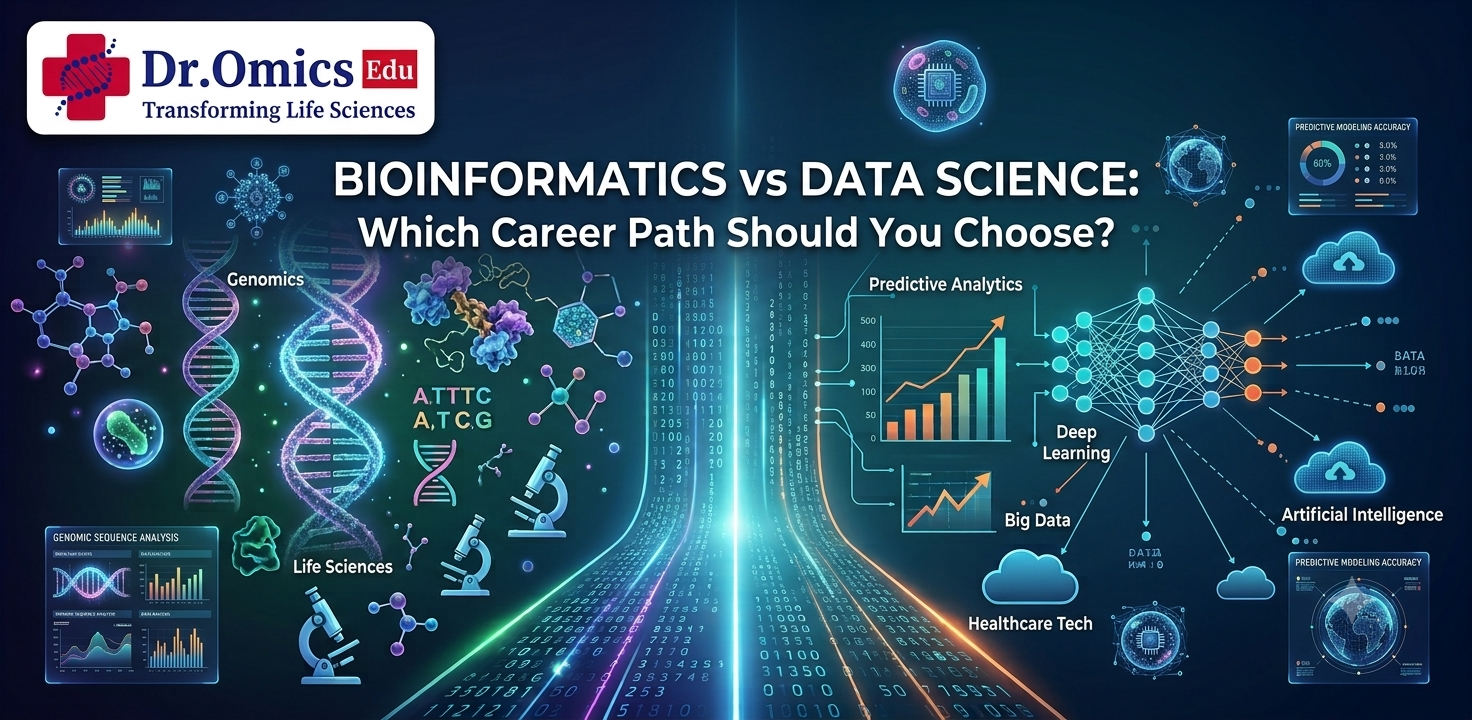
Bioinformatics vs Data Science: Which Career Path Should You Choose?
Dr. Omics Edu Team ·
Data has officially become the modern world’s gold, but how you choose to mine it makes all the difference for your future. Two of the most rewarding, high-growth fields dominating the job market today are bioinformatics and data science.
While both rely heavily on coding, statistics, and machine learning, their focus, daily challenges, and core domains differ significantly. If you are stuck deciding between data science or bioinformatics, this guide breaks down the key distinctions, skill sets, and salary outlooks to help you make the right career comparison: bioinformatics vs data science.
1. Defining the Fields
Before diving into the bioinformatics vs data science comparison, it helps to look at their core scopes.
- Data Science is a broad discipline focused on extracting actionable insights, predictive models, and patterns from structured and unstructured data across any industry—ranging from e-commerce, finance, and marketing to tech and logistics.
- Bioinformatics is a specialized domain of data science combined with biology. It focuses exclusively on analyzing, storing, and modeling biological datasets like genomic sequences (DNA/RNA), protein structures, and clinical data to solve life science problems.
2. Bioinformatics vs Data Science: Key Differences
The primary trade-off comes down to domain depth versus industry breadth.
Feature | Bioinformatics | Data Science |
Domain Scope | Specialized (Life sciences, genomics, pharma, biotech). | Generalist (Finance, retail, tech, healthcare, transport). |
Data Types | Genomic sequences, transcriptomics, molecular structures. | Business metrics, customer logs, financial trends, sensor data. |
Core Goal | Solve biological puzzles, advance disease treatment, drug discovery. | Optimize business decisions, predict trends, build AI models. |
Essential Skills | R/Python, Nextflow, Linux/Bash, Molecular Biology, Genomics. | R/Python, SQL, Tableau/PowerBI, General Machine Learning, A/B Testing. |
Key Questions Asked | "Which gene variant increases cancer risk?" | "Which customer is most likely to cancel their subscription?" |
3. Career Path & Job Market Comparison
Choosing a bioinformatics data science career trajectory depends on what kind of impact you want to make daily.
The Bioinformatics Path
- Ideal for: Anyone passionate about biology, medicine, genetics, and working on direct healthcare breakthroughs.
- Typical Roles: Bioinformatician, Computational Biologist, Genomic Data Scientist, Clinical Informatics Specialist.
- Top Employers: Biotech startups, pharmaceutical giants (like Pfizer or Novartis), academic research institutes, and clinical diagnostic labs.
The Data Science Path
- Ideal for: Generalists who enjoy business problem-solving, financial forecasting, and flexibility to jump across different industries.
- Typical Roles: Data Scientist, Machine Learning Engineer, Business Intelligence Analyst, Data Engineer.
- Top Employers: Tech enterprises (Google, Amazon, Meta), banks, e-commerce brands, logistics companies, and consultancies.
4. Which One Should You Choose?
- Choose Bioinformatics if: You love molecular biology, want your code to drive medical research or drug discovery, and prefer working within specialized life science teams.
- Choose Data Science if: You want maximum career flexibility across multiple industries, love solving commercial business problems, and want a faster track into general tech roles.
Both choices lead to high-impact, future-proof careers. The real decision lies in whether you want to master the language of life or the language of global business.
