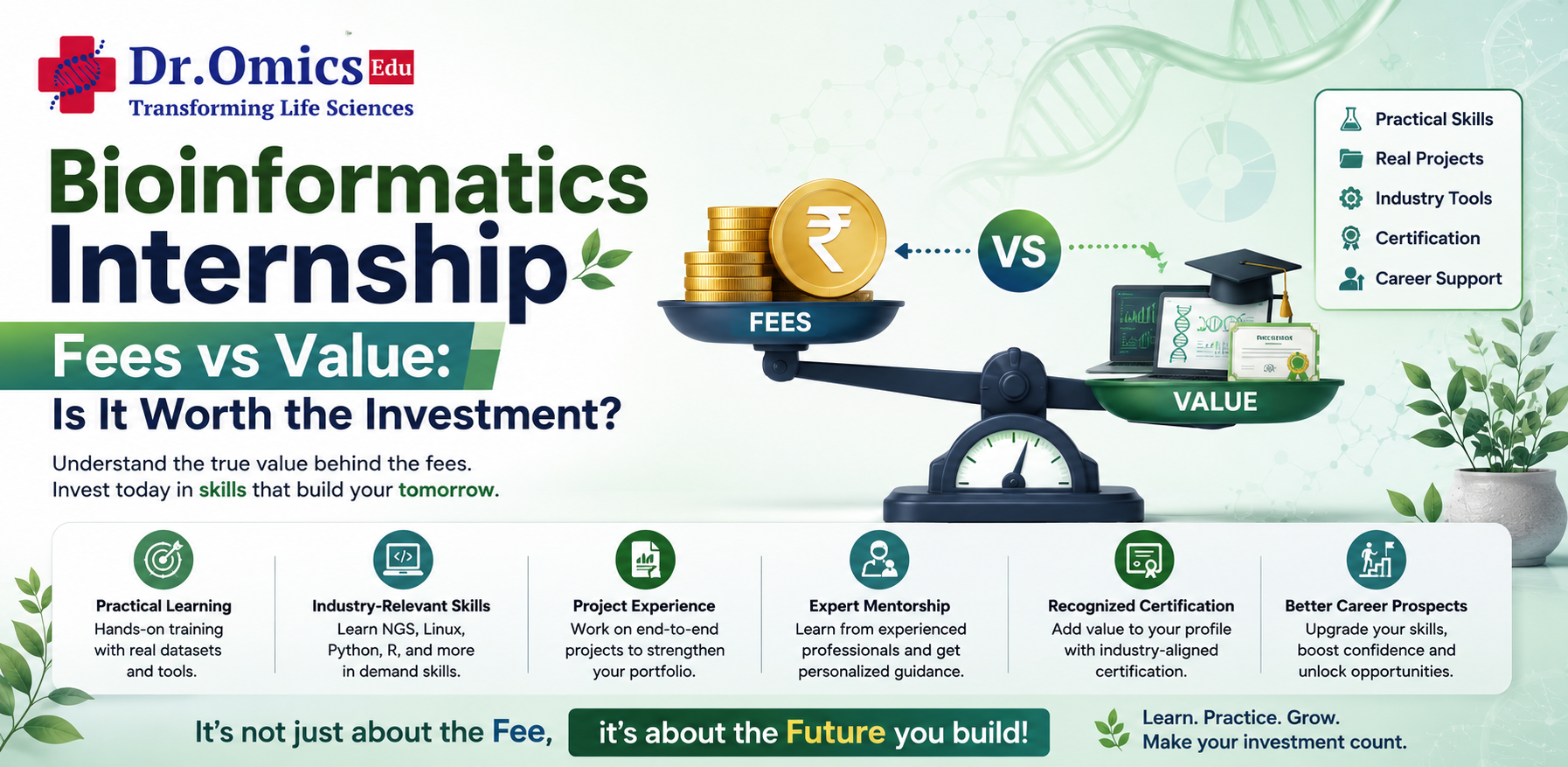
Bioinformatics Internship Fees vs Value: Is It Worth the Investment?
Dr. Omics Edu Team ·
Bioinformatics is becoming an increasingly important career option for students from biotechnology, microbiology, biochemistry, bioinformatics, and other life-science backgrounds. However, before joining an internship or training program, one question is common:
“Is the investment really worth it?”
With programs ranging from short-term workshops to several-month professional courses, bioinformatics course fees can vary significantly. Students often compare the bioinformatics internship cost with the skills, projects, certification, and career opportunities they may receive.
The right way to evaluate an internship is not simply by asking whether it is expensive or cheap. Instead, you should ask:
“What value will I get from the training compared with what I am paying?”
What Determines Bioinformatics Internship Cost?
The cost of a bioinformatics internship depends on several factors, including:
- Duration of the internship
- Online or offline format
- Number of practical sessions
- Trainer expertise
- Tools and technologies covered
- Project-based learning
- Certification
- Mentorship
- Career guidance
- Access to datasets and learning resources
A short introductory workshop may have a low fee, while a professional internship involving NGS, Python, R, Linux, real datasets, and projects may cost more.
Therefore, comparing programs only by their price can be misleading.
What Should You Get for Your Investment?
Before paying for a program, look at what is actually included.
A valuable bioinformatics internship should ideally provide practical exposure rather than only theoretical lectures.
1. Hands-On Training
Bioinformatics is a practical field. Reading about tools is different from actually using them.
For example, instead of simply learning what FastQC does, students should ideally get an opportunity to run quality control on real FASTQ files and understand the generated results.
Hands-on training can include:
- Sequence analysis
- Biological databases
- NGS analysis
- Linux commands
- Python
- R
- Data visualization
- Genomics workflows
2. Real Projects
Projects can be one of the most valuable parts of an internship.
A project allows students to apply what they have learned to a biological question and create something they can discuss during interviews.
For example:
Raw NGS Data → Quality Control → Processing → Analysis → Visualization → Biological Interpretation
Completing such a workflow gives students more practical experience than simply collecting certificates from multiple courses.
3. Industry-Relevant Tools
Technology changes quickly, so students should check whether the course teaches tools that are actually used in bioinformatics workflows.
Depending on the program, this may include tools such as FastQC, BWA, SAMtools, GATK, STAR, BLAST, Biopython, R/Bioconductor, Galaxy, and visualization platforms.
The goal should not be to learn dozens of software names but to understand when and why each tool is used.
Affordable Bioinformatics Training: Is Cheaper Always Better?
Not necessarily.
An inexpensive course may be suitable if you only need an introduction to bioinformatics. However, if your goal is career development, you should consider the overall learning experience.
For example, a low-cost course that provides only recorded videos may appear affordable, but it may not provide:
- Practical assignments
- Personal mentorship
- Real datasets
- Project guidance
- Doubt-solving sessions
- Career support
On the other hand, affordable bioinformatics training with hands-on projects and mentorship may provide much greater value even if the initial fee is slightly higher.
The key is to compare value, not just price.
How to Evaluate Bioinformatics Course Fees
Before enrolling, ask these questions:
What is included in the fee?
Check whether the price covers:
- Training sessions
- Study material
- Software/tool training
- Practical assignments
- Projects
- Certification
- Assessment
- Mentorship
How much practical training is provided?
A course with 80% theory and very little practice may not be ideal for someone looking for job-ready skills.
Will I work with real datasets?
Real datasets help students understand the challenges involved in actual bioinformatics analysis.
Will I complete a project?
A project can become an important addition to your resume and portfolio.
Is there trainer support?
Being able to ask questions and receive feedback can make a major difference, particularly for beginners.
Is Bioinformatics Course Worth It?
The answer depends on your goals.
If you are expecting a certificate alone to guarantee a job, then the answer is no.
However, if the course helps you develop practical skills, complete projects, understand industry tools, and build confidence in analyzing biological data, it can be a worthwhile investment.
For example, consider two students.
Student A completes several inexpensive courses but only watches lectures and collects certificates.
Student B completes one structured program, learns Linux and programming, works on real NGS datasets, completes a project, and can explain the workflow during an interview.
Even if Student B spent more money, the second student may have gained considerably more career value.
This is why the question “is bioinformatics course worth it?” should be answered by looking at the skills gained rather than the certificate alone.
Understanding Bioinformatics Course ROI
ROI means Return on Investment.
When evaluating bioinformatics course ROI, the investment is not only the course fee. You should also consider your time and effort.
Your return can include:
- Technical skills
- Practical experience
- Projects
- Certification
- Portfolio development
- Industry exposure
- Networking
- Career guidance
- Increased confidence
For example:
Investment: Course fee + time + effort
Return: Skills + projects + experience + career opportunities
The stronger the skills and experience you gain, the greater the potential value of the investment.
However, career outcomes depend on many factors, including your educational background, technical skills, project quality, interview performance, and the job market. No internship can guarantee a particular salary or job.
Short-Term Internship vs Long-Term Training
A short internship may be useful if you want to explore bioinformatics before committing to a longer program.
It can help answer questions such as:
- Do I enjoy computational biology?
- Am I interested in NGS?
- Do I want to learn programming?
- Do I enjoy working with biological datasets?
A longer program may be more appropriate if you want deeper practical exposure and multiple projects.
Therefore, the right choice depends on your current level and career objective.
What Should Beginners Prioritize?
If you are new to bioinformatics, don't focus only on the number of tools included in a course.
Instead, look for a program that builds a strong foundation in:
Biology + Linux + Programming + Statistics + Bioinformatics Tools + Projects
For example, learning Python without applying it to biological data has limited value for someone specifically pursuing bioinformatics.
Similarly, learning dozens of NGS tools without understanding the underlying biological concepts may make it difficult to interpret results.
A good program should connect concepts, tools, and practical applications.
How to Get the Best Value From Your Internship
Even the best training program will only provide limited value if you don't practice outside the sessions.
To maximize your investment:
Practice regularly: Repeat the workflows yourself rather than simply watching demonstrations.
Build projects: Keep your project files, reports, and results organized so you can use them as part of your portfolio.
Learn Linux: Many professional bioinformatics tools are command-line based.
Improve programming: Python and R can significantly expand your capabilities.
Understand the biology: Don't treat bioinformatics as only software operation.
Document your work: Maintain notes and explain what each step of your analysis does.
Conclusion
So, is a bioinformatics course worth it?
It can be—provided you choose a program based on skills and practical value rather than price or certification alone.
When comparing bioinformatics course fees and bioinformatics internship cost, consider the complete package: practical training, real datasets, projects, mentorship, industry-relevant tools, certification, and career support.
The most valuable affordable bioinformatics training is not necessarily the cheapest program. It is the one that gives you meaningful skills for the investment you make.
Ultimately, your bioinformatics course ROI depends on what you do with the knowledge after completing the program. A certificate may help strengthen your profile, but practical skills, projects, problem-solving ability, and continuous learning are what can help you build a sustainable career in bioinformatics.
