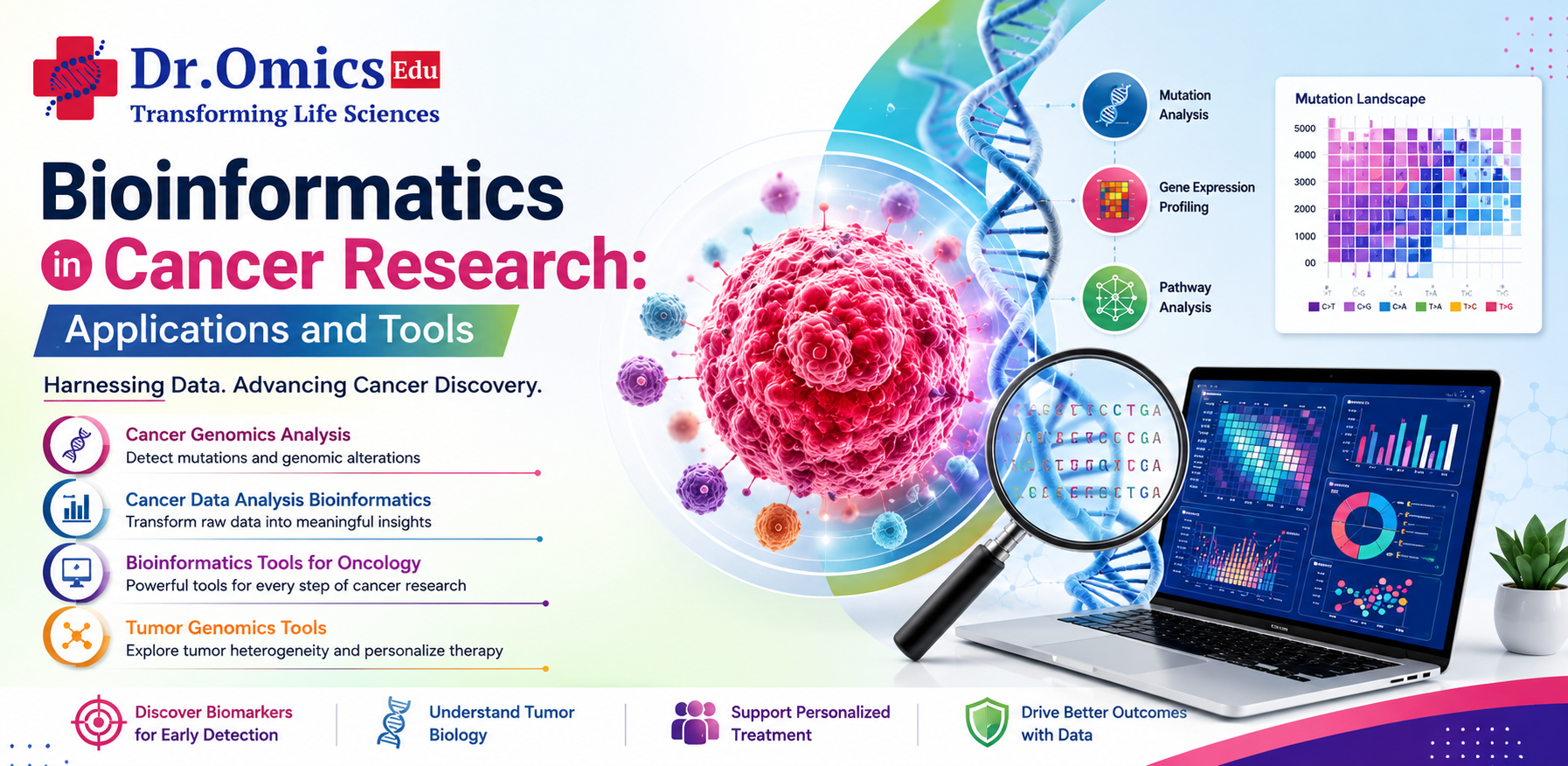
Bioinformatics in Cancer Research: Applications and Tools
Dr. Omics Edu Team ·
Cancer research has entered a new era where bioinformatics is transforming how scientists understand, diagnose, and treat cancer. With next-generation sequencing (NGS) generating massive amounts of genomic data, researchers now depend on computational tools to identify mutations, analyze gene expression, discover biomarkers, and develop personalized treatment strategies.
In this blog, we'll explore the importance of bioinformatics cancer research, its key applications, and the most widely used bioinformatics tools for oncology.
What is Bioinformatics in Cancer Research?
Bioinformatics combines biology, computer science, and statistics to analyze complex biological data. In oncology, it helps researchers study genomic and transcriptomic data to uncover the molecular mechanisms behind cancer and identify potential therapeutic targets.
From detecting cancer-causing mutations to understanding tumor evolution, cancer data analysis bioinformatics has become an essential part of modern cancer research.
Applications of Bioinformatics in Cancer Research
1. Cancer Genomics Analysis
One of the most important applications of bioinformatics is cancer genomics analysis, where researchers identify genetic alterations such as single nucleotide variants (SNVs), insertions/deletions (Indels), copy number variations (CNVs), and gene fusions. These discoveries help identify oncogenes, tumor suppressor genes, and actionable mutations for targeted therapies.
2. Tumor Genomics Analysis
Every tumor has a unique genetic profile. Tumor genomics tools allow researchers to study these differences, understand tumor progression, predict treatment response, and support precision oncology.
3. Gene Expression Analysis
RNA sequencing enables scientists to compare gene expression between healthy and cancerous tissues. Bioinformatics tools identify differentially expressed genes and disrupted biological pathways, helping researchers discover potential biomarkers and therapeutic targets.
4. Biomarker Discovery
Bioinformatics plays a vital role in discovering biomarkers for early diagnosis, prognosis, disease monitoring, and predicting patient response to treatment. Machine learning and AI are increasingly improving the accuracy of biomarker identification.
5. Precision Oncology
Personalized medicine is one of the biggest achievements of bioinformatics. By analyzing a patient's genomic profile, clinicians can recommend therapies that specifically target the mutations present in an individual's tumor, leading to more effective treatments and improved outcomes.
Popular Bioinformatics Tools for Oncology
Several powerful tools are commonly used in bioinformatics tools for oncology workflows:
- FastQC & MultiQC – Quality assessment of sequencing data
- BWA, HISAT2 & STAR – Sequence alignment
- GATK & FreeBayes – Variant calling
- featureCounts & DESeq2 – Gene expression analysis
- ANNOVAR & VEP – Variant annotation
- GSEA, KEGG & Reactome – Pathway enrichment analysis
- IGV (Integrative Genomics Viewer) – Genome visualization
Together, these tools support comprehensive cancer data analysis bioinformatics, from raw sequencing reads to meaningful biological insights.
Future of Cancer Bioinformatics
Emerging technologies such as Artificial Intelligence (AI), machine learning, single-cell sequencing, spatial transcriptomics, and multi-omics integration are reshaping cancer research. These innovations enable researchers to analyze complex datasets more efficiently, identify novel biomarkers, and accelerate the development of precision therapies.
Conclusion
Bioinformatics has become an indispensable part of modern oncology. From cancer genomics analysis and biomarker discovery to precision medicine, computational approaches are helping researchers better understand cancer and improve patient care. As sequencing technologies continue to evolve, mastering bioinformatics cancer research, bioinformatics tools for oncology, and tumor genomics tools will be increasingly valuable for researchers and healthcare professionals alike.
