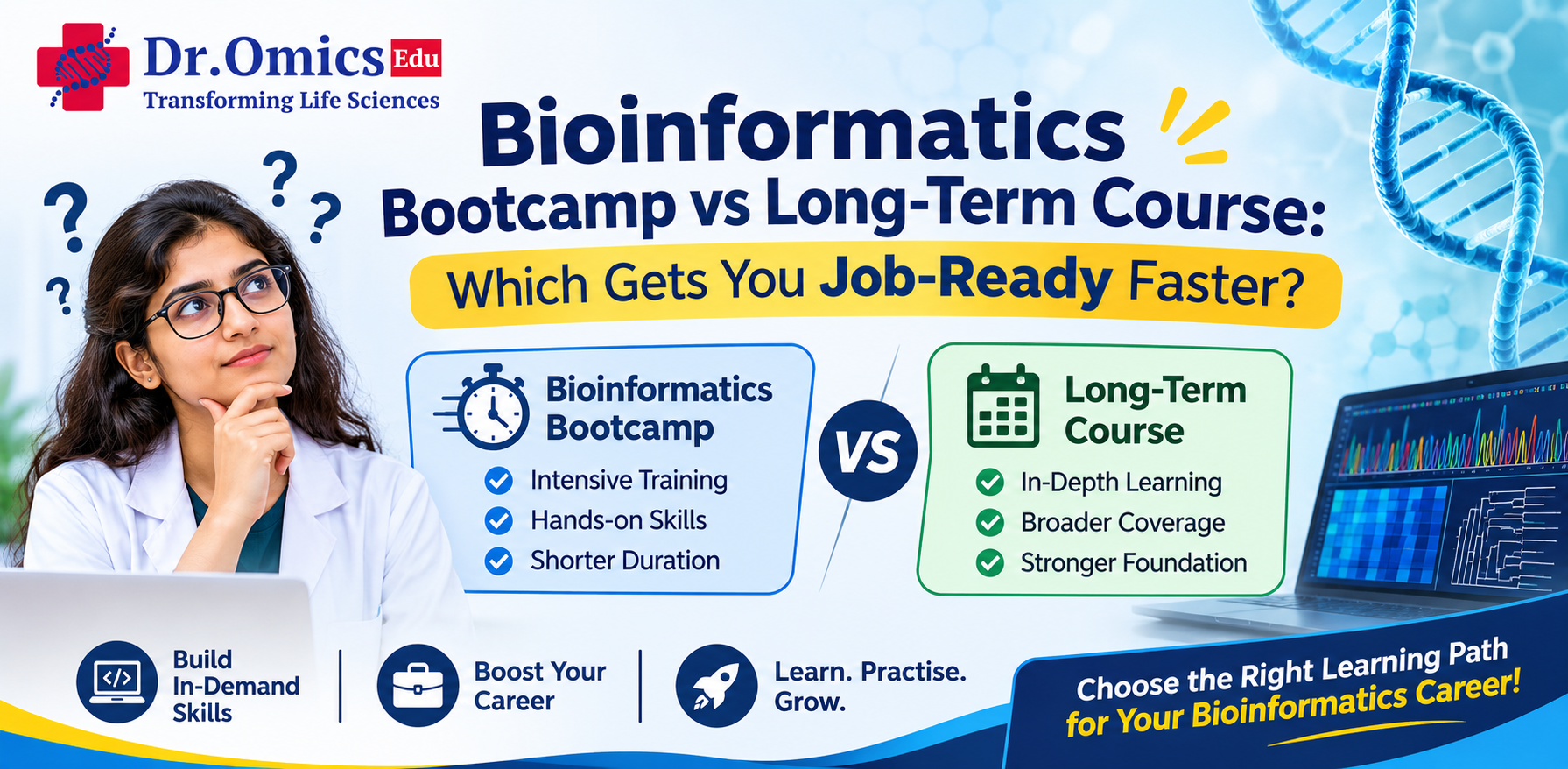
Bioinformatics Bootcamp vs Long-Term Course: Which Gets You Job-Ready Faster?
Priyanka Bhore ·
Bioinformatics is becoming an important field in biotechnology, healthcare, pharmaceuticals, and life science research. As demand for biological data analysis increases, students and graduates are looking for practical ways to build careers in this domain.
But which is better: a short-term bioinformatics bootcamp or a long-term bioinformatics course?
Let's understand the difference.
What Is a Bioinformatics Bootcamp?
A bioinformatics bootcamp is an intensive training programme focused on developing practical skills within a shorter duration.
It typically covers:
- Linux and command-line basics.
- Python and R programming.
- Biological databases and BLAST.
- DNA-seq and RNA-seq analysis.
- NGS tools and workflows.
- Practical assignments and mini-projects.
It is suitable for life science graduates, researchers, and professionals who want focused, hands-on training.
What Is a Long-Term Bioinformatics Course?
A long-term course or diploma provides structured learning over several months, starting with fundamentals and progressing towards advanced applications.
It may include:
- Bioinformatics fundamentals.
- Linux, Python, and R.
- Sequence analysis and biological databases.
- NGS and transcriptomics.
- Metagenomics and microbiome analysis.
- Structural bioinformatics and CADD.
- Research projects and practical assignments.
It is particularly useful for beginners who need time to develop technical confidence.
Bootcamp vs Diploma Bioinformatics: Key Differences
Factor | Bootcamp | Long-Term Course |
Duration | Short-term | Several months |
Learning | Intensive | Gradual |
Practical training | Focused | Extensive |
Tool coverage | Selected tools | Wider range |
Projects | Mini-projects | Multiple projects |
Best for | Skill upgrades | Beginners and career development |
Which Makes You Job-Ready Faster?
The answer depends on your background.
- Life science graduates: A focused bootcamp can help develop practical computational skills.
- Complete beginners: A long-term course provides a stronger foundation.
- Researchers and professionals: Specialized intensive bioinformatics training can help upgrade specific skills.
Remember, completing a course alone does not guarantee employment. Practical experience, programming knowledge, independent projects, and problem-solving abilities are equally important.
Skills You Need for a Bioinformatics Career
To improve your job readiness, focus on:
- Linux and command-line operations.
- Python and R programming.
- BLAST and biological databases.
- DNA-seq and RNA-seq analysis.
- NGS tools such as FastQC, HISAT2, STAR, and SAMtools.
- Practical projects using biological datasets.
What Is the Fastest Way to Get a Bioinformatics Job?
There is no shortcut to becoming job-ready. However, the right training approach can make your learning more effective.
Choose a programme that combines theoretical concepts, practical demonstrations, real datasets, assignments, and independent projects.
A bootcamp helps you learn faster. A long-term course helps you learn deeper. The right choice depends on your current skills and career goals.
Frequently Asked Questions
1. Is a bioinformatics bootcamp enough to get a job?
It can help develop practical skills, but relevant qualifications, projects, and technical knowledge are also important.
2. Is a diploma better than a bootcamp?
A diploma offers broader learning, while a bootcamp focuses on intensive skill development.
3. Can biotechnology graduates enter bioinformatics?
Yes. Biotechnology, microbiology, genetics, and other life science graduates can enter this field by developing computational and data analysis skills.
4. Which programming language should I learn first?
Python is a good starting point, followed by R for statistical analysis and biological data visualization.
Start Building Your Bioinformatics Career!
At Dr. Omics Labs, we emphasize practical learning and industry-relevant bioinformatics applications.
Develop your skills, work with biological datasets, and gain confidence in bioinformatics analysis.
Learn. Practise. Analyse. Grow with Bioinformatics!
Explore bioinformatics training programmes at Dr. Omics Labs.
