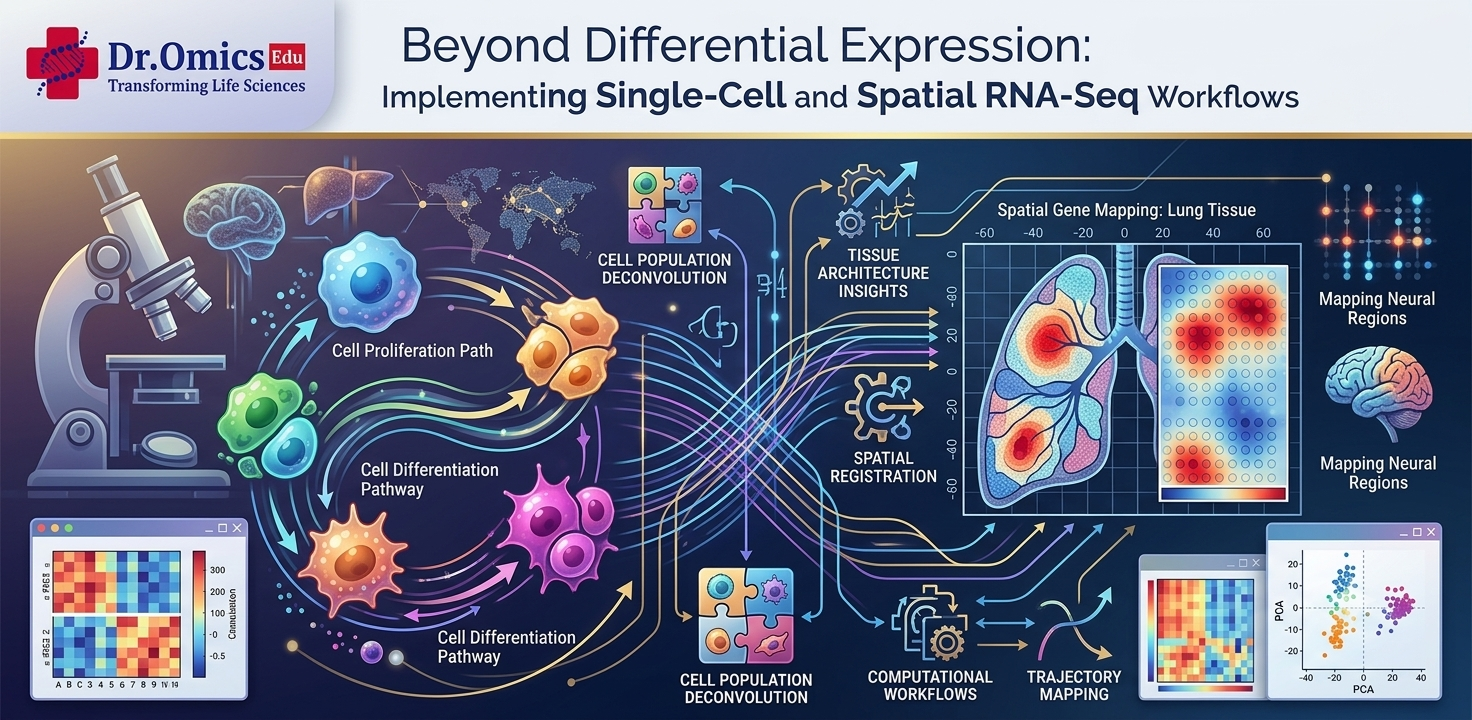
Beyond Differential Expression: Implementing Single-Cell and Spatial RNA-Seq Workflows
Dr. Omics Edu Team · · Updated
For years, RNA Seq Data Analysis has focused on identifying differentially expressed genes using bulk sequencing approaches. While the DESeq2 pipeline remains one of the most trusted methods for computing differential transcriptomics, modern research is moving beyond bulk analysis to uncover cellular heterogeneity and tissue organization.
Welcome to the era of Single Cell RNA Sequencing and Spatial Transcriptomics 2026—where researchers can identify individual cell populations, discover developmental trajectories, and visualize gene expression directly within tissues.
Why Move Beyond Differential Expression?
Traditional bulk RNA sequencing provides an average expression profile across thousands of cells, often masking rare cell populations and complex biological interactions. Today's advanced transcriptomics technologies enable researchers to answer questions such as:
- Which specific cell types drive disease progression?
- How do cells communicate within their native tissue environment?
- Which genes are activated during cellular differentiation?
- Where are these genes expressed inside the tissue?
These insights are transforming precision medicine, cancer biology, neuroscience, immunology, and developmental biology.
Modern Transcriptomics Workflow
A comprehensive transcriptomics workflow now includes:
- Quality control and preprocessing of RNA sequencing data
- Gene expression quantification and DESeq2 pipeline analysis
- Single Cell RNA Sequencing clustering and cell annotation
- Cell-type deconvolution models for complex tissues
- scRNA-seq trajectory analysis to study cellular differentiation
- Mapping tissue spatial gene expression using spatial transcriptomics platforms
- Biological interpretation through pathway and functional enrichment analysis
Together, these approaches provide a multidimensional view of biological systems that bulk RNA-seq alone cannot achieve.
Why Learn These Skills?
The demand for researchers skilled in RNA Seq Data Analysis, Single Cell RNA Sequencing, and Spatial Transcriptomics 2026 continues to grow across academia, biotechnology, pharmaceutical companies, and clinical research organizations.
Developing expertise in these cutting-edge technologies prepares you to work on next-generation genomics projects involving precision medicine, biomarker discovery, immune profiling, and tissue-level gene expression analysis.
Start Your Transcriptomics Journey
Whether you're beginning with RNA Seq Registration for your first transcriptomics course or looking for advanced Transcriptomics Training, mastering modern RNA sequencing workflows will equip you with one of the most sought-after skill sets in computational biology.
The future of transcriptomics is no longer limited to identifying differentially expressed genes—it's about understanding which cells express them, where they are located, and how they interact to shape complex biological systems.
