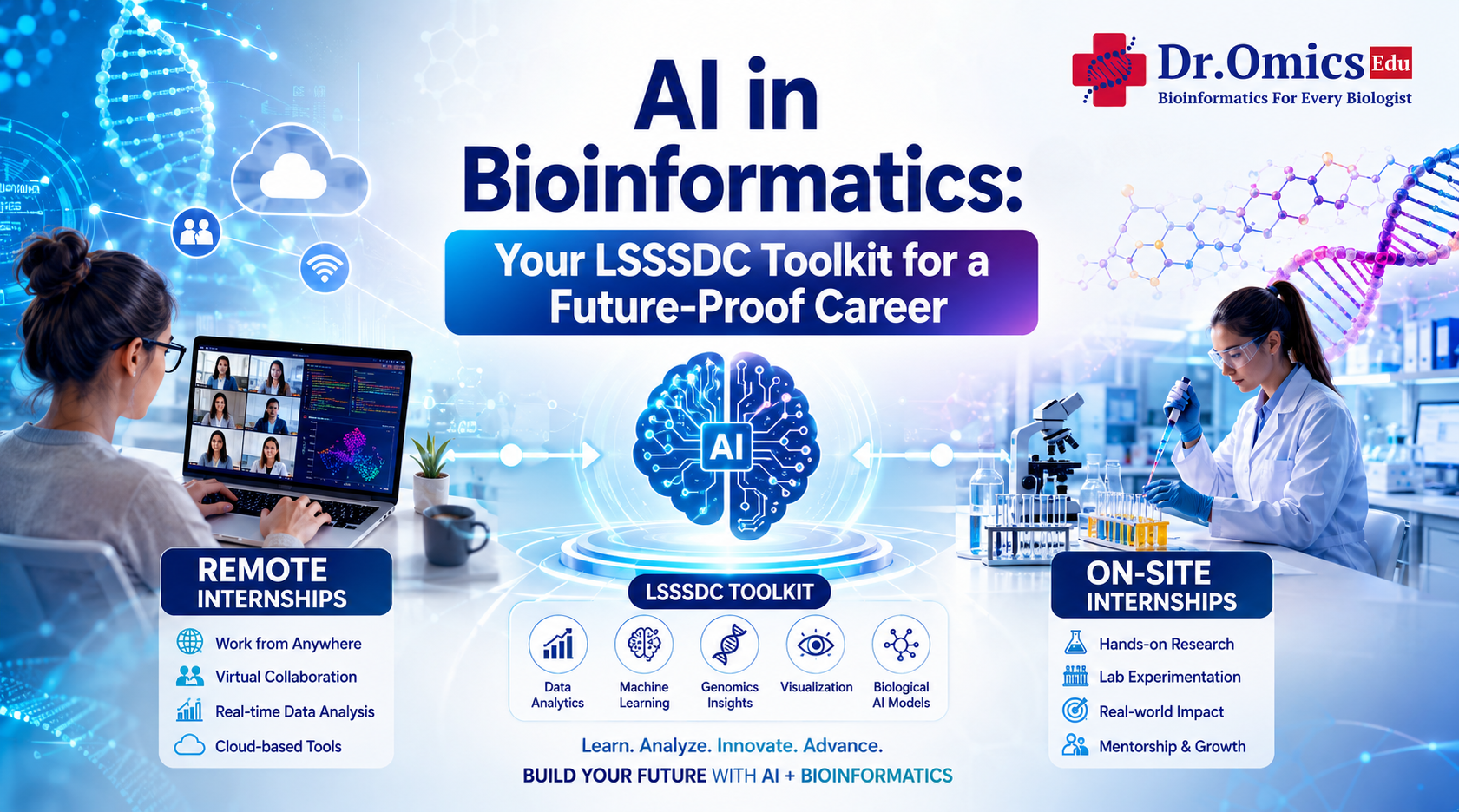
AI in Bioinformatics: Your LSSSDC Toolkit for a Future-Proof Career
Dr. Omics Edu Team · · Updated
Artificial Intelligence (AI) is transforming the life sciences by enabling researchers to process, interpret, and apply biological data with unprecedented speed and accuracy. From decoding genomes to accelerating drug development, AI in bioinformatics is becoming a cornerstone of modern biotechnology. As the demand for AI-enabled professionals grows, acquiring industry-recognized skills through the Life Sciences Sector Skill Development Council (LSSSDC) can help aspiring bioinformaticians build a future-ready career.
Why AI Matters in Bioinformatics
The rapid expansion of genomic sequencing, multi-omics research, and clinical data has created datasets too large and complex for conventional analytical methods. AI-powered algorithms can identify patterns, predict biological outcomes, and automate repetitive analytical tasks, enabling researchers to generate insights more efficiently.
Today, AI supports applications such as genomic variant analysis, disease prediction, protein structure modeling, biomarker discovery, and personalized medicine. These innovations are reshaping research laboratories, pharmaceutical companies, healthcare organizations, and biotechnology startups worldwide.
Machine Learning Is Driving Biological Discovery
One of the most impactful branches of AI is machine learning for bioinformatics. Machine learning algorithms learn from existing biological datasets to predict new outcomes without requiring explicit programming for every scenario.
In genomics, machine learning for genomic data helps researchers classify genetic variants, identify disease-associated mutations, predict gene expression patterns, and improve diagnostic accuracy. These computational approaches reduce analysis time while increasing the reliability of biological interpretations.
As precision medicine continues to evolve, machine learning has become an essential competency for bioinformatics professionals working in research and clinical environments.
LSSSDC AI Skills Build Industry-Ready Professionals
The Life Sciences Sector Skill Development Council (LSSSDC), operating under the Ministry of Skill Development and Entrepreneurship (MSDE), develops competency-based training aligned with industry needs. By integrating LSSSDC AI skills into bioinformatics education, learners gain practical exposure to computational biology, data analytics, AI applications, and modern laboratory workflows.
Industry-recognized certification demonstrates that professionals possess standardized, job-ready competencies valued by employers across pharmaceuticals, diagnostics, genomics, and biotechnology research. This practical focus helps bridge the gap between academic knowledge and workplace expectations.
Python: The Foundation of Modern Bioinformatics
Among the most valuable technical skills is Python for bioinformatics. Python has become the preferred programming language for biological data analysis because of its simplicity, flexibility, and extensive scientific libraries.
Bioinformaticians use Python to automate data processing, analyze sequencing datasets, visualize biological information, and develop machine learning models. Combined with AI techniques, Python enables efficient handling of complex genomic data and supports scalable research workflows.
Predictive Modeling Is Transforming Biotechnology
Another rapidly growing application is predictive modeling in biotech, where AI algorithms forecast biological outcomes using historical and experimental data. Predictive models assist researchers in identifying disease biomarkers, optimizing clinical trials, predicting protein interactions, and improving therapeutic development.
These capabilities help organizations reduce research costs, shorten development timelines, and make evidence-based scientific decisions, making predictive analytics a highly sought-after skill in biotechnology.
AI Accelerates Drug Discovery
One of the most exciting applications of AI in drug discovery is the identification of promising drug candidates through computational analysis. AI can rapidly screen millions of chemical compounds, predict molecular interactions, estimate drug efficacy, and identify potential safety concerns long before laboratory testing begins.
By reducing time and resource requirements, AI is enabling pharmaceutical companies to develop innovative therapies more efficiently while supporting precision medicine initiatives.
Conclusion
The convergence of artificial intelligence and bioinformatics is creating exciting career opportunities across biotechnology, genomics, healthcare, and pharmaceutical research. Professionals equipped with AI knowledge, programming expertise, and practical computational skills are becoming increasingly valuable in the global life sciences workforce.
Developing competencies in AI, machine learning, Python programming, predictive analytics, and genomic data analysis through LSSSDC-aligned training prepares aspiring bioinformaticians for a resilient, future-proof career in one of the fastest-growing scientific disciplines.
